Designer LED spotlights
- Tracked delivery to your country Tracked delivery
- Secure payment at checkout Multiple payment methods
- 14 days to change your mind 14-day returns
- Secure payment Secure payment


Not sure of your style? Find it in 30 seconds
A few questions, and we will show you the pieces made for you.

Frequently asked questions
How do I choose the right light output?
At what height should the light be installed?
What type of bulb?
Compatible with LEDs and dimmers?

Light changes everything
From statement chandeliers to discreet wall lights, we help you choose the right brightness, height and style for every room.
- Tracked delivery
- Pay in instalments, where available
- 14 days to change your mind
- Advice & showroom in Lyon, France
Check three criteria first: mounting (recessed, adjustable or surface-mounted), colour temperature and ingress protection rating. A designer LED spotlight lights in a directed way, draws a regular grid on the ceiling and is chosen from the product page, including base and dimensions.
What is a designer LED spotlight and what light does it give?
A designer LED spotlight is a small light point, recessed, adjustable or surface-mounted, whose LED is integrated into the fitting or housed in a GU10 or GU5.3 base. It lights in a directed way, draws a regular grid on the ceiling and is chosen according to its colour temperature and its ingress protection rating.
Designer LED spotlight and designer LED fitting: what is the difference?
The spotlight is the light point itself. A designer LED fitting means the complete unit: trim, body, driver and fixings. A single spotlight lights a step, a headboard or a painting; an aligned series creates the grid of a ceiling. The designer LED projector, for its part, is fixed on a plate, bracket or stake and sends light at a distance. These families can be browsed in our lighting catalogue.
Designer LED lighting: what it changes in a room
The light of a spotlight is sharper than that of a diffusing ceiling light: it marks materials, carves a short shadow and brings out a worktop, a bookshelf or a wall. In a living room, it highlights more than it lights. The designer spotlight range gathers the models whose design matters as much as the beam.
Which styles of designer LED spotlight to choose according to the mood?
Style can be read in three things: the shape of the trim, the finish and the type of light. A discreet trim suits a uniform ceiling, an adjustable model highlights a wall, and a spotlight with a strong design becomes a decorative element in its own right, even when switched off.
Black, white or metal designer LED spotlight: what effect?
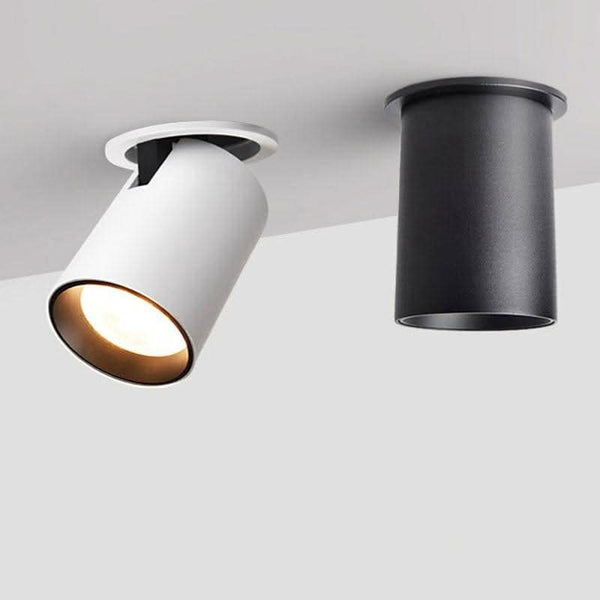
Black spotlights draw a visible, graphic grid: they structure a living room or an entrance. The white versions disappear into a light ceiling and let the light alone take the stage. Metal spotlights show a more technical look, very readable on a kitchen wall or a covered outdoor area.
Modern spotlight, designer spotlight: how to find your way?
The vocabulary of product pages describes a shape, not a hierarchy of quality. A modern spotlight plays on geometric sobriety, a spotlight with a crafted design asserts a volume or a material. Both meet in the modern spotlights, to be chosen first on finish and beam.
Recessed, adjustable or surface-mounted designer LED spotlight: which mounting for which ceiling?
Recessed is chosen for a hollow ceiling or a false ceiling: it sits flush with the surface and frees up height. Adjustable suits rooms that change use, its tilt serving a wall or a worktop. The surface-mounted spotlight and the projector are installed when there is no recess available.
| Type of spotlight | Mounting | Where to install it | What it brings | What to check |
|---|---|---|---|---|
| Fixed recessed LED spotlight | Recessed in a cut-out | False ceiling, hollow ceiling, solid ceiling with housing | Wide, discreet lighting, regular grid | Cut-out, recess depth, base |
| Adjustable recessed LED spotlight | Recessed, movable head | Living room, kitchen, wall to highlight | Directs light towards a worktop or a wall | Tilt, beam, colour temperature |
| Surface-mounted LED spotlight | Screwed onto a solid support | Concrete, low ceiling, support without cut-out | Installs without ceiling work | Dimensions, number of light points, finish |
| Designer LED projector | Plate, bracket or stake | Terrace, facade, path, garden | Directed accent lighting | Ingress protection rating, orientation, power supply |
Recessing a spotlight without a false ceiling: what to check?
First note the cut-out and depth required on the product page, then measure the height available above the slab, including wiring and driver clearance. A solid ceiling often requires a recess housing. The recessed models with a careful design are then installed like any other spotlight.
Adjustable spotlight or fixed spotlight: when to choose the movable head?
A movable head is useful when the room moves: worktop, reading, a painting that is moved. A fixed spotlight is enough for a circulation area or a regular grid on the ceiling. Compare the adjustable recessed spotlights and the designer adjustable spotlights depending on whether the cut-out is already made or not.
Which colour temperature and intensity for a designer LED spotlight?
Colour temperature sets the mood: a warm white relaxes a living room or a bedroom, a neutral white stays readable in a kitchen or a hallway, a cool white lights an outdoor area or a garage. Intensity is adjusted with a compatible dimmer, and the beam is chosen wide or narrow.
Warm white, neutral white, cool white: what to choose?
Around 2700 to 3000 kelvins, the light leans towards amber: it flatters wood, textile and skin, which makes it the usual reference for a bedroom. Around 4000 kelvins, the light is whiter and keeps colours accurate, useful above a worktop. Above 5000 kelvins, it becomes cool and is mainly suited to outdoor areas. The exact value appears on each product page.
Do you need a dimmable LED spotlight in a living room?
Yes, as soon as the room is used at several times of the day. A dimmer compatible with the fitting and its driver varies the intensity without flickering. The dimmable LED spotlights set the evening scene, and combine well with an existing living room lighting.
Where to install a designer LED spotlight, room by room?
A spotlight is chosen first for the task it lights: worktop in a kitchen, headboard in a bedroom, stair steps, entrance wall. In a living room, it highlights a painting or a bookshelf rather than lighting the whole room, where general lighting remains useful as a complement.
| Room | Recommended type of spotlight | Colour temperature | Point to watch |
|---|---|---|---|
| Living room | Adjustable recessed or surface-mounted, dimmer | Warm white to neutral white | Avoid too tight a grid, complement with general lighting |
| Kitchen | Recessed or surface-mounted above the worktop | Neutral white | Light the work areas, not only the centre |
| Bedroom | Discreet adjustable, dimmer recommended | Warm white | Direct light away from the bed and the gaze |
| Staircase | Recessed in the ceiling or in the step | Neutral white | Light each step without dazzling |
| Bathroom | Spotlight suited to damp rooms | Neutral white | Check the ingress protection rating of the model |
| Outdoor | Projector or outdoor spotlight | Neutral white to cool white | Ingress protection rating and available power supply |
Lighting a living room or a bedroom with designer LED spotlights
In the living room, place two or three adjustable spotlights towards the wall to highlight, and keep a general source in the centre. In the bedroom, aim for grazing light above the headboard or towards a painting, never in the line of sight. Bedroom spotlights are chosen on this criterion before the finish.
Designer LED spotlight for kitchen, bathroom or staircase
In the kitchen, align the spotlights on the worktop rather than in the centre of the room: the spotlights designed for the kitchen favour a narrow beam. To light a staircase, a short grid avoids shadow areas between the steps. Outdoors, the designer outdoor spotlights require a high ingress protection rating, and the solar models need no connection.
How to replace a designer halogen with a designer LED spotlight?
Replacement is done base for base: a designer halogen spotlight and its LED equivalent must share the same base and the same supply voltage. The existing support is kept, the low-voltage supply is checked if applicable, and the heat given off drops, which changes comfort of use.
Checking the base and power supply before replacing a halogen
Note the base of the model in place, GU10 at 230 volts or GU5.3 at low voltage, then identify the presence of a transformer. An old transformer can prevent an LED from starting properly: check its compatibility before ordering. The base always appears on the product page.
What changes in the room after replacement
The light stabilises immediately, the heat at the ceiling decreases and consumption drops, without any figure being promised here. The beam may appear narrower than with a halogen: aim the head to compensate. The rest, dimensions and cut-out, depends on the model chosen.
How to install and maintain a designer LED spotlight?
A recessed spotlight is installed in a ceiling cut-out following the dimensions indicated on its product page; a surface-mounted spotlight is screwed onto a solid support. Cut the power before working, respect the clearance space of the fitting, then dust the trim and the lens with a dry cloth.
Fitting a spotlight in a false ceiling or a solid ceiling
Switch off the circuit breaker, mark the cut-out at the indicated diameter, then check that the driver and wiring fit within the available height. In a solid ceiling, a recess housing settles the question. Once the power is back on, adjust the orientation and check that no hot point touches the insulation.
Cleaning and making a designer LED spotlight last
A dry cloth on the trim and the lens is enough. Avoid abrasive products and direct sprays, which scratch the finish and dull the light. In a damp room, check the seal and the ingress protection rating of the installed model from time to time.
How to match designer LED spotlights with the rest of the decor?
Set a hierarchy: spotlights provide functional or accent lighting, a designer chandelier or a pendant carries the general light, an LED wall light lights a passage. Keep the same family of white to avoid visible differences, and align the exposed finishes with the rest of the room.
Sharing the roles between spotlight, chandelier and pendant
The chandelier or pendant occupies the centre and sets the tone; the spotlights work around the edges, on a wall or a reading corner. Two separate sources are better than a single very powerful one. This reasoning also applies with an adjustable grid rather than with fixed spotlights.
Complementing with a wall light or extra lighting
An LED wall light suits circulation areas, a headboard or a hallway that the spotlights do not reach. It adds a light close to the wall without competing with the ceiling grid. Stay on a colour temperature close to that of the spotlights already installed.
Payment, delivery and returns
Payment is secure, delivery is tracked and returns are possible; Designix customer service supports the choice of fitting before and after the order. Lead times, costs and conditions appear on the site and should be checked before confirming the basket. To compare one last model, go back through all our light fittings or the selection of designer spotlights.
Frequently asked questions about designer LED spotlights
What is a good brand of LED spotlights?
There is no single answer: a good brand is recognised by the clarity of its product pages, a standard base, the quality of the driver and the availability of spare parts. At Designix, each page states colour, material, base, colour temperature and ingress protection rating, enough to compare without guessing.
What are the drawbacks of LED lamps?
LEDs give off little heat, but their electronics dislike poorly ventilated spaces. Their light is more directional, therefore less diffuse than a halogen, and the quality of the driver determines the lifespan. A cool white is tiring in the evening: choosing the temperature suited to the room limits these pitfalls.
Recessed or surface-mounted designer LED spotlight: what to choose?
Recessed requires a cut-out in the ceiling and gives a flat surface, with no visible volume. The surface-mounted spotlight is screwed onto a solid support and suits low ceilings or rooms where no cut-out is possible. The choice therefore depends first on the available support.
Can a designer halogen be replaced with a designer LED spotlight?
Yes, provided the same base and the same supply voltage are kept. The existing support is kept, any low-voltage transformer is checked and the base, colour temperature and ingress protection rating of the chosen model are verified on the product page.
How to pair a designer LED spotlight with a designer chandelier in the living room?
Share the roles: the designer chandelier carries the general light, in the centre, while the spotlights light a wall, a bookshelf or a reading corner. Keep the same family of white to avoid visible differences, and vary the two sources separately if possible.