
Bamboo spotlights
This selection is also available in our French store: Spots en bambou



- Tracked delivery to your country Tracked delivery
- Secure payment at checkout Multiple payment methods
- 14 days to change your mind 14-day returns
- Secure payment Secure payment
Not sure of your style? Find it in 30 seconds
A few questions, and we will show you the pieces made for you.
Frequently asked questions
How do I choose the right light output?
At what height should the light be installed?
What type of bulb?
Compatible with LEDs and dimmers?

Light changes everything
From statement chandeliers to discreet wall lights, we help you choose the right brightness, height and style for every room.
- Tracked delivery
- Pay in instalments, where available
- 14 days to change your mind
- Advice & showroom in Lyon, France
A bamboo spotlights is chosen first for the light it casts: a woven shade diffuses a soft halo instead of a hard beam, and the black finish draws a clean silhouette on the ceiling or wall. Allow one point per area to light, then check the socket before ordering.
What kind of light does a bamboo spot give?
A woven bamboo shade filters the light and sends it back as a halo rather than a directed beam. In this collection, the weave is mounted on a black-finished frame, in a round shape (Sumba, Bali) or a tube (Tiffany, Blyssa). The result depends on the bulb: E14 at 40 W on Sumba and Bali, E27 at 28 W max on Tiffany and Blyssa.
The halo of a woven shade
The weave cuts the light into fine slats and projects a regular pattern onto the wall, softer than a clear-glass spot. In a hallway, this effect replaces a slightly harsh frontal light; in a living room, it creates a warm zone without glaring onto the sofa. Round models give a circular halo, tubes a stretched pool of light, better suited to a worktop. To play with that pool of light and the direction of the points, compare the adjustable models and the spots with a strong design.
What the socket changes in the result
The socket does not change the colour of the light, it limits the bulb you can screw in. In E14, the socket is compact and takes standard LED bulbs; in E27, the bulb is wider and fits inside the volume of a tube shade. An LED bulb of equivalent power is suitable, provided you stay under 40 W per E14 socket and under 28 W max in E27. The warm or neutral tone then comes from the choice of bulb, not from the fixture. See the black LED spots.
Where to install bamboo spotlights in the home?
The bamboo spotlights in the collection are intended for the hallway and living room, then the kitchen, entrance and bedroom. All are IP20: protected against contact and dust, not against moisture. They therefore stay away from water splashes and do not replace a bathroom fixture.
In which rooms a bamboo spot finds its place
The hallway and living room are the most obvious settings: the first for the regular line of a track, the second for ambient light placed high up. The kitchen comes next, above the worktop, provided the fixture is kept out of splash zones. The entrance, bedroom, staircase and toilet mainly take the wall light. For a hallway, start with spots to light a hallway; for a living room, look at LED lighting for the living room.
Wall light or ceiling spot depending on the room
An adjustable wall light such as Bali (Ø 12 cm, E14, 40 W) is fixed at hand height and directs the flow towards a wall or a reading corner, without touching the ceiling. A ceiling spot is better suited to long circulation areas and rooms where the floor must stay clear. In a narrow entrance, the wall light avoids having to drill above the passage. In a living room, the two combine. Find the wall formats in the adjustable models.
How to arrange spots on the ceiling?
Spots are distributed according to the areas to light and the walkways, not at random. In a hallway, the points are aligned along the axis; in a living room, the corners and walls are lit rather than just the centre. A regular spacing between points avoids dark zones.
Arranging in a hallway
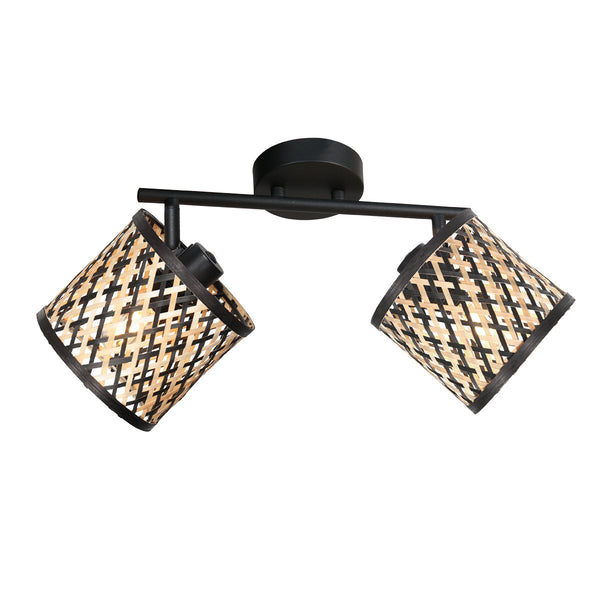
First trace the centre line of the hallway, then place the points on it at equal intervals: the eye follows the line and the perspective seems longer. The tube track the Tiffany tube track (L 49 cm, E27, 28 W max) covers a good stretch of hallway with a single fixing point. In a short hallway, a two-light spot is enough and costs fewer drill holes. See also all black spots.
Distributing in a living room
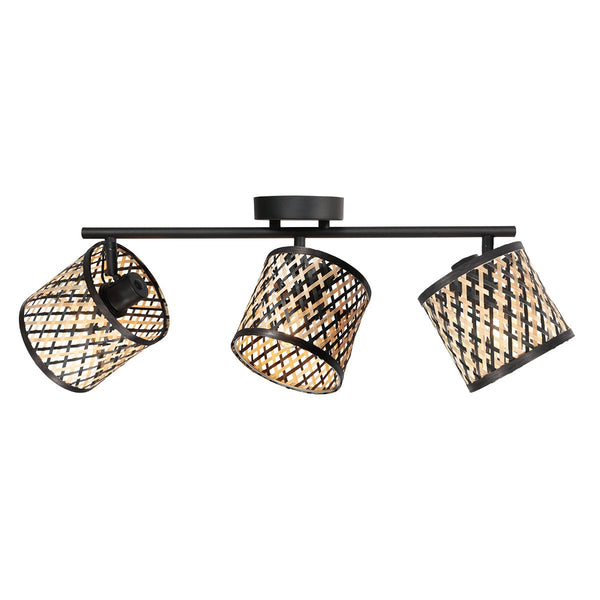
In a living room, the centre of the ceiling lights poorly: it leaves the walls in shadow and marks faces. Better to place the points towards the walls, above a bookcase or a picture, and keep the centre for accent light. The the Sumba three-light spot allows three shades to be aimed in three directions. For a more contemporary result, see the modern-style spots.
How many spots in a kitchen?
There is no universal number: count one light point per work area, then one for the whole. A two- or three-light track above the worktop completes the general lighting. Several adjustable points are better than a single central point, which leaves shadows on the worktops.
How many light points above the worktop?
Count one area, one point: sink, preparation board, hob. If the worktop is continuous, two well-spaced points are better than three crowded in the same place. Height matters as much as number: a shade too low dazzles, too high it no longer lights the worktop. The right reference is found by standing in front of the worktop and checking that the light falls in front of you, not in your eyes. See the kitchen LED spots.
Is a multi-light spot enough in a kitchen?
Yes for a small closed kitchen: a two- or three-light track above the worktop is enough for both general lighting and the worktop, provided you stay in IP20 away from splashes. The its two-light version suits short worktops, and the Blyssa spot (L 26 cm, E27) lines up well above an island. For an open kitchen, rather add recessed points: the recessed spots for kitchens.
How to wire spots in series or in parallel?
Parallel wiring is the one to choose for several spots: each fixture stays independent and a burnt-out bulb does not switch off the others. Series wiring runs the current from one to the next and cuts the whole line at the slightest fault. Connection to the mains is entrusted to an electrician.
How to wire spots in series?
In series, the live wire leaves one spot to enter the next, then the next again: the fixtures form a chain. The wiring works, but it accumulates constraints and removes all independence. One missing or burnt-out bulb is enough to leave the room in the dark, which quickly becomes annoying in a hallway. This connection is mainly found on small decorative sets, rarely on circulation lighting.
Why prefer parallel wiring?
In parallel, each spot receives its own feed from the common line: removing a bulb does not affect the others, and a fixture can be changed without touching the rest. This is the logical wiring as soon as there are several points in the same room, in the kitchen as in the hallway. The cable cross-section, the number of possible feeds and the connection to the consumer unit are the electrician's business. To place these fixtures among all our light fixtures, compare the formats.
How to install recessed ceiling spots?
A recessed spot is installed in a cut-out made in the ceiling: the location is marked, a hole is drilled to the diameter of the spot, the cables are passed through, the connection is made with the power off, then the spot is put in place. In this collection, the bamboo spots are surface-mounted: the marking is identical, without cutting.
How to install a recessed ceiling spot?
Mark the locations in pencil, checking that no joist or conduit runs directly above, then drill to the diameter indicated by the fixture. Switch off the power at the consumer unit, pass the cables through the hole, connect, then push in the spot and its springs. The operation requires a hollow ceiling and a clean cut: once the hole is made, it cannot be undone. That is the real difference with a surface model, which can be moved without leaving a trace. See the recessed spots for living rooms.
And for a surface-mounted bamboo spot?
Here, no cutting: the base plate is screwed directly to the ceiling or wall, then the shade is put in place. Marking remains the only delicate step, because you have to aim right for the points to be aligned. The the Bali adjustable wall light is fixed to the wall at Ø 12 cm and then adjusted by hand, which forgives a slight installation offset. Another option if drilling worries you: the black recessed spots.
How to match bamboo spots with the rest of the room?
Woven bamboo and the black finish go well with light wood, rattan, natural textiles or off-white. In a contemporary interior, keep a single model per room so the line stays readable; in a bohemian style, you can mix a wall light and a track while keeping the same family of material.
Which materials to pair with a bamboo spot?
The weave naturally dialogues with light wood, fibre, linen and matt pottery. The black frame, for its part, contrasts and avoids a slightly bland all-wood effect. An off-white or beige wall brings out the weave pattern; overly saturated tones visually swallow it. For a light version, see if you prefer a white colourway. For a more industrial result, the metal spots play the opposite card.
How to adjust the light with a dimmer?
Only the Bali wall light is stated as dimmer-compatible in this collection: it dims for a night-light in an entrance or bedroom. The other models are switched on from the switch. To modulate elsewhere, you need a module compatible with the installed bulb, without exceeding the maximum power of the fixture, and check the compatibility of the LED bulb before purchase. See the dimmable spots and the dimmable LED models.
Which bamboo spot to choose by room and socket?
The choice is made first by room and number of light points, then by socket. A long hallway calls for a tube track, a narrow entrance an adjustable wall light, a kitchen a two- or three-light spot above the worktop. All models share bamboo, IP20 and a two-year warranty.
| Model | Format | Socket | Max power | Where to place it | What sets it apart |
|---|---|---|---|---|---|
| Sumba Ø 12 cm, three lights | Round, Ø 12 cm, H 11 cm | E14 | 3 x 40 W | Kitchen, hallway, living room | Three bamboo shades on a single base |
| Sumba Noir, two lights | Round, Ø 12 cm, H 11 cm | E14 | 2 x 40 W | Kitchen, hallway, living room | Same size, two-light version |
| Tiffany Noir | Tube, L 49 x W 14 x H 12.5 cm | E27 | 28 W max | Kitchen, hallway, living room | Bamboo spot, E27, 28 W max |
| Blyssa | Tube, L 26 x W 14 x H 12 cm | E27 | 28 W max | Kitchen, hallway, living room | Two lights, compact format, contemporary style |
| Bali | Round wall light, Ø 12 cm | E14 | 40 W | Entrance, bedroom, living room, hallway, staircase, toilet | Only adjustable wall light, dimmer-compatible, black and beige |
| Room | Recommended format | Possible socket | Point of vigilance |
|---|---|---|---|
| Hallway | Tube track or two- to three-light spot | E14 or E27 | Align the points along the axis of the passage |
| Living room | Three-light spot or adjustable wall light | E14 or E27 | Aim the points towards the walls, not in the line of sight |
| Kitchen | Two- or three-light spot above the worktop | E14 or E27 | IP20: keep out of splash zones |
| Entrance | Adjustable wall light | E14 | Provide the cable feed to the wall |
| Bedroom | Adjustable wall light alongside a bedside lamp | E14 | Fix on the reading side, without aiming at the face |
It remains to decide between format and socket. A narrow hallway and an entrance are handled with a two-light or the Bali wall light; a large kitchen or a living room rather call for the length of the Tiffany tube track. If you hesitate between E14 and E27, start from the stock of bulbs you already have.
Order from Designix with secure payment and tracked delivery, returns possible, and a customer service that answers installation or bulb compatibility questions before and after purchase. The whole selection is covered by a two-year warranty. To broaden the comparison, browse the adjustable spots in black or the Designix lighting collection.
Frequently asked questions
How to wire spots in series?
In series, the current passes through each spot one after the other: the fixtures all depend on the previous one. A burnt-out bulb or a loose contact then cuts the whole line. For a hallway or a kitchen, parallel wiring remains preferable, and connection to the mains is entrusted to an electrician.
Can a bamboo spot be installed in a bathroom?
The bamboo spots in the collection are IP20: protected against contact and dust, not against moisture. In a bathroom, they therefore stay away from water splashes, in a dry zone. Near a shower or bathtub, you need a fixture specifically designed for moisture.
Do you need special bulbs for a bamboo spot?
The socket decides: E14 at 40 W maximum on Sumba and Bali, E27 at 28 W maximum on Tiffany and Blyssa. An LED bulb of equivalent power is suitable, provided you do not exceed the power indicated per socket. The warm or neutral result then comes from the choice of bulb.
Which bamboo spot to choose for a hallway?
A long hallway suits the Tiffany tube track, placed on the ceiling and aligned along the axis of the passage. A short or narrow hallway is fine with the Sumba two-light spot. The Bali wall light, adjustable, suits places where you want to direct the light towards a wall.
Is there a dimmer on the bamboo spots?
Only the Bali wall light is stated as dimmer-compatible in this collection. The other models are switched on and off from the switch. To lower the intensity elsewhere, you need a module compatible with the installed bulb, without exceeding the maximum power of the fixture.




