Wall light above the sofa: the right height
This article is also available in French: Applique murale au dessus du canapé
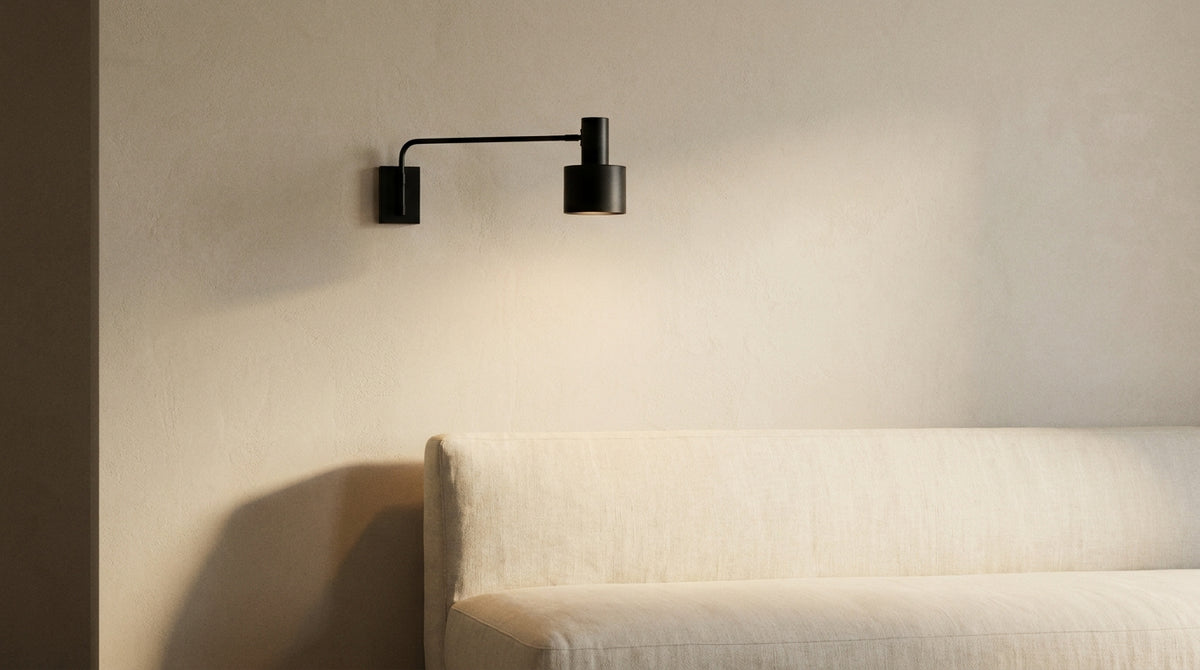
First measure the height of the backrest, then add 40 to 60 cm for the centre of the wall light, which places it around 1.50 m to 1.70 m from the floor. Then check the projection: it should extend past the backrest without ending up in your line of sight. A tape measure, a pencil, and the rest almost decides itself.
The wall behind the sofa is often the neglected part of the living room: the ceiling light whitens the top of the room, the sofa stays in shadow, and evening reading happens under a badly placed halo. A wall light corrects this imbalance without touching the ceiling. The selection of living room wall lights can be browsed by shape, colour and socket, which avoids buying blind.
At what height should a wall light be placed above the sofa?
Allow 40 to 60 cm between the top of the backrest and the centre of the wall light. This reference point places the source above the shoulder, never in your line of sight. Sit down once the point is marked in pencil: if the wall light stares back at you when you are leaning back, it is too low.
How many centimetres above the backrest?
The range narrows depending on the size of the diffuser and the height of the backrest.
- 40 cm for a high backrest and a low ceiling, the wall light stays compact
- 50 cm for a standard backrest, the compromise that lights the sofa without glare
- 60 cm for a large glass diffuser, whose halo spreads wider
- Projection: a wall light that extends 15 cm or more needs 5 cm more, otherwise it grazes heads
Once seated, your eyes drop clearly below their standing position: that is the line you need to clear. The height of a wall light should therefore always be checked with the sofa in place, never on a plan.
And if the sofa is not against the wall?
A sofa set back a few centimetres changes everything, and this is the case guides forget.
- The setback creates a gap where light falls behind the backrest and highlights the wall
- The blind spot grows: the wall light needs to sit slightly lower to reach knees and book
- The walkway calls for a flat wall light, without a protruding arm, so shoulders do not bump it
Unsure about the electrical line or the exact position of the model? You can describe your wall to us before drilling, with two photos and the backrest measurement, and we will reply on feasibility.
What lighting above a sofa: reading, ambience or accent?
For reading, a narrow, adjustable cone placed high. For ambience, a diffuser that hides the bulb and lets soft light through. To highlight the wall, a grazing beam that reveals the material. Use is decided before shape, never after.
Adjustable or fixed?
An adjustable model wins as soon as you read or sew on the sofa: the arm adjusts towards the shoulder and lifts when the room fills with people. A fixed model suits a decorative wall, where the light should stay the same every evening. An adjustable wall light simply needs one adjustment after installation.
Glass, metal, fabric: what does the diffuser change?
Frosted glass softens and lets the source show through. Metal directs the flow and creates a sharp contrast on the wall. Fabric filters strongly and brings the ambience closer to lamp light. An LED model avoids a visible bulb and heats less near heads, as on this LED wall light.
On a bare wall, the wall light can also play the role of a picture: a beam grazing the surface is enough to make it exist in the evening. The principles of accent lighting apply as they are above a sofa, provided you graze the wall rather than hit it head-on. The same wall can be worked with modern wall lights room by room if you want to keep a consistent style from one room to another.
Wall lights for the sofa wall
 Wall light | Heor
 Wall light | Zenena
 Wall light | Flovena
 Wall light | Sveva
 Wall light | Bastia
 Wall light | Tubara
See the whole selection: Wall light, Wall Lamp and Design Wall Lighting
Your sofa is against the wall: what should the wall light be for?
Where to place a wall light in the living room?
On either side of the sofa, at equal distance from the armrests, or at a single point offset outwards. Never centred above the backrest: the middle of the wall belongs to a frame, a moulding or nothing at all. The wall light works the edges, not the axis.
One wall light or two on either side?
- Two for a sofa with more than three seats, with a wide, symmetrical wall
- Just one when the sofa touches a corner or a door eats into the wall
- Offset towards the outside of the sofa, it lights the shoulder without falling on the neighbour's face
The room should be thought of as a whole: a lit sofa but a dark seating area quickly tires. A few reference points to light a living room effectively avoid overloading the wall that already holds the television. For a more contemporary look, a modern wall light plays on the geometry of the model rather than on numbers.
What to check before drilling
The weak point is rarely where you think: a plasterboard wall holds through its studs or a reinforcement plate, not through the plug. Locate the electrical conduit with a detector first, switch off the circuit, and check the flatness of the surface with a spirit level.
How to fix a wall light without drilling?
Three solutions really hold: structural adhesive on a smooth, load-bearing surface, adhesive rail for a lightweight model, and the rechargeable wall light that removes the cable. None forgives crumbly plaster, peeling paint or thick wallpaper.
The fixings that really hold
| Fixing | Suitable wall | Limit |
|---|---|---|
| Structural adhesive | Smooth, load-bearing, sound paint | Hard to remove, leaves a mark |
| Adhesive rail | Tiles, glass, varnished wood | Reserved for a lightweight model |
| Rechargeable model | All surfaces, no cable | Recharging required, limited battery life |
Installation details and beginner mistakes are covered in this guide to fixing a wall light without drilling. Cordless wall lights solve the problem at the root: you place them where the cable does not reach, and move them when the sofa changes position.
When the wall requires an electrical supply
An already tiled wall, a lined partition, an old living room with no socket behind the sofa: the chase becomes a decision, not a DIY detail. The conduit must run straight down, with a back box aligned with the centre of the wall light. A lighting project for a living room handles the supply along with the rest, avoiding reopening six months later. If you are unsure which company to entrust with the installation, Designix's Google listing is public and verifiable: reviews can be read there directly.
What are the trends for wall lights in 2026?
In a survey of 247 wall lights from our catalogue as of 16 November 2026, three shapes dominate the wall: round at 25%, globe at 24%, tube at 23%. In terms of colour, black accounts for 53% of the survey, white 40%, gold 40%, and the collection contains 13,539 references on the same date.
Black, white, gold
- Black: it stands out on a light wall, fades on a dark wall, draws a clean line
- White: it disappears into a painted wall, leaving only the light visible
- Gold: it marks a living room wall, especially in small touches
The chosen shapes follow the colour: a globe calls for a sober wall, a tube needs length. This on-trend living room wall light serves as a starting point to visualise a coherent pair before confirming the references.
The dimmer, an evening criterion
Of 85 listings in the survey that declare the information, 24% mention dimming. That is few, yet it changes everything: at full power you read, at half you dine, at a third the wall light becomes a visual landmark. Wall lights with a dimmer should be chosen together with a compatible bulb, never without it.
Softened living room light does not rely on a lowered ceiling light but on low, offset sources. The sofa wall light is one of them, the most cost-effective in terms of wall space occupied.
In stock · shipping costs shown at checkout · up to 30% off in your cart


Ready to turn inspiration into reality?
Tell us about your room, your style and your budget, and we will show you the pieces that truly suit your project.
Get guidance in 30 seconds →