Wall light for terraces: how to choose it and install it right
This article is also available in French: Applique murale terrasse
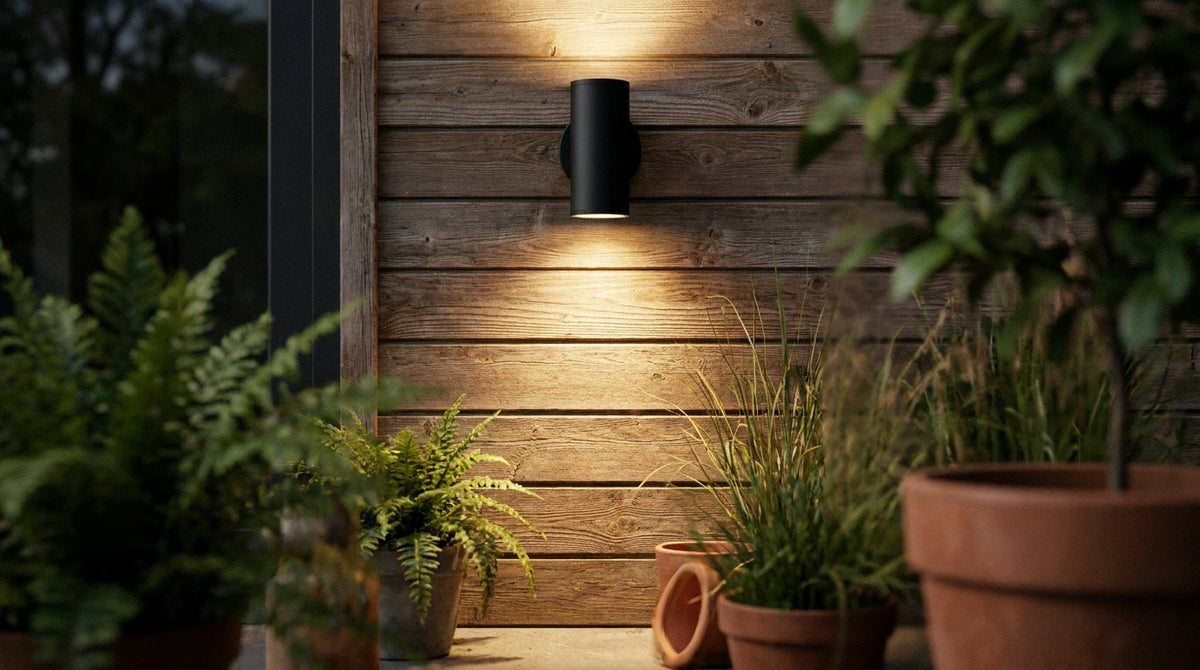
Mount the wall light between 1.70 and 1.80 m from the ground, at shoulder height. Aim for IP54 minimum if the wall gets rain, IP65 on a wind-driven facade. Then the socket: integrated LED if you never want to touch it again, E27 or GU10 if you like changing the bulb and the colour temperature.
On a terrace, a wall light is not decoration: it lights a walkway, a dining corner, a door. The collection of outdoor wall lights for terraces brings together 1,611 references as of 13 November 2026, from solar models to E27 models.
Which wall light should you choose for a terrace?
Start with the exposure, the rest follows. Sheltered wall, IP44 is enough. Slanting rain on the wall, go up to IP54. Wind-driven facade, aim for IP65. Then the socket: integrated LED if you never want to touch it again, E27 or GU10 if you like changing the bulb.
A comparison table tells you the differences, not what works in your home. A west-facing gable swept by showers and a loggia wall do not call for the same housing. An outdoor wall light is chosen on three facts: the water it receives, the height of the fixing point, the colour of the surface.
What power for an outdoor wall light?
Allow 8 to 15 W in LED to cover a corner of the terrace, 20 W and more if the wall light becomes the main source. Power does not say everything: a beam directed downwards lights better than a scattered 360° output.
The socket decides your freedom. In a survey of 89 references from our catalogue as of 13 November 2026, 46% state an integrated LED, 33% an E27 socket, 13% a GU10. The integrated LED cannot be replaced. The E27 takes a filament bulb or a warm 2700 K. The outdoor LED wall lights cover both cases, and LED wall lights offer the widest choice in adjusted output.
Material and colour: what holds up outdoors
Aluminium dominates for a simple reason: it does not rust and it paints well. In the same survey of 89 references as of 13 November 2026, 87% state aluminium, 38% metal, 25% glass, 21% plastic. Black remains the majority at 64%, ahead of white at 27%.
The colour of the housing answers to the wall, not to the furniture. On a light render, black draws the light; on wood cladding, anthracite blends in. The same logic applies indoors, where a living room wall light in the same metal links the room and the terrace. The 5-year warranty is stated on 66% of the survey, an argument that matters for a light screwed in for ten years.
Outdoor wall lights for terraces: the selection


At what height should you install an outdoor wall light?
Between 1.70 and 1.80 m from the ground, at shoulder height. The light goes down without glare and the housing stays within reach to change the bulb. Above a table or a step, go down 15 cm; under a low canopy, go up by the same amount.
Where should you put wall lights on the terrace?
One point per use zone, never a regular row just for looks. The detailed installation rules are in our guide on at what height to install a wall light. Three locations come up again and again:
- On either side of a door, 20 cm from the frame, to light the passage without dazzling the person coming in.
- Above a table, offset 40 cm towards the open side, so the light falls on the plates.
- Along a bare wall, one point every 2 to 3 m, to draw a continuous low line.
- Near a step or a staircase, on the riser, to read the relief of the ground.
The fixing matters as much as the measurement. A hollow block wall or a plasterboard lining needs suitable plugs, otherwise the housing works loose. Our article on installing a wall light details the drilling and the connection.
And on a covered terrace?
Under a canopy, the wall light lights two surfaces: the wall and the ceiling, which reflects a soft light. IP44 is enough in most cases, water almost never reaching the housing. An adjustable model lets you correct the direction once installed.
If you do not know what runs behind your wall, describe your terrace from the contact page: we answer before you drill.
How to light a terrace: how much light do you need?
Aim for 50 to 100 lumens per m² to move around, 150 to 200 to eat or read. A single wall light does not cover 20 m²: it marks a point. Two or three low sources are better than one central spotlight.
Terrace lighting is built in layers, like that of a living room. Our guide on how to light your terrace details the logic: a light that guides, one that sets the mood, one that reassures.
How many lumens to light a terrace?
A 10 W LED wall light gives out 800 to 1,000 lumens, enough for 6 to 8 m² of accent lighting. For a large 12 m² table, plan two wall lights rather than one more powerful. The detail by use is in our guide on how many lumens to light a terrace.
Which IP rating for which wall exposure?
The IP rating describes resistance to water and dust: first digit dust, second digit water. Reading the standard is useless without observing the wall. Our article on the IP rating of an outdoor light explains the two digits.
| Wall exposure | Minimum rating | Typical case |
|---|---|---|
| Under a canopy, never wet | IP44 | sheltered dining corner |
| Slanting rain | IP54 | typical facade |
| Wind-driven facade | IP65 | gable exposed to the wind |
| Poolside, water jets | IP67 | coping |
In a survey of 89 references from our catalogue as of 13 November 2026, 49% state IP54, 37% IP65, 11% IP44 and 1% IP67. In other words, very watertight models exist but remain rare. The IP65 outdoor wall lights group the models to reserve for the most exposed walls.
What is your situation on the terrace?
How to light a terrace without electricity?
Go solar or rechargeable. A solar wall light charges during the day and switches on at dusk, with no conduit, no drill, no panel. Performance depends on the orientation of the panel: due south, it holds; under a deep canopy, much less so.
Solar wall light or plug-in wall light?
The three families do not provide the same service. Choose according to the wall, not according to whim:
- Solar, no cable, runtime depends on sunlight, avoid on a north wall.
- USB rechargeable, detach to recharge, perfect for a rental or a balcony.
- Wired, the only option for stable power all year round, but it requires an electrical point.
The solar wall light for a terrace wall suits a garden entrance or an isolated garage wall well.
Does a motion sensor change things?
Yes, on a terrace used as a passage. The sensor switches on as you approach and frees up hands full of things. It does, however, require a timer setting, otherwise the light goes out in the middle of the meal. The outdoor wall light with sensor is reserved for circulation areas, not above the table.
For a complete project, combining wall lights, bollards and string lights, it is possible to have a terrace lighting project studied. Our Google listing remains available if you want to see the work carried out, without going through our sales pitch.
In stock · shipping costs shown at checkout · up to 30% off in your cart


Ready to turn inspiration into reality?
Tell us about your room, your style and your budget, and we will show you the pieces that truly suit your project.
Get guidance in 30 seconds →