White wall light: how to choose the right one
This article is also available in French: Applique murale blanche : la choisir sans se tromper
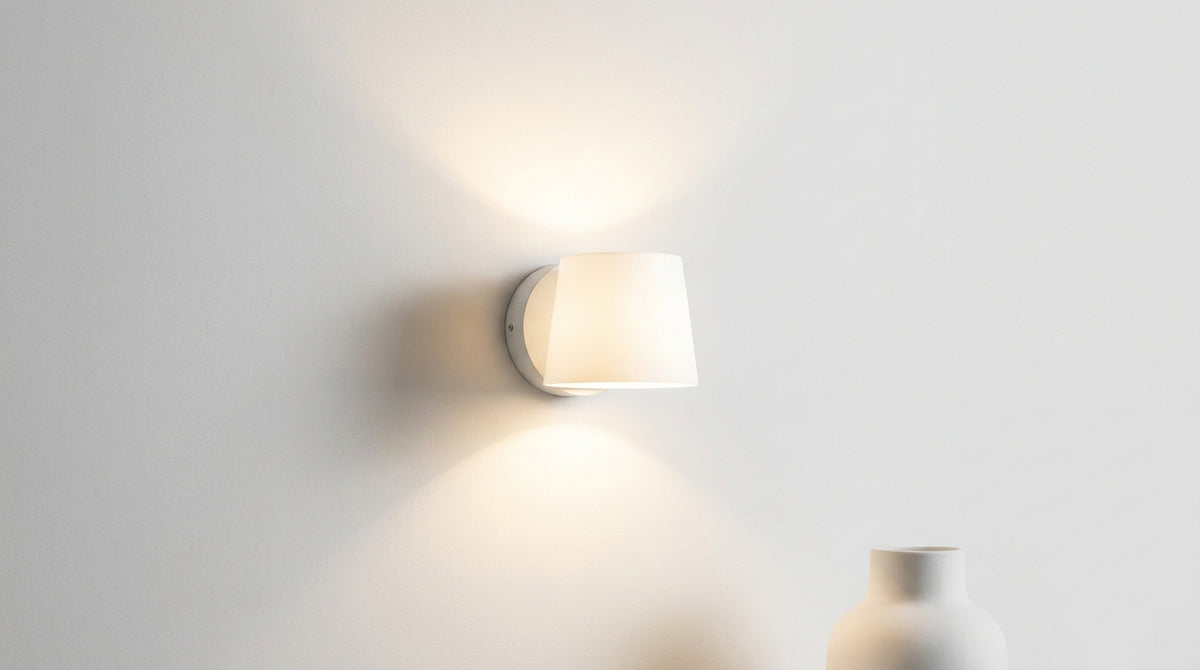
Look for the socket first, the colour comes later. On a survey of 80 white wall lights from our catalogue as of 5 October 2026, integrated LED accounts for 38% of the listings, G9 for 21% and E27 for 20%. Then set the temperature, around 2700 K for a warm white. White itself is almost never up for debate.
Which white wall light gives good light?
The choice comes down to three data points on the listing: the socket, the colour temperature and the direction of the light. A source that throws light back onto the wall illuminates without glare. In a living room, two light points are better than one placed in the centre.
The white wall light can then be filtered by room, by socket and by protection rating, which saves you scrolling through thumbnails without ever knowing what you are looking at.
Modern white wall light: aim for indirect light
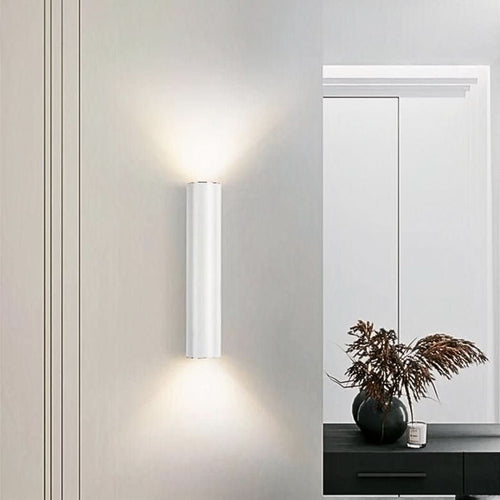
A well-placed modern wall light goes unnoticed. It washes the wall with an even light and lets the eye rest on the rest of the room. The light goes up or down, never straight into your eyes.
That is the whole logic of ambient lighting: to light a room without a ceiling light, you replace a central point with several low, discreet sources.
- Direction: light upwards to wash the wall, downwards to read
- Diffuser: opal glass or acrylic, never a bare source facing the sofa
- Temperature: 2700 K for a warm halo, 3000 K for a crisper look
The result swings from one extreme to the other depending on the white or yellow light you choose, and that is the only setting you notice immediately.
Living room wall light: how many sources?
Two sources minimum, placed at two different heights, and a third if the room is long. The survey of 80 listings as of 5 October 2026 confirms it: 81% of models list the living room as a room of use, 84% the bedroom, 40% the hallway and 25% the staircase.
The rest happens elsewhere: a central LED ceiling light spreads the base light, the wall light sculpts the walls.
What are the trends for wall lights in 2026?
White leads by a wide margin, no debate: 100% of the survey of 80 white wall lights from our catalogue carries the mention White as of 5 October 2026. Metal dominates the materials, with 90% of the survey, ahead of aluminium at 50%. The real trend: a black or gold accent on a white base.
The materials declared on the listings
These are the characteristics filled in, not brand talk. On style, modern is declared on 79% of the listings in the survey, contemporary on 74%, minimalist on 30%.
- Metal: 90% of the survey, the safe bet, often painted matt white
- Aluminium: 50%, lighter, slimmer profile
- Glass: 26%, a globe that softens the light
- Acrylic: 25%, the solution for large volumes
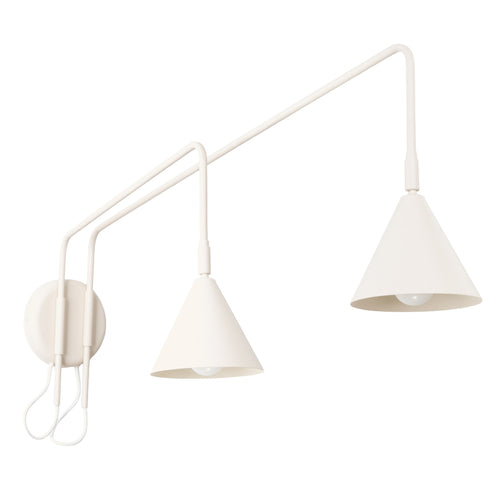
Some shapes really do break the mould: the most elaborate wall lights play with the sphere, the oval or the leaf.
In the same room, consistency of shapes matters more than colour, because a design light fixture that is too different from the others breaks the overall line.
White, black accent and gold accent
White is not a default choice. In the same survey, while 100% of the listings carry the mention White, 45% also declare black, 25% gold and 9% beige. In other words, most models are two-tone.
Modern wall lights make the most of this contrast: white body, black or gold interior, visible especially when switched off.
In a bedroom, this detail goes above the bed, and a well-chosen bedroom light is a welcome replacement for a bulky bedside lamp.
Which room should your white wall light illuminate?
Which socket should you choose for a white wall light?
It all depends on whether you want to change the bulb. In the survey of 80 listings as of 5 October 2026, the integrated LED socket comes first with 38%, ahead of G9 at 21% and E27 at 20%. E14 brings up the rear at 8%.
| Socket | Share of the survey of 80 | What it changes |
|---|---|---|
| Integrated LED | 38% | Non-replaceable source, even light |
| G9 | 21% | Small pin bulb, crisp light |
| E27 | 20% | The widest choice of bulbs |
| E14 | 8% | Slim format, common on reading lights |
Integrated LED socket: when the source cannot be replaced
The source is built into the fixture. You gain an even light and no bulbs to buy. You lose the option of changing the temperature afterwards.
G9 socket: small format, strong output
A tiny pin bulb, often hidden behind a diffuser. The light is precise and directional, which makes it the socket of choice for reading lights.
E27 socket: the widest choice of bulbs
You keep control of everything: filament, dimming, 2700 K or 3000 K. The mention LED appears on 93% of the survey of 80 listings, all technologies combined.
- Dimming: compatible on 38% of the survey of 80 listings, excluded on 4%
- Protection rating: IP20 on 89% of the survey, IP65 on 10%, IP44 on 1%
- Certification: CE declared on 100% of the listings in the survey
To avoid needing any bulb at all, the wall lamp with integrated LED needs no additional source.
If you are still unsure about the silhouette, a design wall light in a tube or sphere shape remains readable even when switched off.
White wall lights: the Designix selection


At what height should you install a white wall light?
Allow 1.20 m to 1.40 m from the floor for a reading light, with the top edge at shoulder height once seated. In a hallway, aim for 1.80 m to 2 m. On a staircase, the line follows the handrail, step by step.
Reading height above a bedside table
The right height is measured sitting on the bed, not standing in the room. The cone of light should fall on the pages without reaching the face of the person next to you.
Our guide on wall light height details the measurements room by room.
On style, an adult bedroom wall light frees up the bedside table and creates a wall design.
In the evening, it is better to check what light to sleep with without disturbing the other person, around 2700 K and at low intensity.
Height in a hallway or on a staircase
Higher and more spaced out. A grazing light avoids shadow areas between two doors, and the wall light never crosses your line of sight.
- Hallway: 1.80 m to 2 m from the floor, one every two to three metres
- Staircase: one wall light per landing, never at eye level
- Bedside: 1.20 m to 1.40 m, measured seated
On a stone wall or stubborn concrete, a wall light without drilling saves you the drill and can be moved as you like.
How can you avoid paying too much?
Look at the declared warranty before the displayed price. In the survey of 80 listings as of 5 October 2026, 88% state two years, 8% five years and 5% three years. A wall light with a longer warranty is often the cheapest over time.
The warranty says more than the headline price
A model with no mention of warranty tells you nothing about its lifespan. The listing states it in black and white. That is the first filter to apply before comparing anything.
If your project covers several rooms, the shortest route is to describe your project in a few lines: we help you sort through the references before you order.
The listing filters to use
Four filters are enough to narrow a department down to a handful of models. The White Wall Light collection has 3,149 references as of 5 October 2026: without filters, you will be scrolling for a long time.
- Socket: LED, G9, E27 or E14, chosen for a reason, not by chance
- Protection rating: IP20 is enough in a dry room, IP65 for exposed use
- Dimming: check the mention, not all models support it
- Warranty: the only criterion that still says something about the product in five years
On the same subject
In stock · shipping costs shown at checkout · up to 30% off in your cart
Ready to turn inspiration into reality?
Tell us about your room, your style and your budget, and we will show you the pieces that truly suit your project.
Get guidance in 30 seconds →