Wall-mounted lamps: choosing and installing them right
This article is also available in French: Lampe a fixer au mur
First find the power supply: a recessed feed, a wall light to plug into a socket, or a battery model. Then the height: 1.40 to 1.70 m for an ambient wall light, at seated shoulder height for a bedside reading light. Finally the protection rating: IP20 in dry rooms, IP44 in wet rooms, IP65 outdoors.
What are lamps that fix to the wall called?
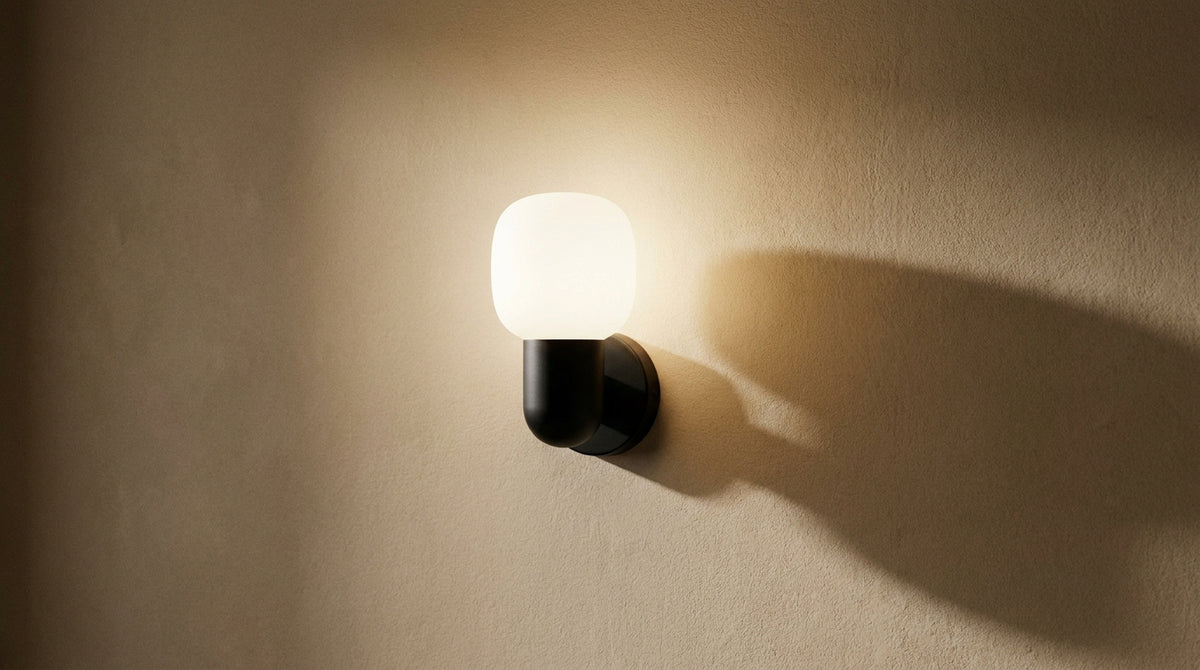
When the light source is carried by the wall and lights only from that point, it is called a wall light. Three families share the use: the ambient wall light, the adjustable reading light and the spotlight bar. "Wall lamp" remains the everyday term; manufacturers write wall light.
Wall light, reading light, bar: three families, three uses
The most widespread format remains the wall light: a slim block against the wall, a light that goes up or down, often placed in pairs on either side of a bed.
- Ambient wall light: diffuses upwards or downwards, to frame an opening or a mirror.
- Reading wall light: adjustable arm that concentrates the light on the page without lighting the person next to you.
- Spotlight bar: three or four adjustable points on a single support, above a worktop or a picture.
- Wall light with switch: control built into the back, no two-way switch to run, as on a wall light with switch.
What our catalogue survey says
The wall collection has 7,435 references as of 29 September 2026. On a survey of 233 of these listings on the same date, wall mounting is declared on 93%, IP20 on 89%, the E27 base on 41% and metal on 88%. The wall, then, but almost always for dry interiors.
These models are reviewed by buyers: their feedback appears on the Designix Google listing, available online.
Which wall lamp for which room?
The room decides the protection rating and the colour temperature; the shape comes after. In a dry room, IP20 is enough. In a bathroom, aim for IP44 at minimum near the water point. Outdoors, IP65. The rest comes down to the base and the style.
| Room | Minimum rating | Temperature | Common base |
|---|---|---|---|
| Bedroom | IP20 | 2,700 K | E27, E14 |
| Living room | IP20 | 2,700 to 3,000 K | E27 |
| Kitchen | IP20 | 3,000 to 4,000 K | LED, G9 |
| Bathroom | IP44 | 3,000 K | LED |
| Outdoors | IP65 | 2,700 to 3,000 K | LED |
For brightness, a benchmark: on the same survey of 233 listings, dimming is declared on 33% of references. A dimmable LED wall lamp can then be adjusted from morning to evening.
In the bathroom, the rating rules everything
IP20 protects against fingers, not water. The threshold changes with the actual exposure of the fixture.
- IP44: resists splashes, essential near the sink or above the mirror, like an IP44 wall light in a bathroom.
- IP65: withstands rain and jets, the only reasonable level for a facade or a terrace.
- IP20: bedroom, living room, hallway, office, anywhere the air stays dry.
Bedroom, living room, terrace: three sets of requirements
Each room imposes its fixing and its light colour, the style comes next.
- Bedroom: two symmetrical wall lights on either side of the bed, each with its own control, to choose from the adult bedroom wall lights.
- Living room: an adjustable model near the sofa for reading, another with grazing light on the back wall.
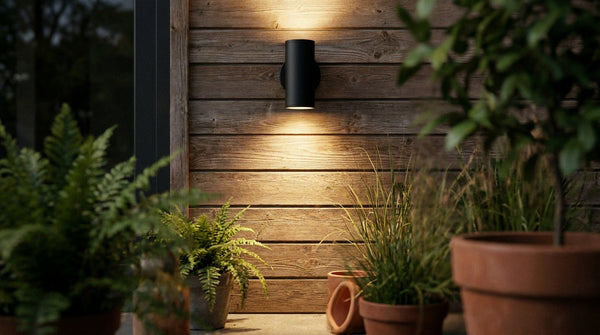
- Terrace and entrance: an outdoor wall light in IP65, aluminium or metal body, withstands the seasons.
In the kitchen, the kitchen wall light is fixed short and slim under the top of the cabinets, to light the worktop without casting shadows.
Lamps and wall lights to fix to the wall
 Glass Ball Wall Light | Kena
 Northern Lights Wall Light | Rian
 White linen dimmable wall light, adjustable steel arm | Prestige Chic
 Cube LED outdoor wall light, aluminium up & down | Uaso
 Wood and black wall light | Fusion Élégante
 Black Velvet Green Wall Light
See the whole selection: Wall Light, Wall Lamp and Designer Wall Lighting
How to fix a wall lamp without drilling, and how to power it?
Three setups hold without drilling: high-strength adhesive rail on a smooth painted wall, a bracket fixed to an existing piece of furniture, and the battery-powered wall light. On plasterboard or concrete, a suitable plug remains the only durable fixing, especially for a metal body.
The fixings that really hold
To learn how to fix a wall light without drilling, start from the weight of the fixture and the nature of the wall, never from the adhesive alone.
- High-strength adhesive: on smooth paint and non-porous surface, for a lightweight model with no cable.
- Bracket on furniture: the weight goes into the headboard or a panel, the wall stays intact.
- Molly plug: essential in plasterboard as soon as the fixture has weight.
- Flush box: takes the electrical feed and serves as the fixing point.
Cordless: battery, cells or socket
A battery wall light hangs where no cable runs: it recharges with a cable, then goes back up. Battery life remains its weak point, worth keeping in mind if the lamp is used every evening.
For connection to an existing socket, the plug-in wall light without an electrician is content with a visible cable, hidden by a cable cover.
And if no power supply exists in the right place?
Better to light a room without a ceiling light by combining two low wall lights and a mobile source, rather than running a line across the room.
At what height should you fix a lamp to the wall?
Allow 1.40 to 1.70 m from the floor for an ambient wall light, 1.10 to 1.20 m for a bedside reading light, and 1.50 m above the worktop for task lighting. Measure from the finished floor, not from the skirting board.
Bedside reading light, sofa, worktop: three dimensions
These benchmarks are checked once seated, not standing: the height of a wall light is judged from the point where you read.
- Bedside reading light: 1.10 to 1.20 m, at shoulder height once seated, about 60 cm from the edge of the mattress.
- Sofa: 1.40 to 1.60 m, offset to the side so as not to dazzle.
- Worktop: 1.50 m, under the top of the wall cabinets, never in the line of sight.
- Hallway and stairs: 1.90 to 2.10 m, evenly spaced.
For a headboard wall light, two models are better than one ceiling light: each controls its own light, and the back wall stays free.
Which colour temperature for a wall lamp?
Allow 2,700 K for rest rooms, 3,000 to 4,000 K for reading or working. The choice between white or yellow light therefore depends on use, not on the style of the fixture.
An adjustable fixture often settles the question: tilt the light towards the wall, the light bounces off the paint and softens without losing any readability.
Unsure about the exact height or whether there is a power feed in the right place? Describing your wall to the team takes two minutes and avoids drilling in the wrong place: talk to the team about your project.
Which wall do you want to light in your home?
On the same subject
In stock · shipping costs shown at checkout · up to 30% off in your cart


Ready to turn inspiration into reality?
Tell us about your room, your style and your budget, and we will show you the pieces that truly suit your project.
Get guidance in 30 seconds →