Bedside wall lights: choosing well and fitting correctly
This article is also available in French: Lampe a fixer sur tete de lit
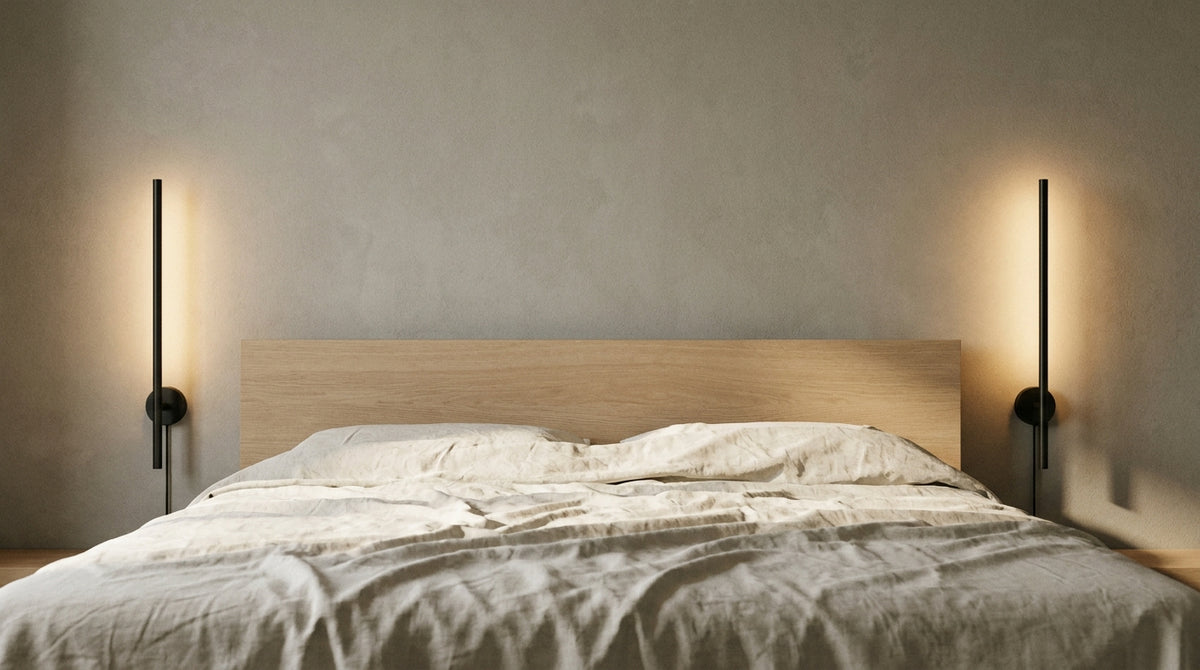
Place the bottom of the wall light at shoulder height, sitting up in bed, 30 to 40 cm from the edge of the mattress. One on each side if two people read, with a beam that falls onto the page and never into your partner's eyes.
Which light above a bed?
A fixed, adjustable wall light set at shoulder height: that is the most stable and most common solution. A table light remains useful when drilling is not possible. The real criterion is not style, it is the direction of the beam and exactly where the light falls.
Three points decide the choice: the free space above the mattress, whether there is a socket at that spot, and whether you want to drill or not. An adult bedroom wall light frees up the bedside table and brings the light down to where the book is.
Wall-mounted or table light: the real criterion
The question is not settled by how beautiful the model is, but by how much space the bedside area has and how stable the light is.
- Fixed wall light: takes up no space on the bedside table, beam stays still, perfect if the bed does not move.
- Reading light on an arm: adjustable to the millimetre, ideal when two people read at different paces.
- Table light: can be moved, but takes up the bedside table and tips over easily.
- Cordless model: best kept for concrete walls or rentals, the battery sets the pace.
There is no shortage of choice: the bedside wall light collection has 886 references as of 29 September 2026, from discreet models to long-armed ones.
What an electrician checks first before fitting
Three pieces of information read on the product page decide whether it can be done, before any thought of decoration.
- IP20: out of a sample of 36 references from our catalogue on 29 September 2026, this rating appears on 100% of the pages. Enough in a dry bedroom, not enough near a bathtub.
- E27 bulb holder: 69% of the same sample state this format, the easiest to replace.
- Dimmability: 56% state it (out of 32 completed pages), a real comfort when two people share the bed.
- 2-year warranty: mentioned on 100% of the pages in the sample.
These points are developed in our article on the bedside wall light for reading in bed.
Which bedside light for your bedroom?
At what height should a wall light be fitted for a bedhead?
Allow 90 to 110 cm from the floor to the bottom of the fitting, which is shoulder height once seated in bed. Sideways, keep 30 to 40 cm between the centre line of the wall light and the edge of the mattress.
The measurement that lets you read without shadow
The light should come from the side and slightly behind the shoulder, never straight in line with the face.
- Height: bottom of the fitting at shoulder height when seated, not above the head.
- Setback: 30 to 40 cm from the edge of the mattress, to avoid the shadow of your own hand.
- Direction: shade open downwards, never aimed at the person reading next to you.
Two readers, two different heights
Two people do not have the same seated height. Set the measurement for the shorter of the two, even if it means raising the second one slightly.
| Situation | Bottom of the fitting | Distance from the mattress |
|---|---|---|
| Single bed, one reader | 90 to 110 cm from the floor | 30 to 40 cm |
| Double bed, two readers | same measurement on both sides | 30 to 40 cm on each side |
| Bed with a headboard panel | fixed to the panel | aligned with the pillow |
The details of the calculation are explained in our article on the height of a bedside wall light. For a finish that stays smart, slim-armed wall lights are easier to line up with a pencil than with a laser measure.
The safety guidelines and the clearances to respect are summarised in our guide on at what height to fit a bedside wall light.
If you are still hesitating between a fixed wall light and a reading light on an arm, describe your bedhead to us: you can talk to an adviser and decide before drilling, from our address in Vaulx-en-Velin.
Which are the best lights for reading in bed?
Choose a source that lights the page without dazzling: bottom of the fitting at shoulder height, adjustable shade, bulb between 2700 K and 3000 K. A reading light on an arm or an adjustable wall light does better than a table bedside lamp, which often lights at an angle.
Bedside reading light: what matters
The arm matters more than the finish. Three qualities make the difference in use.
- Reach: the arm brings the light down onto the page, it does not send it towards the wall.
- Length: a short arm forces you to hold the book right under the shade.
- Switch: within reach from the bed, without getting up.
Our article on the adjustable wall reading light details this adjustment, and the height of a bedside reading light is calculated in exactly the same way as for a wall light.
Bedside LED lighting: the temperature that does not flatten the mood
An LED at 2700 K gives warm light and keeps the bedroom readable without flattening it. Above 3000 K, the light whitens the walls and tires the eye in the evening.
On this point, the reading lamp with an adjustable source solves the problem better than a ceiling light, because it only lights the useful area.
Bedside wall lights and reading lights: the selection


Reading in bed without waking the other
Turn the power down, not the direction. A narrow beam placed on the page does not reach the neighbouring pillow, even at medium intensity.
- Direction: the cone falls onto the book, never towards the bed.
- Intensity: dimmability is stated on 56% of the sample of 29 September 2026, worth choosing for two.
- Shade: an opaque model closed at the top limits the spread of light upwards.
A well-adjusted bedroom light often replaces two bulky bedside lamps. To take the look all the way, see our article on hotel-style atmosphere and bedside tables.
How do you fit a bedside light without damaging the wall?
Mark first, drill afterwards. A strip of masking tape, a pencil and a spirit level are enough: mark the measurement, switch on dry to check the result, then drill to the diameter of the wall plug. On plasterboard or a bedhead panel, the choice of fixing changes everything.
Fixing to a solid wall, plasterboard or a bedhead panel
- Concrete or solid brick: hammer-in plug and suitable screw, the most solid fixing.
- Plasterboard or panel: toggle plug essential, a standard plastic plug will not hold.
- Bedhead panel: screw into the panel, never into the void behind it.
- Reinforced concrete: go for a cordless model or a freestanding floor lamp.
Marking out before drilling, in the right order
The classic mistake is drilling before checking the light.
- Mark the measurement in pencil, with a cross for the centre line.
- Hold up the fitting dry and switch on to judge the shadow.
- Check that no cable runs at that spot with a detector.
- Drill to the diameter of the bit, without forcing, then insert the plug.
Our article on the wall light without drilling covers adhesive solutions when the wall cannot be touched, and the wall lamp with wall mounting remains the norm on 89% of the pages in the sample.
Cordless or clip-on bedside light: what really holds
A clip-on bedside light holds if the panel is thick and rigid enough not to vibrate at the slightest movement. A rechargeable cordless bedside light can go anywhere, but the battery sets the pace.
The Designix Google listing remains the public reference for checking the company in one click: see the Designix Google listing.
On the same subject
In stock · shipping costs shown at checkout · up to 30% off in your cart


Ready to turn inspiration into reality?
Tell us about your room, your style and your budget, and we will show you the pieces that truly suit your project.
Get guidance in 30 seconds →