How to install a pendant light on the ceiling: a step-by-step guide
This article is also available in French: TUTORIEL : INSTALLER UN LUMINAIRE SUSPENDU AU PLAFOND
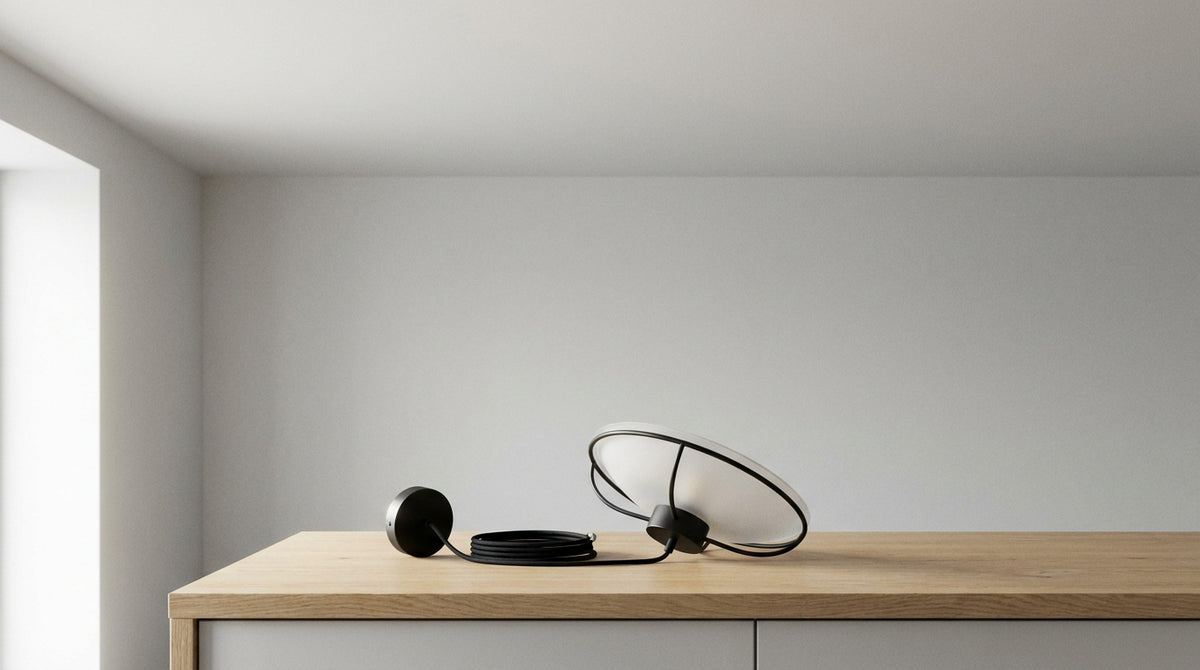
Start by locating the fixing point on the ceiling from the wire: the wire dictates the position of the canopy, not the other way round. Switch off the power at the circuit breaker, check that there is no voltage with a tester, then drill at the centres of the bracket. Two holes are enough in most cases.
How do you install a pendant light on the ceiling?
Switch off the circuit breaker, check that there is no voltage with a tester, then locate the fixing point from the wire coming out of the ceiling. Drill at the centres of the mounting plate, screw it on, connect the wires and adjust the cable length last. The order matters: the fixing is finished before the wiring begins.
Switch off the power and check that there is no voltage
The circuit breaker for the lighting circuit is switched off at the consumer unit; the wall switch is not enough. If you are carrying out a living room and main room renovation, take the opportunity to identify what shares the circuit. Test each wire with the detector before touching it, including the neutral.
- Circuit breaker switched off at the consumer unit, never just the switch
- Voltage detector applied to each wire, neutral included
- Ladder stable and clear, with two people if the ceiling is high
- Insulated tools: screwdriver and wire strippers
Locate the fixing point before drilling
The canopy must land on the wire, not next to it. Hold the mounting plate against the ceiling, letting the wire come out through its centre, mark the two centres in pencil, then check with a spirit level that the bracket is truly horizontal. A half-centimetre gap shows as soon as the light is hanging.
- Centring: the wire in the middle of the canopy
- Centres marked in pencil, never by eye
- Spirit level placed on the mounting plate before drilling
- Drill diameter matched to the plug
Cable length, diameter and material are decided before buying. Browsing the pendant lights by material and size avoids fitting a mounting plate for a model that will not work.
Pendants to install on the ceiling
 Applique Boule Salle de Bain Moderne | Luminance
 Applique salle de bain tube ovale | Fiye
 Applique Salle de Bain ZAMBELIS 20W CCT IP44 DESIGN Blanc Sable 25457
 Applique salle de bain dimmable | Qilo
 Spot orientable salle de bain rond | Lisio
 Applique mural noir salle de bain | Calix
See the whole selection: Bathroom Lighting, Ceiling, Wall or Mirror Lighting
How do you fix a pendant when the ceiling is not solid concrete?
It all depends on the substrate. In plasterboard, a toggle or needle plug carries the load; in panelling or a beam, a wood screw is enough; on a solid slab, a hammer-in hook or the screwed mounting plate will hold. The fixing must take the weight of the light with a margin.
| Substrate | Fixing | What to watch |
|---|---|---|
| Solid concrete slab | Expansion plug or hammer-in hook | Drill with a hammer drill, exact diameter |
| BA13 plasterboard | Toggle or needle plug | Never a simple plastic plug |
| Panelling, wooden beam | Direct wood screw | Find the solid material under the panelling |
| Old plaster | Toggle plug and find the solid material | Test the hold before hanging |
- Hammer drill and bit at the exact diameter of the plug
- Suitable plugs for the substrate, never chosen at random
- Spirit level to check the mounting plate is horizontal
- Screwing by hand, to feel the grip in the substrate
Plasterboard, panelling: which plug should you choose?
A toggle plug works by bearing behind the board, while a needle plug screws directly into the plasterboard. For a light fitting, one or two plugs are enough. For hanging a pendant without a hook, the screwed mounting plate remains the most discreet.
Solid slab: hammer-in hook or screwed mounting plate
The hammer-in hook is driven in with a hammer into a sized pilot hole, then the cable is hung on it. The screwed mounting plate spreads the load over two points and leaves less trace when removed. In both cases, stay in line with the wire: that is what prevents pulling at an angle when you want to install a ceiling light.
If the ceiling inspires you less than the pendant, writing to us to validate your installation is the simplest way out: we tell you which fixing will hold in your home, and we can fit it with you.
How do you wire the cables of a pendant light?
Three wires usually arrive: the live (brown, red or black), the neutral (blue) and the earth (green-yellow). A two-wire pendant connects to live and neutral; the green-yellow is then taken to the terminal in the box, never cut off clean. The connector blocks are tightened by hand.
Two wires, three wires: what changes
- Live: brown, red or black, to be protected before any contact
- Neutral: blue, essential for operation
- Earth: green-yellow, to be taken up even when the light does not have one
- Labelling: note which wire goes where before removing the old one
If you are unsure about the order of operations, the wiring is described wire by wire in our article on wiring a light to the ceiling.
DCL box and no DCL
The DCL box is that round ceiling rose, with three terminals and a cover. You unscrew it, connect, screw it back: nothing to drill. Without a DCL, the wires arrive loose and must be housed in a connector block tucked under the canopy. The method for installing a pendant on a DCL box details the connection in both configurations.
At what height should a pendant hang above a table?
Allow 75 to 85 cm between the bottom of the shade and the tabletop for a dining table. Above an island, go down to 70 or 80 cm to light the worktop without dazzling. In a living room or bedroom, aim for 210 to 220 cm from the floor so people can walk underneath.
- Dining table: 75 to 85 cm above the tabletop
- Kitchen island: 70 to 80 cm above the worktop
- Circulation, living room, bedroom: 210 to 220 cm from the floor
- Diameter: about one third of the table width
Dining room and kitchen island
The wider the table, the lower and more spreading the pendant should be. A reliable marker: a diameter equal to one third of the tabletop width. Above an island, a kitchen pendant placed at 75 cm lights the worktops without blocking the view into the room.
Two or three light points need even spacing to avoid dark areas. Our guide to balancing several pendants above an island gives the spacings that work.
For a dining table, choose the model before fixing: a wide dining room light requires a higher mounting height than a narrow model.
Living room and bedroom: what height above the floor?
Above a circulation area, people walk underneath: 210 to 220 cm from the floor avoids bumps. A living room pendant can hang lower above a coffee table or a reading corner. For very high volumes, see our field report on pendants under high ceilings.
Where are you going to hang your pendant light?
Sloped ceiling, cathedral ceiling, high ceiling: how do you deal with it?
On a sloped ceiling, the wire must stay vertical in the room, not perpendicular to the sloping surface; otherwise the pendant hangs crooked. Under a high ceiling, you lengthen the cable and bring the light source down to where it is used, never the other way round. The bracket itself is always fixed into the roof structure.
- Sloped ceiling: adjustable cable rather than a rigid rod
- Cathedral ceiling: long cable, light source lowered to working height
- High ceiling: plan simple access for changing the bulb
- Fixing: into the roof structure or purlin, not just the cladding
Sloped ceiling: aim for vertical
A pendant hangs according to gravity, not according to the ceiling. The canopy sits flat on the slope, the cable drops to the desired plumb line, and the gap between the two is visible to the eye. An adjustable cable copes better with a slope than a rigid rod: that is the deciding criterion when you want to hang a light under a sloped ceiling.
High ceiling: bring the light down
In a cathedral volume or a stairwell, a light source left near the ceiling lights nothing. Bring the light point down to working height, even if that means using a long cable. A multi-point dining room chandelier solves the case, and an LED ceiling light takes over when there is not enough height to hang a pendant.
From a survey of 157 references in our catalogue as of 30 September 2026, suspended mounting accounts for 11% of the listings (feature declared on 151 listings), 91% of the survey is metal and 85% is IP20. In other words, indoor metal pendants clearly dominate; the other families are chosen for a specific use.
When the doubt concerns the company rather than the fixing, the Designix Google listing can be checked in one click.
On the same subject
In stock · shipping costs shown at checkout · up to 30% off in your cart
Ready to turn inspiration into reality?
Tell us about your room, your style and your budget, and we will show you the pieces that truly suit your project.
Get guidance in 30 seconds →