Lighting a walk-in closet: see your clothes, not shadows
This article is also available in French: Conseils Pour Éclairer Votre Dressing
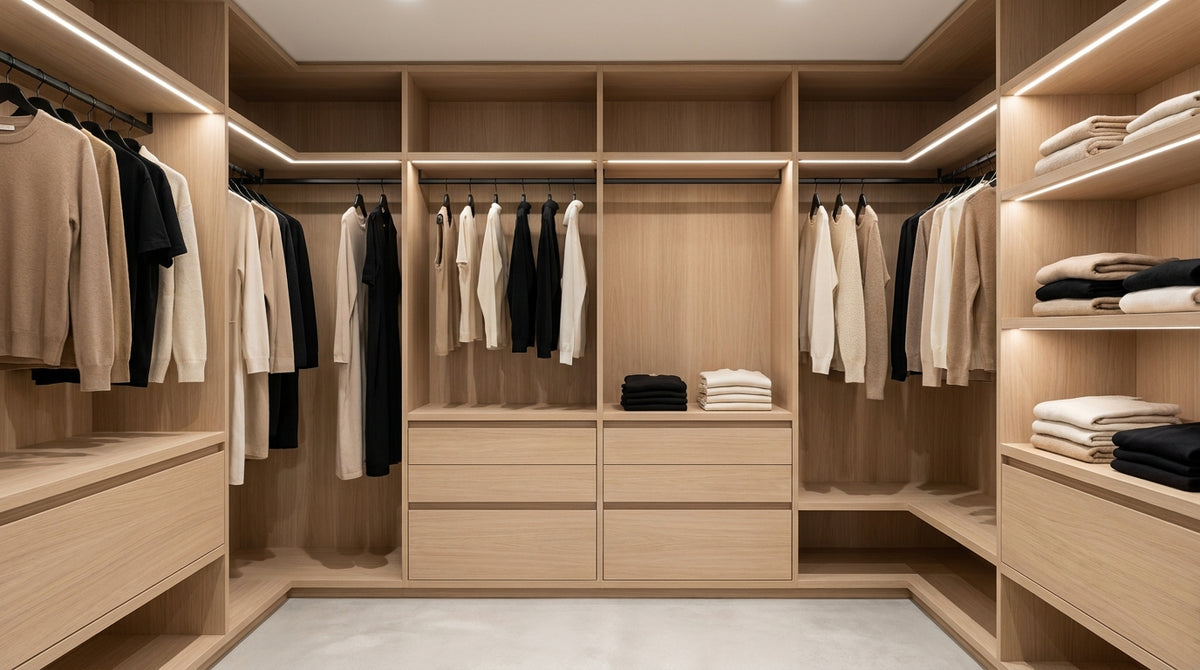
Light your walk-in closet in three layers: an LED strip or bar at the back of each shelf, a circulation light for the walkway, and a dedicated light for the mirror. Plan for at least three sources, at 3000 K and CRI above 90. No particular sealing is needed in a dry closet.
How do you light a walk-in closet properly?
Three layers are enough: a strip at the back of the shelves to read colours, a circulation light that frees the walkway, and a front-facing source near the mirror for the complexion. A single ceiling source leaves shadows in every corner and makes the room look narrower than it is.
Inside the furniture, the layer that does the most
A strip stuck to the front of the upright lights the clothes from the front. Placed at the back, it lights them from behind and the shadow of the rail covers everything hanging. For a room to redo, our bedroom and office lighting project starts from the height of the rails and the way the doors open, not from the style of the fixture.
Circulation and mirror: the other two layers
The walkway needs a broad, non-glaring light, the mirror a light that comes from the front. Four guidelines cover most walk-in closets:
- Ceiling: two adjustable spotlights rather than a central ceiling light, which leaves the body's shadow in the middle of the room.
- Mirror: a source on each side, or a linear wall light above, never a spotlight pointing down.
- Entrance: a switch within reach, completed by a sensor if the walk-in closet has no window.
- Floor: nothing at all, except a recessed marker light in a walk-in closet over 6 m².
This advice for lighting your walk-in closet depends less on the model chosen than on the position of each source. The lighting collection can be filtered by mounting type, which saves searching blindly.
What are the lighting ideas for a walk-in closet?
Three families cover almost every case: the LED strip built into the furniture, the standalone bar or wall light when no cable runs there, the 220V wall light when a supply exists. The choice depends less on style than on what you already have to hand when the work is done.
LED strip for a walk-in closet
The strip goes under each shelf and sends light down onto the stacks of clothes. Choose a model that can be cut at the marked points: without them, the remaining length ends up as a lost reel. The cut marks and the choice of connectors are detailed in cuttable LED strip.
Automatic walk-in closet lighting
A presence sensor, or a door contact, switches the walk-in closet on when opened and off after an adjustable delay. This is the setup that forgives forgetfulness, and the only one that works with your hands full. The wiring is prepared in advance, as explained in installing an LED strip.
220V walk-in closet lighting
A 220V supply allows a classic wall light or ceiling light, with a wall switch and a replaceable bulb. Two measurements matter more than the model: the height of the wall light relative to the mirror and its distance from the wall. The usual values are given in height of a wall light.
In an adjoining bedroom, our bedroom lighting ideas give combinations of sources that coexist without clashing.
What gives the best light?
The strip placed at the back of the shelf gives the best light, because it puts the source as close as possible to what needs to be seen. Next comes the wall light at mirror height. The ceiling light alone comes last: it lights the floor and leaves the clothes in the body's shadow.
| Source | What it lights | Its limitation |
|---|---|---|
| LED strip | The contents of the shelves, without cast shadow | Length fixed at installation, can be cut at the marks |
| Wall light | The face in front of the mirror | Requires a supply and a free wall |
| Adjustable spotlight | The walkway, a specific stack | Shows up textures, glares if badly aimed |
| Central ceiling light | The whole room, flatly | No light inside the furniture |
A walk-in closet is therefore judged by its task lighting, the light that illuminates a stack of jumpers, not by the number of points fitted to the ceiling.
Walk-in closet lighting with a motion sensor
The sensor suits windowless walk-in closets and narrow walkways: the light follows you in. Two settings make the difference in use, the delay and the sensitivity, because an over-sensitive sensor switches on as soon as you pass the open door. For models to place on the wall, the selection can be found in wall lamp.
Do you need a sealed fixture in a walk-in closet?
No. A dry walk-in closet is fine with IP20, the most common rating. Out of 250 references in our catalogue surveyed on 5 October 2026, 94% carry IP20: looking for sealed only narrows the choice.
The warranty follows the same pattern, with 2 years on 94% of the same survey. Buyer reviews can be found on the Designix Google listing.
If the number of sources is still unclear, the quickest way is to describe your walk-in closet to us: dimensions, orientation, whether an electrical supply is present. We send back the list of matching fixtures, without four rounds of back and forth.
How can I light my walk-in closet without electricity?
Three solutions work without touching the consumer unit: a rechargeable LED bar stuck under the shelf, a battery-powered wall light fixed to the wall, or a strip plugged into an existing socket in the adjoining room. None requires opening a wall.
What if I have no electricity on the ceiling?
Move the light down: onto the wall, into the furniture, onto the rail. A walk-in closet under 6 m² is very well lit with three low sources. The solutions that work without any ceiling point are detailed in lighting a room without a ceiling light.
If a ceiling point does become necessary, there is still the line run from a nearby socket, described in ceiling lamp without an electrical supply.
Wireless walk-in closet lighting
A rechargeable bar sticks under the shelf and comes off for charging. A battery-powered wall light fixes to the wall without drilling fresh plaster, as detailed in wall light without drilling. The choice then comes down to battery life and the length covered: wireless LED bars dress a shelf, a strip dresses a whole piece of furniture.
What is the constraint of your walk-in closet?
How much light for a walk-in closet?
Allow 3000 K and a CRI above 90, then spread the light rather than concentrating it: three weak sources are better than one strong point. In a walk-in closet of 4 to 8 m², the circulation stays discreet and the essential part goes into the furniture.
Which colour temperature for a walk-in closet?
3000 K gives a slightly warm white that stays accurate on colours, 4000 K leans neutral, cooler in a windowless room. It is not a matter of taste: under 2700 K, blue jeans and black jeans look the same.
How many lumens per square metre?
Allow 100 to 150 lumens per square metre for circulation, and the equivalent in directed light inside the furniture. The full method, transferable from one room to another, is explained in how many lumens for a bedroom.
| Temperature | Rendering in a walk-in closet | When to choose it |
|---|---|---|
| 2700 K | Warm white, yellowed tones | Walk-in closet open to an already warm bedroom |
| 3000 K | Warm white, faithful colours | The default choice |
| 4000 K | Neutral white, cooler rendering | Windowless walk-in closet, no daylight |
Fixtures and sources for lighting a walk-in closet
 LED ceiling light | Lumière Zenith
 Chandelier | Essence Lumineuse
 Pendant light | Mirdanissa
 Pendant light | Uther
 Pendant light | Velarena
 Living room floor lamp | Foglia
See the whole selection: Alternative Keria Lighting: your new address | Designix
In stock · shipping costs shown at checkout · up to 30% off in your cart


Ready to turn inspiration into reality?
Tell us about your room, your style and your budget, and we will show you the pieces that truly suit your project.
Get guidance in 30 seconds →