2024 lighting trends: what still holds up in 2026
This article is also available in French: Tendances D'Eclairage En 2024
2024 lighting trends: what still holds up in 2026
Take three measurements before you choose: the bottom of a pendant hangs 70 to 80 cm above a tabletop, a bedside wall light sits 1.20 m from the floor, and an accent point sits at eye level with the object it lights. Then set your white between 2700 K and 3000 K. These measurements separate what, among the 2024 trends, deserves to stay in your home.
What are the 3 types of lighting, and why does that settle almost every trend question?
Three layers are enough: ambient, task, accent. A room with only one of them is badly lit, even with the most beautiful model. This grid sorts a trend with a single question: which layer does it reinforce? It is the sorting we apply to help you choose a light fitting: the layer first, the shape second.
Ambient lighting, the layer you do not see
It lights the walls and the ceiling, never directly the eye. An indirect strip, a diffusing ceiling light or two low sources at 2700 K build it. Without it, an interior stays flat, whatever trend you follow. Our article on ambient lighting details the mounting positions.
Task lighting, the one you notice
It lights the place where you read, where you chop, where you work. A well-aimed 8 W adjustable GU10 spotlight beats a wide ceiling light. The rule fits in one sentence: the beam goes on the surface, not on the room. The power and aiming guidelines are in our guide on task lighting.
Accent lighting, the layer that changes everything
One source per object, a tight beam, and the eye stops where you decide. It is the layer most tied to fashions, and therefore the riskiest: you change it without touching the rest.
- Ambient: wide light, 2700 to 3000 K, never in the line of sight
- Task: directed beam, 4000 K on a worktop
- Accent: one source per object, narrow beam
Once the missing layer is identified, style becomes a simple choice: rattan, brass or smoked glass, all serve the same function. Our designer lighting collection can be browsed by use.
What is the trend colour for 2024, and does it still hold?
Warm white between 2700 K and 3000 K, and matte finishes. Temperatures above 4000 K have receded in living rooms. A light colour is not bought with the fitting: the bulb provides it, so it is the cheapest setting to correct.
Warm white, the setting that ages best
Allow 2700 K for a bedroom, 3000 K for a living room, 4000 K reserved for the kitchen and the desk. A dimmable fitting covers all three moods with a single control, provided the bulb accepts the dimmer. E27 cap for large rooms, E14 for small ones, GU10 for recessed spotlights.
Brass, smoked glass, raw ceramic: the finishes that last
These materials have been coming back for several seasons, which sets them apart from passing colours. Brass develops a patina, smoked glass softens the source, raw ceramic diffuses it without glare.
- Brass: develops a patina, accepts filament bulbs
- Smoked or ribbed glass: softens the light without extinguishing it
- Raw ceramic: matte, no reflection on a worktop
- Natural fibres: warm, keep away from water points
These finishes return year after year in our lighting trends, a sign that they have settled in.
Which light fittings are in fashion, and which already look dated?
Fibre pendants, large volumes and indirect light remain. Exposed neon, very slim ceiling lights and visible bulbs have dated. The right criterion is not the style, but what the fitting does to the light passing through it.
| 2024 trend | Status in 2026 | What decides |
|---|---|---|
| Fibre pendants | Holds | The filtering of the light |
| Organic shapes | Holds | Consistency with the furniture |
| Large volumes | Holds | Weight and fixing |
| Exposed neon | Dated | Direct glare |
Fibre pendants and organic shapes
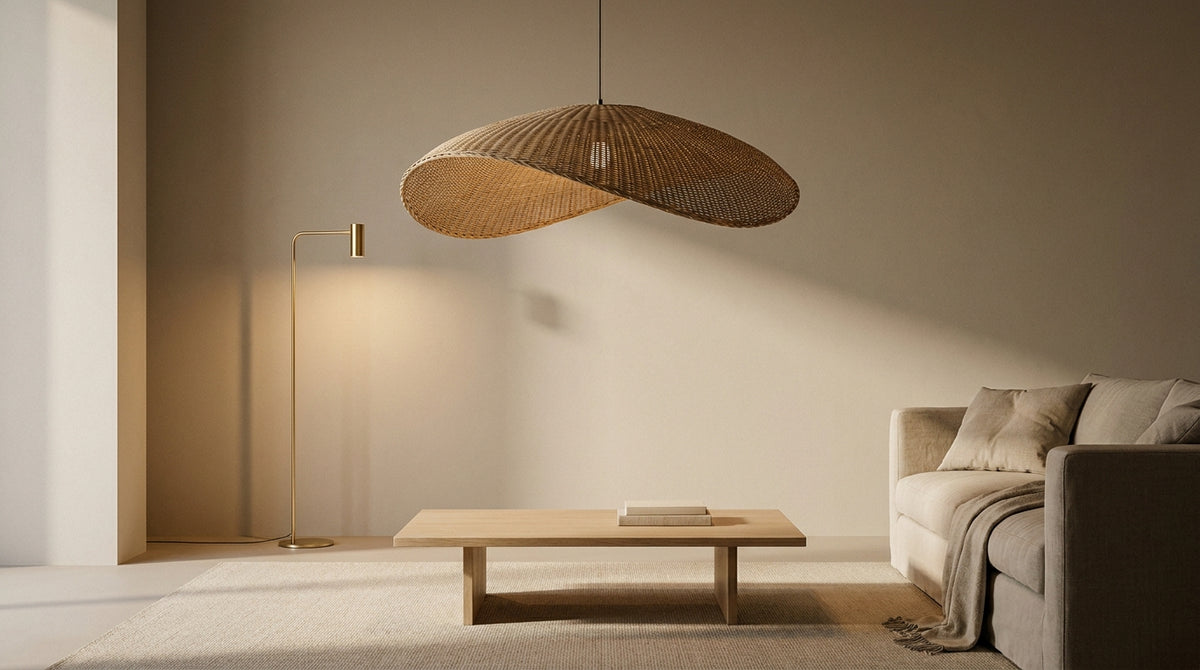
Rattan, wicker and cane filter the light instead of blocking it, which lights widely without glare. In a living room, a large-diameter chandelier replaces a central ceiling light without darkening the room.
Exposed neon, the trend that has aged worst
Too direct, too cold, and visible in your field of view as soon as you sit down. When it stays, it is reserved for a hallway or a deliberate decor. An indirect lighting profile gives the same line without the harshness of the beam.
Large volumes, indirect light and what remains for 2026
What holds in 2026 holds for a reason of use: lighting widely without glare. Large formats raise two practical questions, the suspended weight and the nature of the support. A pendant light of large section is fixed to a solid slab or a planned anchor point, never to a plasterboard rail alone.
Two guidelines before ordering: the total weight with the bulb, and the adjustable cable length, which must cover your ceiling height. The rest is in our watch on 2026 lighting trends.
How do you apply these trends room by room?
By height and temperature, not by style. Three points per room at minimum: a high source, a low source, a mobile source. A room lit by a single ceiling light stays flat, even with a designer model.
Living room and lounge
A diffusing pendant in the centre, two low sources in the corners. The sofa stays in relative shadow: that contrast is what makes the room readable. Our advice on creating a warm atmosphere details this balance.
Dining room: height before style
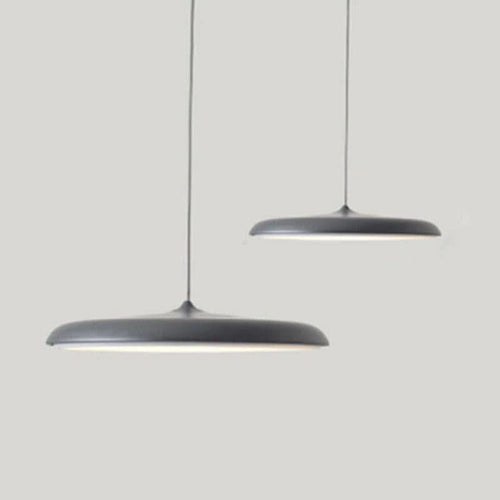
The bottom of the shade sits 70 to 80 cm above the tabletop, about 1.50 m from the floor with a standard table. Higher, the light no longer draws anything; lower, it gets in the eye. The diameter of the fitting follows that of the table, about half: a dining room light that is too narrow creates a well of light in the centre of the tabletop.
Before ordering, a check on your room (surface, ceiling height, cap) avoids the buying mistake: you can have your lighting project validated in a few minutes.
Bedroom and kitchen: two opposite settings
Bedroom at 2700 K, with no source in line with the bed: two low points are a better replacement for a ceiling light. Kitchen at 4000 K over the worktop, 3000 K above the table. A wall light at bedside height frees the nightstand and avoids raking light in the eyes.
Which room do you want to light first?
What to check before buying
Four readings, five minutes: ceiling height, length of the tabletop, accepted cap and location of the electrical outlets. Without them, the most fitting model becomes an object to resell. Dimmer compatibility tops the list of oversights.
The measurements to take
- Ceiling height: it determines the useful cable length
- Length of the tabletop: the diameter of the fitting follows half of it
- Electrical outlet: centred or offset, it changes the fixing
The compatibilities we forget
- Cap: E27 on large rooms, E14 on small ones, GU10 on directed spotlights
- Dimmer: the bulb must be dimmable, and the fitting compatible
- Ingress protection: IP44 minimum near a water point
- Weight: a large volume is fixed to a solid support
One last point before deciding: the Designix customer reviews show what these projects look like once installed, not only in a catalogue photo.
In stock · shipping costs shown at checkout · up to 30% off in your cart
Ready to turn inspiration into reality?
Tell us about your room, your style and your budget, and we will show you the pieces that truly suit your project.
Get guidance in 30 seconds →