Lighting 2026: 7 trends that genuinely transform a room
This article is also available in French: Les 7 tendances Éclairage qui vont marquer 2026
The 7 lighting trends that will define 2026
Count seven directions for 2026: layered light, large formats above the table, lightweight materials, replaceable bulbs, controlled colour temperature, cordless portable fixtures and a terrace treated like a room. Pick two, not seven. Then check on the product page what will actually fit in your home.
What are the 7 lighting trends that will define 2026?
Seven movements are emerging: lighting in layers rather than with a single central point, daring the large format above the table, preferring materials that do not weigh a room down, keeping a replaceable bulb, controlling colour temperature, adopting cordless fixtures and treating the terrace as a room. Our selection of designer lighting already covers them, from small formats to very large ones.
The seven trends, one by one
- Layered light: three sources at three heights, not a single ceiling light.
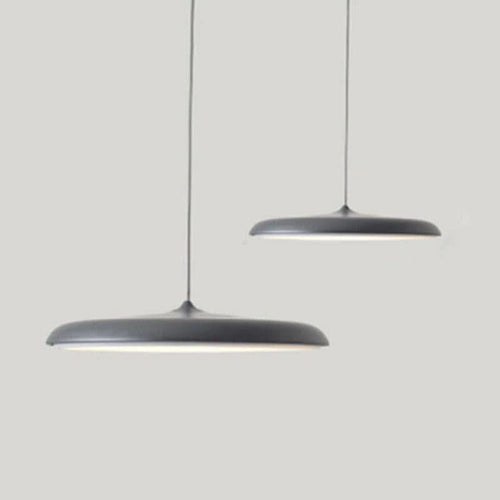
- Large format: a statement piece above the table that structures the room.
- Lightweight materials: glass, linen, fine metal, rattan, all letting light through.
- Replaceable socket: E27 or E14, the bulb can be changed without changing the fixture.
- Controlled temperature: 2700 K in the evening, 3000 K for reading or cooking.
- Cordless: rechargeable floor lamps and wall lights that follow you around the room.
- Lit terrace: IP44 or IP65, with the comfort of a living room outside.
Not all of them last. A trend that endures changes a daily gesture: reading without squinting, switching off without getting up, dining under a light that flatters faces. The 2024 lighting trends that survived are exactly those.
The sorting happens on a simple criterion: what can be adjusted stays, what merely shines passes. Mounting height, variable intensity, direction: three adjustments that will outlast the season. Other families are detailed in our article on 2026 lighting trends.
How to check a trend on a product page?
Four details are enough: mounting, socket, protection rating and dimmability. A product page that is silent on three of these points is not ready to be bought.
Our wall light collection counts 6,535 references as of 5 October 2026. Nobody reads 6,535 pages: you open three, compare, and decide.
If you would rather start from your room than from a trend, you can describe your room to the team: they will tell you what can be installed without breaking everything.
Why is layered light replacing the single central point?
Because a single point on the ceiling produces a single level of shadow: everything is lit the same, so nothing stands out. Three sources at three heights light up faces, materials and corners. In the evening you do not switch everything on: you choose the layer you need.
How many sources should you plan, and at what heights?
- Ceiling: 2.20 m to 2.30 m from the floor, so you can move around without thinking about it.
- Wall: at 1.10 m for reading, at 1.80 m for broad lighting.
- Floor: a large portable format, easy to move near the sofa.
- Accent: a point aimed at a picture, a plant, a textured wall.
The ceiling layer does not need to be strong, just discreet and well distributed. A slim LED ceiling light in the centre is enough to hold the background of the room while the rest does the work.
Then comes the accent, the one that adds relief: a grazing light on a wall changes a room more than an extra chandelier. The principles are gathered in this guide on accent lighting.
On a sample of 247 of our wall lights as of 5 October 2026, wall mounting applies to 96% of the pages (declared on 243 of 247) and metal to 84% (declared on 241 of 247).
Does a wall light replace a bedside lamp?
Yes, and it frees up the bedside table. Placed at 1.10 m from the floor, it lights a book without waking the other person. In this segment, wall lights are chosen first by mounting height, then by finish.
Should you dare the large format above a table?
Yes, as soon as the table is longer than 1.20 m: a piece 60 to 90 cm in diameter structures the room better than three small ones. Allow 75 to 85 cm between the bottom of the fixture and the tabletop. Lower and you bump into it; higher and the light falls off to the side.
At what height should you hang a large fixture above the table?
| Situation | Recommended diameter | Height above the tabletop |
|---|---|---|
| Round table, 120 cm | 60 to 70 cm | 75 to 85 cm |
| Rectangular table, 180 cm | 80 to 90 cm, or two pieces aligned | 75 to 85 cm |
| Kitchen island | 40 to 60 cm, two of them | 75 to 85 cm |
The format is chosen once the table is in place, not before. A living room chandelier that is too small leaves a gap above the tabletop, whatever its quality.
Does a cordless fixture really last a whole evening?
A battery-powered fixture lights an entire evening and recharges by USB. It is the simplest solution when no socket is in the right place. A rechargeable floor lamp replaces a fixed installation without drilling into a wall.
Portable silhouettes have changed status: they are no longer stopgaps but pieces in their own right. Read up on 2026 floor lamp trends before settling on a family.
Once the format is decided, everything comes down to the finish: that is where our lighting collection is quickest to compare.
Which room do you want to change first this year?
Bulb or integrated LED: what to choose in 2026?
The socket keeps the advantage: the bulb can be replaced, repaired and adjusted without touching the fixture. Integrated LED wins on slimness and allows very fine designs, but is thrown away with the piece. On 216 product pages recorded on 5 October 2026 in our catalogue, 37% declare an E27 socket and 16% an integrated LED.
E27 socket or integrated LED: which one can be repaired?
| Criterion | Bulb with socket | Integrated LED |
|---|---|---|
| Failure | bulb replaced on its own | fixture to be replaced |
| Slimness | a little deeper | finer design |
| Dimming | depends on the bulb | depends on the driver |
| Choice of tone | free, at any time | fixed at purchase |
The socket requires checking one thing before buying: compatibility with your dimmer. The details of the differences are in this guide to dimmable bulbs.
Glass, linen or metal: which material lightens the room?
- Glass: lets light through, never hides the bulb.
- Linen and fabric: diffuses softly, ideal in a bedroom.
- Fine metal: gives structure without weight, in black or gold.
- Rattan and wicker: casts shadows, warms up a white wall.
A light colour does not make a light room: thickness decides. The topic is close to that of eco-friendly lighting, where material matters as much as consumption.
The selection is commented on by buyers, and our public review page can be checked in one click if a finish makes you hesitate.
How to choose colour temperature, room by room?
One rule holds: 2700 K where you relax, 3000 K where you work, 4000 K only in a technical room. The higher the number, the whiter the light and the harsher it makes skin tones. A single temperature per room, kept from floor to ceiling, is enough.
2700 K, 3000 K, 4000 K: what to choose depending on the room?
| Room | Temperature | Why |
|---|---|---|
| Living room | 2700 K | relaxes and flatters wood |
| Dining room | 2700 K | faces stay natural |
| Kitchen | 3000 K | you can read a recipe and chop cleanly |
| Bedroom | 2700 K | low light before sleeping |
| Study | 3000 to 4000 K | concentration during the day |
Keeping the same tone in a room takes consistency, not technology. Smart lighting is mainly useful for correcting an initial mistake, or for switching from a working white to an evening white without changing bulbs.
Can you light a terrace like a living room?
Yes, on one condition: treat outside like inside, with several sources and a suitable protection rating. IP44 is enough under a canopy, IP65 for a truly exposed area. Stay at 2700 K: white light outside mainly lights up the neighbours. Our guidance on outdoor lighting follows the same rules as indoors.
The fixtures that carry these seven trends
 Wall light | Kena
 Wall light | Lumière Agile
 Wall light | Valara
 Wall light | Zovira
 Wall light | Vivora
 Wall light | Dorven
See the full selection: Wall light, Wall Lamp and Designer Wall Lighting
In stock · shipping costs shown at checkout · up to 30% off in your cart
Ready to turn inspiration into reality?
Tell us about your room, your style and your budget, and we will show you the pieces that truly suit your project.
Get guidance in 30 seconds →