Do you really need to cut the power to change a light bulb?
This article is also available in French: Faut il couper le courant pour changer une ampoule
Do you really need to cut the power to change a light bulb?
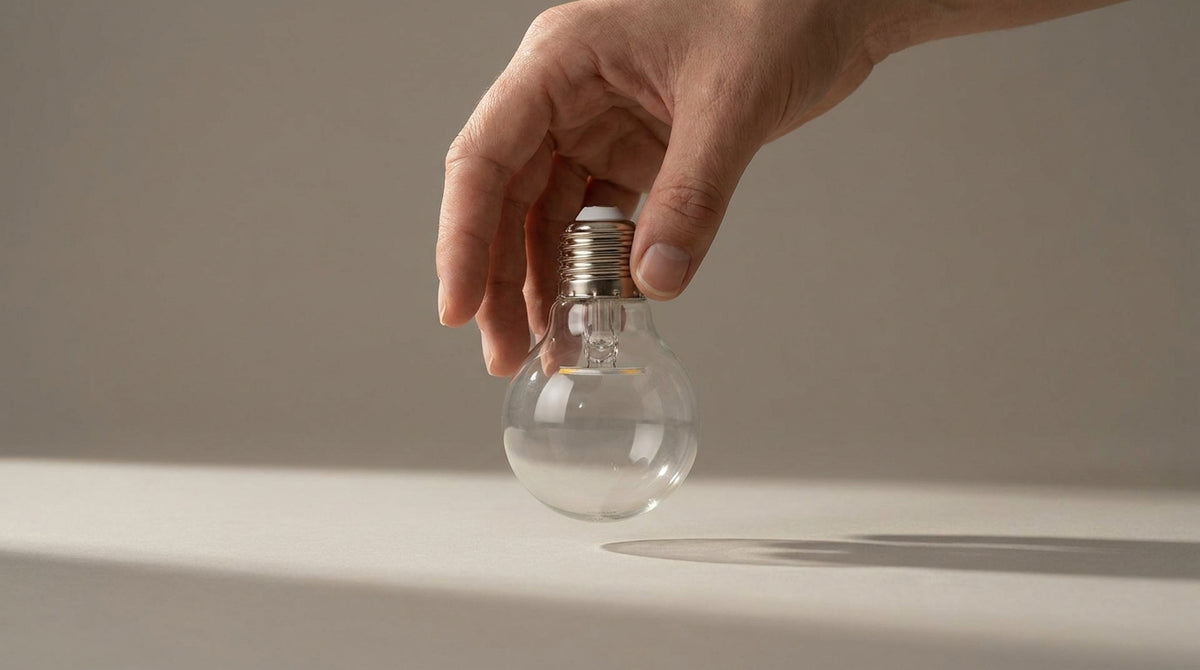
Yes, as soon as the socket is metal, the fixture is fixed to the ceiling or wall, or you are unscrewing a pin-base bulb. On a table lamp with the plug removed, the job stays safe. At the consumer unit, cutting the power takes ten seconds.
Not sure which circuit to cut? Our Designix help page covers the cases where the breaker is not labelled as expected. The team also answers when a socket will not budge.
Why the switch is not enough on a fixed fixture
A wall switch opens a single wire, with no guarantee which one. If the neutral is cut and the live wire is still present, the socket stays live, ready to send current through your hand.
- Live wire the dangerous wire to touch, still in place after switching off in an old installation
- Neutral cut on its own, the socket stays fed by the live wire
- Double cut the circuit breaker takes both live and neutral out of service
- Dry hands essential, and well away from any damp surface
- Check try to switch the lamp on after cutting the power, the doubt clears in a second
Screw base, pin base, integrated LED: three levels of risk
Three families of base, three moves, and one identical rule: cut the power at the consumer unit as soon as the fixture is fixed.
| Bulb type | Removal move | Cut at the breaker |
|---|---|---|
| E27 or E14 on a table lamp | unscrew by hand | no, if the plug is removed |
| E27 or E14 on a ceiling light | unscrew by hand | yes |
| GU10 or G9 pin base | press and pull straight | yes |
| Integrated LED | open the fixture | yes |
On a survey of 33 references in the Ampoules Design collection on 5 October 2026, the bases break down as E27 42%, G9 27%, G4 24% and E14 15%. The collection contains 282 references.
How do you change an LED bulb in a ceiling light?
Trip the breaker, climb onto a stable stepladder, then unscrew a quarter turn without gripping the glass with your whole hand. Let the bulb cool if the fixture has just been on: the base heats up even with LED.
Changing a ceiling bulb in a fixed fixture
The job comes down to four steps, and the last one saves a trip back to the shop.
- Cut the circuit breaker, not just the switch
- Stepladder stable feet, never a chair, both hands free
- Removal soft cloth, a quarter turn opposite to the fitting direction
- Reference same base, same wattage, a photo of the old bulb if needed
Nothing replaces a note taken before dismantling. Our article on the ceiling bulb details how to open ceiling light covers.
How to remove the bulb from a floor lamp or a standing lamp
Pull the plug out of the socket: the lamp is off the mains, and the job loses all risk. Bayonet bulbs come out by pressing lightly, then turning a quarter turn.
On a floor lamp, the base stays accessible and the bulb can be replaced without tools.
A ceiling light with an integrated module leaves nothing to unscrew. In that case, the specifications are read on the LED ceiling light itself, before any dismantling.
Can LED bulbs be replaced?
Yes when the base is exposed: an LED in E27, E14, G9 or GU10 is replaced like any other bulb. No when the LED is soldered into the fixture: you then have to change the module, or the whole fixture if the part no longer exists.
Which bulb are you going to unscrew?
How to change an integrated LED bulb
An integrated module is held by screws or clips, behind a diffuser. Cut the circuit, open the diffuser, then locate the connector before pulling.
Fixings vary from one model to another. Our guide on the integrated LED bulb covers the most common assemblies.
How to change a spotlight bulb without a trim ring
A spotlight without a trim ring is held by two side springs and comes out by pulling the module down. The usual base is GU10, at 230 V.
Our article on the spotlight without clips shows how to get a grip on it.
For replacement, GU10 LED bulbs clip in without tools. The base size is read from the diameter in millimetres, while the E27 or E14 reference designates the thread.
If you already know which base you are unscrewing, the Ampoules Design collection gathers the matching references. You can also get in touch with the team if the socket leaves you unsure.
LED bulbs E27, E14, G9, G4 and GU10


What are the drawbacks of LED lamps?
Dimming comes first: not all LEDs are dimmable, and an ordinary LED fitted to a dimmer flickers or buzzes. Then come the very directional beam and the cold light by default, which hardens an interior.
How long does a bulb last?
An LED lasts several thousand hours, far more than a halogen. On the survey of 33 references in the Ampoules Design collection on 5 October 2026, 100% of the listings state LED technology, and the warranty is 2 years on 73% of them, 5 years on 27%.
The life announced by a manufacturer is read at room temperature, in a ventilated fixture. Recessed in a closed box, an LED heats up and its life melts away.
Why a new bulb sometimes flickers
Three causes keep coming back: an incompatible dimmer, too low a wattage for the transformer, or a detector letting residual current through. The product listing settles it, with a dimmable yes or no mention.
Our LED bulb comparison covers these mentions criterion by criterion, before you buy.
The moves that prevent breakage
Hold the glass with a soft cloth and turn without forcing. A stubborn base gives way after a slight upward pressure, never after a stronger twist.
How to change a pencil halogen bulb without breaking it
A pencil halogen comes out straight, with two fingers, on the base and not on the glass. A sideways movement shatters the quartz, and gloves keep fingerprints off the reflector.
Our page on the pencil halogen bulb covers how to grip it, G9 pins included.
How to change a halogen bulb in a bathroom
The breaker takes on a different weight in a damp room. On the survey of 33 references in the Ampoules Design collection on 5 October 2026, 100% carry an IP20 rating: none of the surveyed references is intended for a damp room, nor for outdoors.
In a bathroom, look for a higher rating, as on IP44 bulbs, and always cut the power at the consumer unit: water is not satisfied with a switch turned off.
A kitchen pendant often hides its socket behind frosted glass, which makes it harder to identify the base.
On wall lights, access is more direct and replacement takes a few minutes. When a new fixture refuses to light up despite a correct bulb, the Designix Google listing gives verifiable reviews, and the team answers live.
In stock · shipping costs shown at checkout · up to 30% off in your cart
Ready to turn inspiration into reality?
Tell us about your room, your style and your budget, and we will show you the pieces that truly suit your project.
Get guidance in 30 seconds →