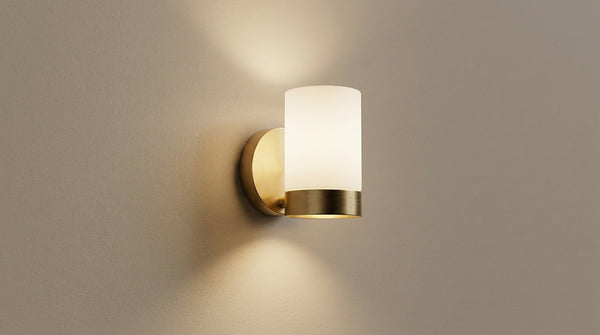
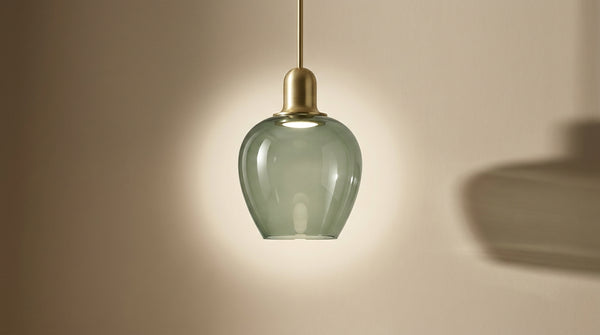
Wall lights: the subtle lighting that transforms a wall
This article is also available in French: Appliques murales : l'éclairage subtil qui transforme vos murs
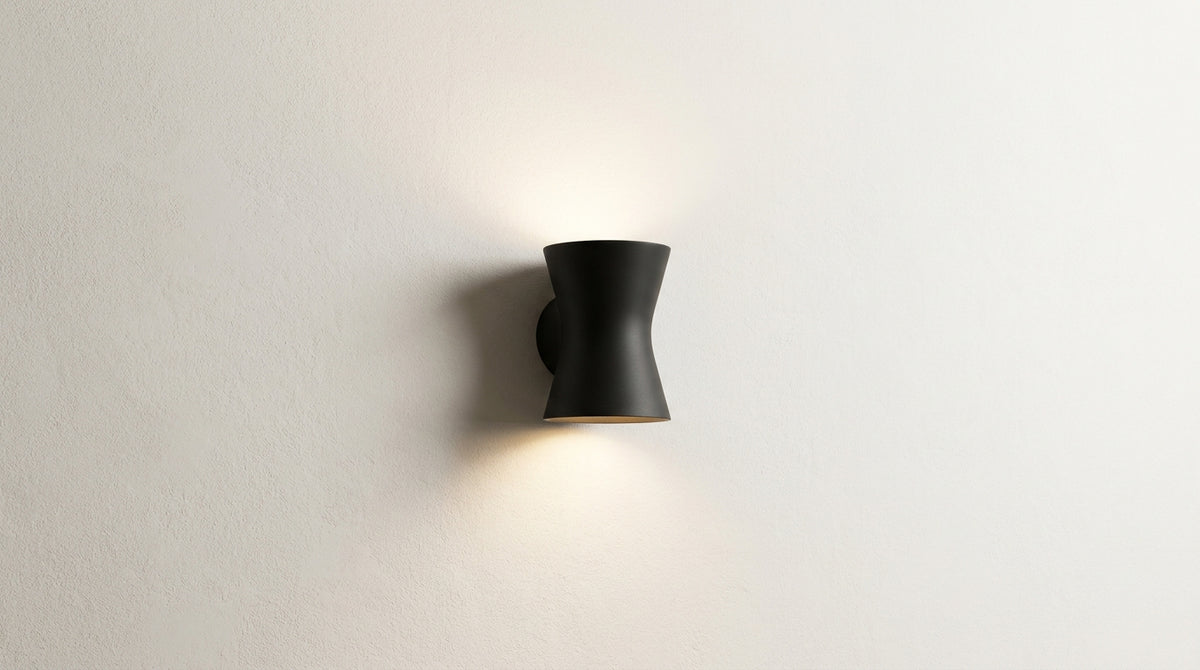
Choose the socket before the style: in a survey of 236 wall lights in our catalogue on 4 October 2026, 47% have integrated LED, 25% G9, 16% E27 and 9% GU10. Then set the height: 1.20 m from the floor for a bedside wall light, 1.70 m in a hallway.
Which wall light to light a room well?
The right wall light depends on what the light needs to touch, not on the style of the room. For simple fill light, an integrated LED is enough. For reading, you need a socket that takes a directional bulb. To light a worktop, a GU10 aimed downwards does better than a globe.
Three measurable criteria decide: the source, the output and the direction. A wall light is judged on these three points before its shape.
Integrated LED, G9, E27 or GU10 socket: what our survey shows
Of the 236 references surveyed on 4 October 2026, integrated LED is declared on 47% of the survey, G9 on 25%, E27 on 16%, GU10 on 9%. These four families do not give the same light and do not age the same way.
| Source | Share of the survey | What it changes on the wall |
|---|---|---|
| Integrated LED | 47% | Even light, no bulb to replace |
| G9 | 25% | Small format, replaceable source, crisp brightness |
| E27 | 16% | Free choice of bulb, visible filament possible |
| GU10 | 9% | Directed beam, for a worktop or a piece of art |
- Integrated LED: for washing a wall without thinking about it
- G9: when the diffuser is small and needs to stay crisp
- E27: when you want to choose the colour of the light
- GU10: when the beam needs to hit a precise point
A wall lamp with integrated LED is replaced, not repaired. A G9 or an E27 ages with its bulb, not with its fitting.
Narrow entrance: two outputs, a single wall light
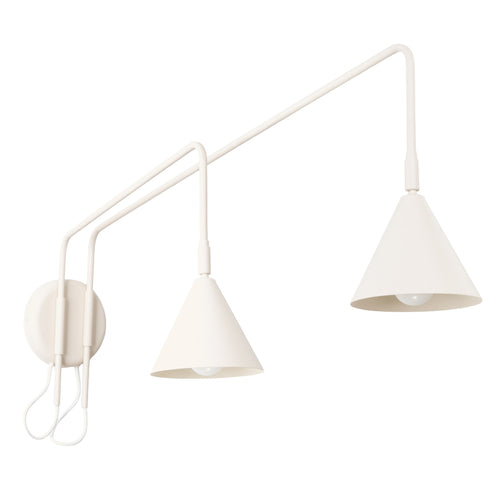
In an entrance less than 1.20 m wide, two wall lights facing each other cast shadows on one another and multiply the drill holes. A double wall light, with two diffusers on the same backplate, lights both sides of the hallway from a single power point. It is the clearest solution for entrance wall lights in a narrow passage.
What is the standard height for installing a wall light?
Allow 1.20 m from the floor to the centre of the diffuser for a bedside wall light, and 1.70 m in a hallway or stairwell. The measurement is taken from the finished floor to the centre of the fitting, never to its top edge.
It is mainly worked out from the ideal height for a wall light in relation to what it needs to light: a page, a step, a face.
Above a bedside table: the measurement that makes reading work
Place the centre 1.20 m from the floor, around 60 cm above the mattress. Higher, the light passes behind the shoulder and the page stays dark. Lower, it hits the pillow and dazzles.
A bedroom wall light with a built-in switch saves you getting up to turn it off. For two sleepers, two separately controlled sources are better than one central fitting.
When the headboard is tall, use the height of a bed wall light measured from the top of the mattress: the 60 cm reference still holds.
Hallway and stairs: guiding without dazzling
In a hallway, 1.70 m from the floor to the centre. On a staircase, the same line followed step after step, beam pointing down. A diffuser that lets the source be seen dazzles as you go up, frosted glass does not.
- 1.70 m from the floor to the centre, hallway and landing
- Beam pointing down on a staircase, never towards the upper step
- Motion sensor for a service passage
- Staggered along a long wall, never two wall lights facing each other
A single wall light or a symmetrical pair?
A pair is justified when the wall has an axis: headboard, fireplace, window. Elsewhere, a single wall light creates a stronger point of light and means fewer drill holes.
What does a wall light cost, and what makes the price move?
Three factors make the difference: the material of the body, the socket and the protection rating. Two wall lights that look alike in a photo can carry very different prices depending on whether the source is integrated or replaceable, and whether the fitting withstands water splashes.
Material, socket, protection rating: the three factors
In the survey of 4 October 2026, aluminium is declared on 34% of the 236 listings, steel on 26%, metal on 25%, glass on 23% (a listing can carry several). The protection rating settles the room: IP20 on 99% of the survey, IP44 on 1%.
- Aluminium: slim, light body, suited to large formats
- Glass: diffuses the light and hides the source
- IP44: the mention to insist on in an area exposed to splashes
The seal and the treatment of the body explain a good part of the difference. An IP44 wall light is the line not to negotiate in a bathroom.
The warranty, the point people forget to compare
The 5-year warranty is declared on 98% of the 236 listings surveyed, 2 years on 2%. On a fitting screwed to the wall, whose replacement means filling holes again, that is not an administrative detail.
If your wall is plaster or the electrical supply is not in the right place, describe your wall to the team: they will tell you what is feasible before you drill anything.
Wall lights: the selection to place on your wall


How do you fix a wall light without damaging the wall?
There are three routes: a rechargeable wall light placed without drilling, a clean drill hole guided by a template, or a wall plug chosen for the substrate. The right choice depends on the weight of the fitting and the nature of the wall, not on where the hole goes.
Without drilling: what really holds
A rechargeable wall light is fixed to an adhesive plate or hung on a hook, with no chasing or drill. It holds on a smooth, painted or tiled wall, provided you degrease the surface before sticking. On an uneven substrate or thick wallpaper, the adhesive gives way.
Mark, degrease, wait before loading the plate: the method for installing a wall light without drilling comes down to that order.
Plaster, brick, concrete: the right move
| Substrate | What holds | The trap |
|---|---|---|
| Plaster | Toggle or winged wall plug | A simple plastic plug can go right through |
| Hollow brick | Wide expansion plug | Drilling without a depth stop breaks the wall |
| Concrete | Hammer-in plug | A drill bit that overheats polishes the hole |
- Template: mark the centres on masking tape, then drill through
- Drill bit: the diameter of the plug, not of the hole
- Power: switch off at the breaker before any drilling
What are the wall light trends in 2026?
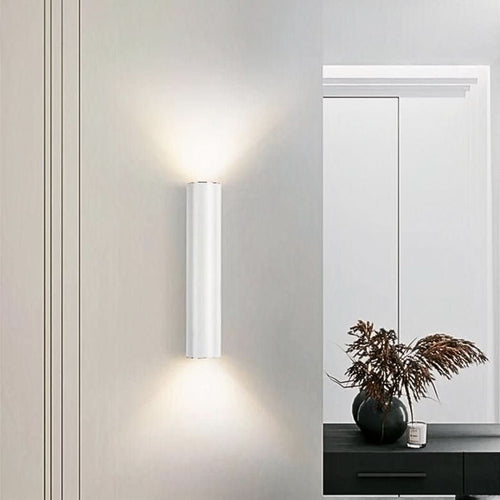
The tube dominates the shapes surveyed, ahead of round and square. Colours stay understated: black and white as a base, gold as an accent. This trend is not only decorative, it answers a reading constraint: a wall light should be forgotten by day and seen when switched on.
Shapes: the tube ahead of round and square
Of the 197 listings in the survey that declare a shape, the tube accounts for 26%, square and round 19% each, original 11%. The tube wins because it reads as a line on the wall, not as an object placed on it.
This restraint leaves room for more elaborate wall lights, when the wall is bare and already carries a strong colour.
The rest of the year's movements can be read in our article on wall light trends in 2026.
Black and white as a base, gold as an accent
Black 46%, white 44%, gold 25%, brown 13% across the 236 listings surveyed, a listing being able to combine several colours. Black blends into a dark wall, white disappears on a light wall, gold only works as an accent.
- Black: light wall or graphic wallpaper
- White: coloured wall, for discretion
- Gold: in pairs, as an accent, never as a base
The accent wall: three wall lights are better than one
An accent wall is built by repetition. Three wall lights aligned at the same height, evenly spaced, light better than a central fitting and give a rhythm. Accent lighting works when the light grazes the wall, not when it hits it head on.
In a living room, place the three points before choosing the furniture: a lighting plan for the living room is drawn on the floor, while the sockets remain accessible.
Which wall should the wall light illuminate in your home?
In stock · shipping costs shown at checkout · up to 30% off in your cart
Ready to turn inspiration into reality?
Tell us about your room, your style and your budget, and we will show you the pieces that truly suit your project.
Get guidance in 30 seconds →