Replacing a cooker hood bulb with an LED: the guide
This article is also available in French: Remplacer ampoule hotte par led
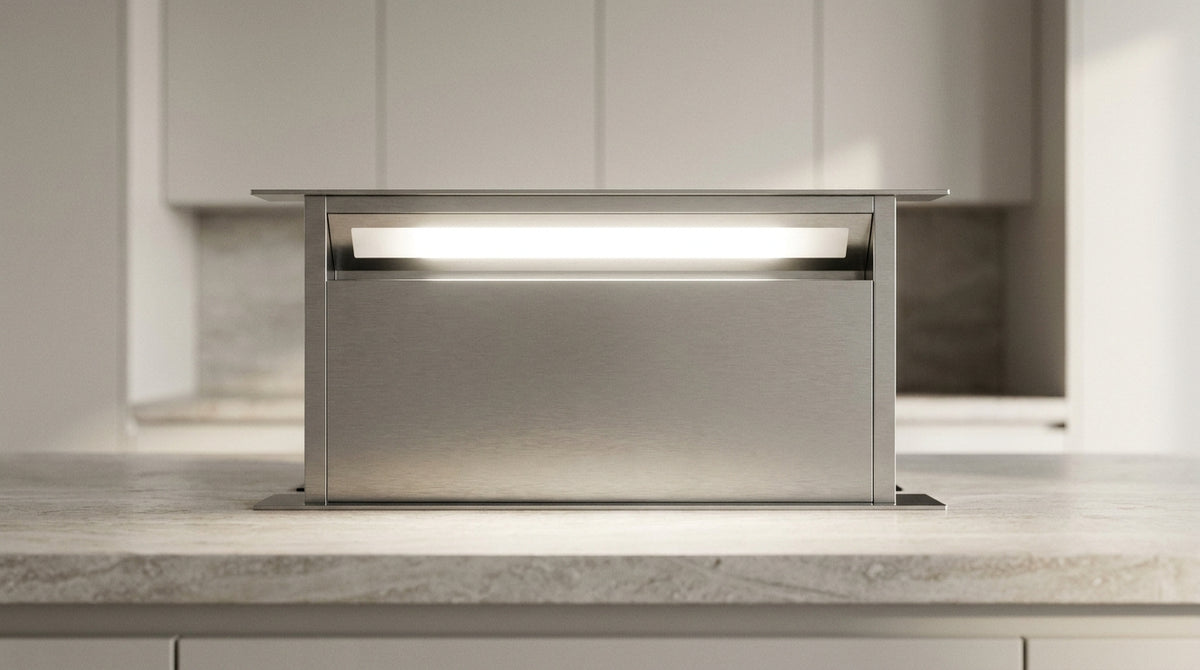
Switch off the power at the circuit breaker, remove the grease filter, identify the bulb base (E14, G4 or G9 on most hoods), then fit an LED with the same base. A few minutes, no tools. An equivalent or slightly lower wattage is enough to restore the same light on the worktop.
Is it possible to replace a cooker hood bulb with an LED?
Yes, almost always. The lighting unit of a hood is a standard fitting: as soon as the LED shares the base of the original bulb, it fits in the same place, under the same cover. The only exception concerns hoods with a low-voltage transformer, which should be checked before ordering.
It is also the least expensive way to rethink the kitchen light. The hood is the only light that shines directly on the prep area: its tint shows on the chopping board, not on the ceiling.
The job, in four steps
- Switch off the power at the circuit breaker, not just at the hood switch
- Remove the metal grease filter to reach the lighting unit
- Unclip the glass cover or unscrew the ring of the fitting, depending on the model
- Fit the LED in the same base, then check there is no flicker
What the hood light changes day to day
An LED that is too cool whitens tomatoes and hardens wood; an LED that is too yellow flattens contrasts and dulls the room. Between the two, a few hundred kelvins decide how the kitchen looks. The ceiling light illuminates the room, the hood illuminates the work.
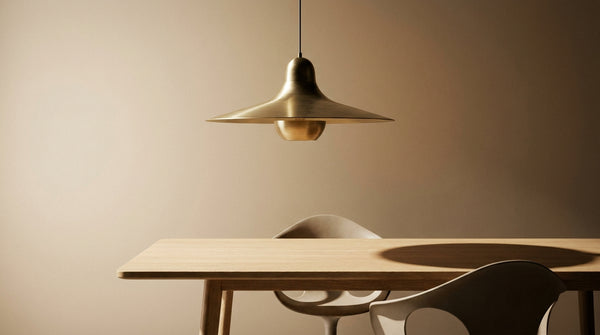
It is also the anchor point for a kitchen pendant hung over the island: both sources must tell the same story.
A hood lights only one surface, and the whole is completed by a kitchen light chosen in the same colour temperature. For the details, kitchen decoration does the rest without touching the lighting.
Which bases do kitchen hoods use?
Four bases cover almost the entire installed base: E14, G4, G9 and GU10. Only one is screw-fit, the others are pin-fit. Identify yours before ordering: a bulb with the wrong base will not fit, and improvised adapters rarely hold up above a hot hob.
G4, G9, E14: how to identify your hood's base?
Look at the removed bulb. Two very fine pins close together means G4. Two wide, spaced pins means G9. A small screw thread means E14. Two bayonet pins means GU10. To confirm without hesitation, compare it with our guide to identifying a G4, G9, E14 or GU10 base.
| Base | Appearance | Voltage | Hoods concerned |
|---|---|---|---|
| G4 | 2 very fine pins | 12 V | recessed units |
| G9 | 2 wide pins | 230 V | canopy and chimney |
| E14 | small screw thread | 230 V | screwed glass cover |
| GU10 | 2 bayonet pins | 230 V | recent adjustable spots |
If your hood has no legible reference, send us a photo of the socket: we will tell you the base and the matching model. You can also ask the team directly.
LED bulbs for hoods and kitchens: the selection


What our catalogue shows
Across a sample of 33 LED bulbs from our catalogue as of 29 September 2026, the bases break down as E27 42%, G9 27%, G4 24% and E14 15%. G4 and G9 bulbs therefore account for half the sample, which matches hood units well.
Also in this sample, the warranty breaks down as 2 years for 73% of references and 5 years for 27%. The LED bulbs collection has 266 references on the same date. A comparison table of LED bulbs helps decide between two similar technologies.
For a narrow screw-fit unit, the small E14 LED bulb fits under the tightest covers.
Which colour temperature for cooker hood lighting?
Aim for 3,000 K to 4,000 K. Warm white creates a cosy kitchen but yellows food and pale worktops. Neutral white, around 4,000 K, renders colours accurately under the hood. Below 2,700 K, you are lighting a living room, not a prep area.
Warm white or neutral white: the food test
Place a tomato and a lemon on the worktop, switch on the hood alone. If the red turns orange, the temperature is too low; if the white of the worktop turns blue, it is too high. This setting is made once and lasts for years. Our advice on lighting a kitchen well completes the method at room scale.
How to check transformer compatibility?
An LED does not draw the same current as a halogen, and some older transformers require a minimum load to start. Three symptoms reveal incompatibility: slow flickering on switch-on, a two-stage start, a light that dims after a few minutes. The procedure to replace a halogen bulb with an LED applies to the hood unit as is.
What are the drawbacks of LED lamps?
Three real limits, all of them manageable. The purchase price remains higher than that of a halogen. An old dimmer does not always accept an LED. And some low-voltage bulbs flicker at low wattage. None of these rules out switching to LED.
- Low voltage: a 12 V transformer designed for halogen may need to be replaced
- Dimmer: a non-dimmable LED flickers as soon as the brightness is lowered
- Colour rendering: an entry-level LED flattens reds, a well-made LED does not
- Flicker: perceived in peripheral vision, it causes fatigue over time
The dimmer is the most often overlooked point: a dimmable LED bulb is recognised by an explicit mention, never by its base. On an adjustable spot unit, GU10 bulbs should be chosen in a dimmable version when the control allows it.
Which base does your hood have?
What should the installer check before approving the swap?
Four points, in this order: the voltage delivered by the unit, the exact base, the maximum wattage allowed by the fitting, and the absence of flicker on switch-on. A swap approved on these four criteria lasts for years; a swap botched on just one ends with a bulb that blows or flickers.
- Voltage: a 12 V G4 unit accepts no 230 V bulb
- Maximum wattage: the value is often printed on the fitting, in watts
- Ingress protection: IP20 is declared on all 33 data sheets in the sample, sufficient under a hood
- Mechanical hold: a badly reclipped cover vibrates and yellows on contact with grease
In the same sample, CE certification is declared throughout. These mentions do not guarantee the quality of the light output, but they rule out dubious references. The details can be read in our LED bulbs collection.
Installers fitting out several homes can use the trade area. For anyone who wants to read customer reviews before ordering, the business's Google listing remains one click away.
In stock · shipping costs shown at checkout · up to 30% off in your cart


Ready to turn inspiration into reality?
Tell us about your room, your style and your budget, and we will show you the pieces that truly suit your project.
Get guidance in 30 seconds →