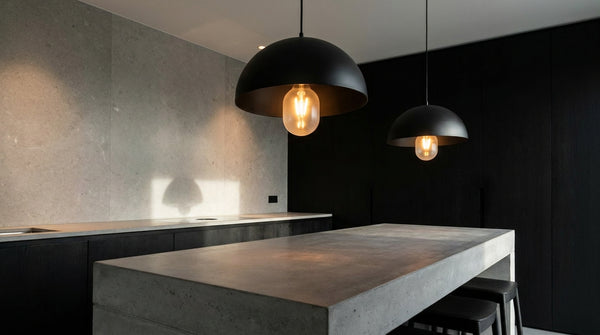
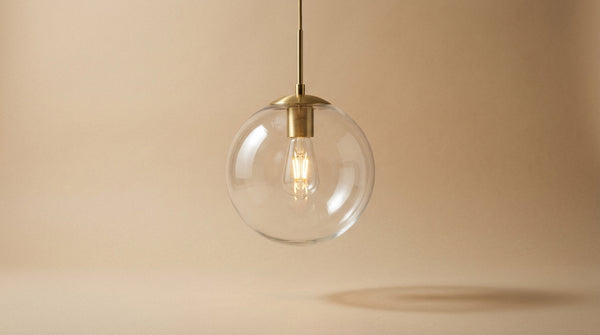
White kitchen pendant light: the right light above the island
This article is also available in French: Suspension blanche cuisine

Allow 75 to 85 cm between the bottom of the shade and the worktop, 65 to 75 cm above a table. Three pendants of 15 to 21 cm aligned over an island, a single one of 30 to 40 cm above a table. Matte white diffuses; glossy white reflects light back towards the eye.
Which light fitting for a white kitchen?
A white pendant in matte metal: 30 to 40 cm in diameter above a table, or three models of 15 to 21 cm aligned over an island. Matte white diffuses light, satin finish reflects it back towards the eye. Check the socket and the protection rating before deciding.
In a white kitchen, the light fitting works for the room: it reflects daylight onto the worktop and makes materials readable. A kitchen and dining room lighting plan is therefore drawn up before choosing the model, not after.
Modern white pendant: matte metal or aluminium rather than glossy
Matte metal absorbs part of the light and softly redistributes it. Brushed aluminium produces the same effect with a finer grain.
- Matte metal: no harsh reflection on the worktop
- Brushed aluminium: same diffusion, easier to wipe clean
- Glossy white: hot spot reflected towards the eye, avoid facing a seat
- White interior: decisive, even when the outside is coloured
The shape follows the use: above the sink, a kitchen pendant by zone is not positioned the same way as above a dining table.
If the room opens onto the living room, the light fitting has to suit both spaces, which points towards round shapes and tubes.
White paper pendant: softness, and its limit near grease
Paper diffuses an enveloping light and softens an all-white kitchen. Its limit is physical: greasy steam settles and does not wipe away.
- Above a table: paper stays away from splashes
- Away from the hob: no greasy steam or direct condensation
- Removable shade: essential for dusting
To get the light level right, think in how many lumens for a kitchen rather than in watts.
When the kitchen connects to the dining room, the kitchen chandelier takes over above the table: a larger piece, a single point.
Which light fitting above a kitchen island?
Two or three pendants aligned along the axis of the island, 75 to 85 cm from the surface. Spacing is calculated on the width of the island divided by the number of points, never on the diameter of the shades. A 2 m island takes three points, a 1.20 m island takes two.
White and wood kitchen pendant: the duo that lasts through the years
White and light wood work because they share the same perceived temperature. Dark wood tightens the contrast and makes the white stand out.
- Matte white and light oak: Scandinavian look, without a dated effect
- White and walnut: sharp contrast, a more graphic kitchen
- Textile cable: the detail that links the pendant to the wood surface
- Three heights of light: ceiling, worktop, floor
This last rule applies to the whole room: light at three heights avoids the single point that flattens everything.
White kitchen pendant, 3 lamps: spacing before diameter
The gap between two points is set before the diameter, otherwise you buy shades that are too wide for the available space.
- Spacing: width of the island divided by the number of pendants
- Diameter: 15 to 21 cm per point over an island
- Margin at the ends: keep half a diameter on each side
A pendant light fitting is also chosen for its cable: three adjustable models can be raised together the day the surface changes height.
Long islands require a separate calculation, detailed in multiple pendants above an island.
White pendants for kitchen and island


White glass kitchen pendant: what does glass change?
Glass lets the bulb be seen: it is a choice of transparency, not of diffusion. A white glass pendant lights more widely than an opaque shade, but it shows the source. In direct view above a table, glare comes quickly.
Glass lets the bulb through, and therefore glare
The more transparent the shade, the more the source matters. A visible filament bulb becomes an object, a bare LED becomes a hard point.
- Frosted glass: the source is hinted at, glare is reduced
- Clear glass: reserve for double-walled models
- IP20: sufficient for a pendant point away from water
- IP44: only if the pendant is close to the sink
From a survey of 101 white references in our catalogue on 13 November 2026, 87% declare IP20. In a kitchen, this covers suspended points; waterproofing is only a question near splashes.
White glass or smoked glass above a light surface
Over a light worktop, smoked glass creates a contrast that white glass does not offer. White glass, on the other hand, steps back and lets the light do the work.
| Criterion | White glass | Smoked glass |
|---|---|---|
| Light surface | Blends into the decor | Creates a contrast |
| Bulb | Very visible | Partially hidden |
| Glare | Higher | Reduced |
| Style | Clean, bright | More assertive |
Manufacturing detail matters as much as the tint, as explained in clear glass pendant.
To compare shapes, glass shades are read by thickness and by diameter.
If the ceiling is low, glass loses its point: a LED ceiling light stays close to the ceiling and frees up height.
How to install a white pendant, and at what height?
The bottom of the shade is set 75 to 85 cm from the worktop and 65 to 75 cm from a table. Fixing comes down to three cases: DCL box, hook in the slab, bracket on a false ceiling. Measure the ceiling height before choosing the cable length.
The height above the worktop and the island
The measurement starts from the bottom of the shade, not from the fixing point. It is taken once the bulb is in place, nobody redoes it afterwards.
- Worktop: 75 to 85 cm
- Table: 65 to 75 cm
- Island: same rule as the worktop, 75 to 85 cm
- Low ceiling: height is adjusted with the cable, not the shade
Below a 2.50 m ceiling, a large pendant is still possible provided the cable is shortened to the minimum.
Before ordering, have the one measurement that does not forgive checked, the one between the worktop and the bottom of the shade: our contact page will answer about your configuration.
DCL box, hook, false ceiling: what holds
The DCL box is the ceiling socket, the hook carries the load in the slab. The two are rarely combined, and a false ceiling requires a bracket.
- DCL box: electrical connection, no load bearing
- Hook: anchored in the slab, preferable for a heavy model
- False ceiling: bracket fixed to the frame, never to the panel alone
Wiring is described step by step in installing a pendant on a DCL box.
2700 K or 3000 K, and the socket that decides
Warm white 2700 K warms a white kitchen, 3000 K keeps a sharper rendering on worktops. The socket decides what you will be able to change later.
- 2700 K: warm light, softer worktop
- 3000 K: sharper rendering, useful for cooking
- Integrated LED: nothing to replace, but nothing to adjust
- E27 or G9: replaceable bulb, adjustable tint
From the same survey of 101 white references in our catalogue on 13 November 2026, 36% are fitted with integrated LED, 18% with E27 and 17% with G9.
A chandelier and a pendant are not installed the same way, as summed up in the difference between a chandelier and a pendant.
Reviews posted on the Designix Google listing relate to installed projects, not to product pages.
In stock · shipping costs shown at checkout · up to 30% off in your cart


Ready to turn inspiration into reality?
Tell us about your room, your style and your budget, and we will show you the pieces that truly suit your project.
Get guidance in 30 seconds →