Replacing a fluorescent tube: what to replace it with, room by room
This article is also available in French: Remplacer un neon
First check the condition of the existing fitting: if it is sound and properly powered, it will take an LED tube with no work needed. If it is damaged, yellowed or badly placed, replace the whole light fixture. Two criteria decide it: the strength of the fitting and the effect you want in the room. Once that diagnosis is made, everything comes down to the light, not the electrics.
What replaces fluorescent tubes today?
There are two answers. An LED tube fits onto the existing fitting when that fitting is sound: a simple job, linear light, no change to the power point. A new light fixture takes over as soon as the light needs to serve a specific purpose, such as a worktop or a wall to highlight. The first gets you out of trouble, the second transforms the room.
The LED tube on the existing fitting, when that is enough
- Sound fitting: intact lampholders, no signs of heat, no buzzing on start-up.
- Utility use: cellar, garage, laundry room, workshop, storage room.
- Dry room: an IP20 rating is enough outside wet rooms.
- Same length: the new tube reuses the existing fixings, with no extra drilling.
The method, from locating the ballast to the final quarter turn, is set out in our guide to replacing a fluorescent tube with an LED tube.
The new light fixture, when that is the real answer
A fluorescent tube lights broadly and flatly, with no direction. As soon as the room has a purpose, that effect cancels itself out: the light falls everywhere, so nowhere. A slim LED ceiling light brings the light down towards the floor or a worktop, with an even output and sometimes dimmable intensity. For safety, the models carry the CE marking and a 2-year warranty, extended to 5 years on some references.
What should replace a fluorescent tube in a kitchen?
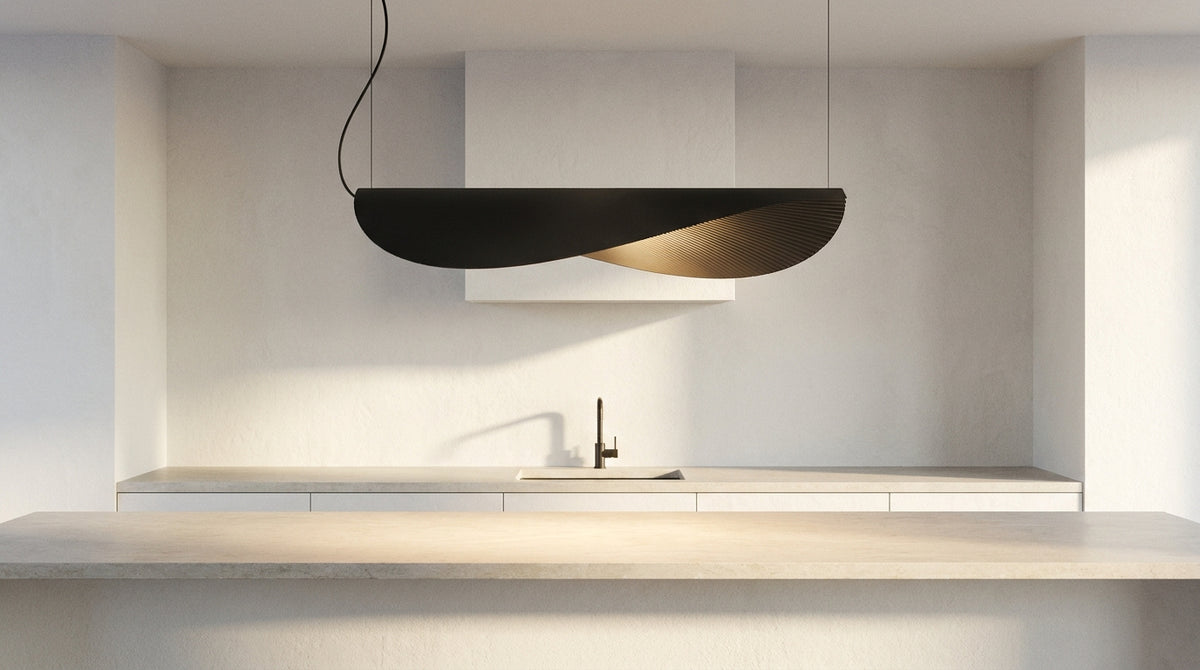
A light fixture that lights the worktop, not the floor. Above an island or a bar, a pendant comes down to a useful height and concentrates the light where you cook. Along a wall run, a wall light or a strip light aligns the lighting with the splashback. The ceiling stays in the background.
Replacing a fluorescent tube: the light fixtures that take its place


The fluorescent tube lights the worktop, not the room
A tube on the ceiling casts even light everywhere, and your shadow falls right on the chopping board. Useful lighting therefore goes close to the surface, between 75 and 85 cm above the worktop, never behind you.
Pendant or ceiling light above the worktop
| Solution | Where to put it | What it changes |
|---|---|---|
| Pendant | Above an island or a bar | Light concentrated on the preparation area |
| Wall light or strip light | Under the wall units, against the splashback | Lights the worktop with no cast shadow |
| Ceiling light | Centre of the room | General lighting and circulation |
Our selection of kitchen lighting is sorted by use, which saves you looking for a model without knowing where to put it. The kitchen pendant references are height-adjustable, precisely because the right distance depends on your worktop.
Unsure about the format to use in place of your fluorescent tube? Describe the room and its measurements on the contact us page: we will point you to the right light fixture, without moving the power point.
Replace a fluorescent tube with a bulb or with a whole light fixture?
A bulb on its own settles the colour and the intensity, never the direction. It can do nothing about a badly placed flat fitting or about light that falls against the grain. Replace the whole light fixture as soon as the lighting needs to come down, concentrate or move around the room.
In your case, what needs to change?
What a bulb cannot settle
- Direction: a bulb lights along the axis of its fitting, not elsewhere.
- Height: the power point stays where it is, the bulb does not move it.
- Glare: without a diffuser, the source stays visible from the sofa.
- Style: a dated fitting stays a dated fitting, whatever bulb is screwed into it.
The three signs that the light fixture needs changing
- The fitting heats up or crackles on start-up, despite a new tube.
- The room has changed use: office, dining area, guest bedroom.
- The effect bothers you: greenish light, flickering, cast shadows.
Changing the light fixture also means allowing yourself a room with character. A large living room chandelier above a table, a wall light for reading: lighting becomes a decorative element, not just equipment. For rooms with no ceiling point at all, our article on lighting a room with no ceiling light sets out the solutions.
The choice also comes down to material: brushed metal for a crisp effect, glass to diffuse, fabric to soften. Our collection of designer lighting can be browsed by these families, and by room.
On this kind of purchase, an outside reference helps you decide: the Designix Google listing shows up-to-date buyer reviews, verifiable in one click.
Is a starter needed for an LED tube?
On a magnetic ballast with a starter, yes: the starter must be removed or replaced depending on the LED tube model chosen. On an electronic ballast, there is no starter and the tube fits directly. Before buying, open the cover and look at what is fixed next to the tube.
Magnetic ballast with starter
- Magnetic ballast: starter present, to be removed or replaced depending on the tube chosen.
- Electronic ballast: no starter, the tube fits onto the existing lampholders.
- Tube stated as compatible: some models fit traditional installations without removing the ballast.
The full method, from the circuit breaker to locking the tube, is described step by step in our guide to changing a fluorescent tube.
The special cases, starter kept or starter removed depending on the model, are set out in our answer to the question does an LED tube need a starter.
Electronic ballast: nothing to change
The tube is powered directly and fitting it is just a quarter turn. Identifying the wires is covered in our article on replacing on an electronic ballast, useful when two models look alike under the cover.
Why is an LED fluorescent tube not working?
Most often, the tube is fitted but not locked: an incomplete quarter turn and the contact is not made. Next come a starter left in place, an oxidised lampholder, an incompatible ballast. Three checks are enough before declaring the light fixture out of service.
Mechanical causes
- Incomplete locking: the pins engage, then turn as far as the notch.
- Bent pins: a tube forced into the lampholder moves off its axis.
- Cracked lampholder or slack spring: the contact becomes unreliable.
Electrical causes
A worn starter, a ballast that no longer keeps up, a power supply cut upstream: if the tube flickers without lighting, the starter is often the cause, as explained in our article on changing a ceiling fluorescent tube.
When the diagnosis points to the light fixture itself, it is often still possible to repair a light fixture rather than force a part that is past it.
And if the fluorescent tube is part of a wall set-up, the Neon Wall Light collection brings together 15 references as of 29 September 2026: metal, aluminium, acrylic, wall mounting, dimmable intensity on some models. Enough to replace a built-in tube without redoing the whole room.
In stock · shipping costs shown at checkout · up to 30% off in your cart


Ready to turn inspiration into reality?
Tell us about your room, your style and your budget, and we will show you the pieces that truly suit your project.
Get guidance in 30 seconds →