LED lamp flickering: repair or replace?
This article is also available in French: Réparer lampe led qui clignote

Why is my LED bulb flickering?
Unscrew the bulb and test it in another socket, elsewhere in the house. If it still flickers, the fault is in the bulb. If it stays steady, look at the installation: worn socket, incompatible dimmer, residual current or a tired transformer. That single round trip settles the question in a few minutes.
| Cause | What you see | Fastest test |
|---|---|---|
| Socket contact | Flickering in bursts, especially when switching on | Move the bulb to another fitting |
| Incompatible dimmer | Flicker at the bottom of the range, steady at full power | Go back to a simple switch |
| Residual current | A regular flash with the fitting switched off | Disconnect it and watch for a night |
| Driver or transformer | Several spots flicker together | Measure the output voltage |
How do you know if an LED bulb is dead or just badly supplied?
A dead bulb does not light up at all, even screwed into a fitting that works. A badly supplied bulb flickers, shimmers, lights up in bursts, then becomes steady elsewhere. The cross test settles it: what is dead stays dead in every socket, what flickers changes behaviour depending on the fitting.
Once the verdict is in, an identical base and equivalent wattage are enough. LED bulbs come in E27, E14, GU10 and G9: note the base before ordering, it is the one mistake that forces you to start over.
How an LED works: what explains the flickering
An LED does not run on 230 V. A driver converts alternating current into direct current, often around 12 V or 24 V. If that current becomes irregular, because of a weak contact or a tired driver, the light starts to pulse.
The full mechanism is described in our article on how an LED works. Remember that the source copes badly with repeated micro-interruptions.
On a survey of 165 references from our collection of LED wall lights, dated 28 September 2026, LED technology is stated on 99% of the product pages and dimming on only 33%. That minority accounts for a good share of the flickering.
How do you fix a flickering LED lamp, test by test?
Switch off the breaker and work in order: bulb tested elsewhere, socket contact inspected, dimmer ruled out, residual current eliminated. The first test that makes the flickering disappear identifies the cause. Allow a quarter of an hour, with a multimeter for two of them.
- Switch off the power at the breaker and check there is no voltage before touching the socket.
- Remove the bulb and try it in a fitting that works.
- Inspect the socket: flattened tab, black marks, oxidised base. Straighten the tab without forcing it.
- Take the dimmer out of the circuit and test on a simple switch.
- Track down residual current: switch with an indicator light, cable running alongside another circuit, power supply left live.
How to test an LED bulb, with or without a multimeter
Without a multimeter, the cross test is enough: the same bulb in two fittings. With a multimeter, measure the voltage at the driver output: a value that collapses or oscillates confirms a tired power supply. In continuity mode, a dead bulb shows an open circuit.
An old dimmer chops the current, which a non-dimmable LED translates into shimmer. Our article on dimmable LED details what happens inside the driver and what to check on a product page.
How to stop residual current in LED bulbs
An LED lamp that flickers when switched off is almost always showing residual current: a switch with an indicator light, a dimmer left live, or two conductors running side by side. Disconnect the fitting for a night: if the flash disappears, the cause is in the installation, not the lamp.
The remedy is a discharge module fitted across the terminals of the fitting, without drilling or removing any cable.
Does an LED spot need a transformer?
An LED spot with a GU10, E27 or G9 base runs directly on 230 V: no transformer. A 12 V spot, however, needs a suitable driver, and that is often what flickers. Check the voltage before replacing anything.
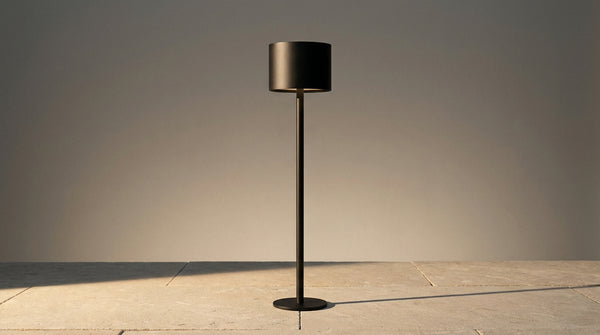
The same reasoning applies when a floor lamp wavers: our guide to repairing a floor lamp follows the same sequence, from the power supply to the socket contact.
How do you replace an integrated LED bulb when it flickers?
LED bulbs with E27, E14, GU10 and G9 bases
 Cube LED outdoor wall light, aluminium up & down | Uaso
 twin-light wall light, linen shade & adjustable LED reading light | Soren
 Bronze LED USB wall light, adjustable-arm reading light | Retina
 Black LED picture light with dimmer, L 60 cm | Litho
 Cannage Lantern Wall Light | Pira
 Design Outdoor Lamp with Detector | SécuriLuxe
See the whole selection: LED wall light, LED wall lamp and wall lighting
An integrated LED bulb cannot be unscrewed: the source is soldered onto a board, behind a diffuser. The driver, however, often stays accessible by taking down the fitting. If the driver is available as a part, the flickering stops. If the board is dead, it is the fitting that gets replaced.
Why does my LED bulb not light up at all?
Three causes cover almost every case: a badly screwed base or a flattened tab, a failed driver, a dead bulb. Start with the contact, it is the most common fault and the quickest to fix. An LED ceiling light that flickers before going out points more to the driver.
Soldered bulb: driver, fitting or replacement?
The answer depends on two things: how accessible the housing is and whether there is a connector. A driver identified by a reference can be replaced on its own. A soldered board without a connector condemns the whole unit.
| What you find | What gets replaced | What to plan for |
|---|---|---|
| Accessible driver, legible reference | The driver alone | Same reference, same voltage |
| Soldered LED board without connector | The complete fitting | Same diameter, same fixing |
| E27, E14 or GU10 socket | The bulb | Identical base and wattage |
On a recessed spot, the difficulty is often the springs, not the electrics. Our guide to changing a spot bulb without clips shows how to remove the module without damaging the bezel.
When the board is dead and the driver is not available as a part, an LED ceiling light of the same diameter takes over, with an integrated driver and dimming stated on the product page.
If the test points to the bulb, it is better to start again with a model whose dimmer compatibility is written in black and white.
That is the case with dimmable bulbs, designed for a dimmer switch.
If you are unsure about an old socket or a recessed dimmer, contacting the workshop remains the shortest route.
When to repair, when to replace the light fitting?
Your LED lamp is flickering: which case are you in?
Repair if the fault is in the contact, the dimmer, the residual current or an accessible part. Replace if the driver is sealed into the body, if the LED board is soldered without a connector, or if the housing has already been opened several times. The question is not the cost, but access to the parts.
What each repair involves, in actions and parts
- Socket contact: pliers, no parts, a few minutes.
- Dimmer: a dimmable model, fitted in place of the switch.
- Residual current: a discharge module across the terminals, no drilling.
- Driver: the exact reference, often the real obstacle.
- Fitting: removal, labelling the wires, refitting and fixing.
Taking a housing apart without damaging the finish has its own guide: repairing a light fitting details removal, labelling the wires and refitting.
When the lamp stays silent, the diagnosis follows another logic: repairing a lamp that no longer lights up covers a complete lack of light.
How to choose an LED fitting that will not flicker
Three criteria settle it: dimming stated on the product page, an accessible or replaceable driver, and a single type of source per circuit. Style comes afterwards.
A living room chandelier is chosen on these criteria as much as on shape, especially above a table where shimmer is noticeable.
A wall light at the head of a bed or above a worktop is often fine with a dedicated switch, more reliable than a recessed dimmer.
To redo a whole room, a design fitting stated as dimmable avoids mixing sources on the same circuit.
On the survey of 165 references dated 28 September 2026, a 2-year warranty is stated on 99% of the product pages. Any doubt about a specific installation is settled with the workshop, whose Google listing can be checked in one click.
On the same subject
In stock · shipping costs shown at checkout · up to 30% off in your cart


Ready to turn inspiration into reality?
Tell us about your room, your style and your budget, and we will show you the pieces that truly suit your project.
Get guidance in 30 seconds →