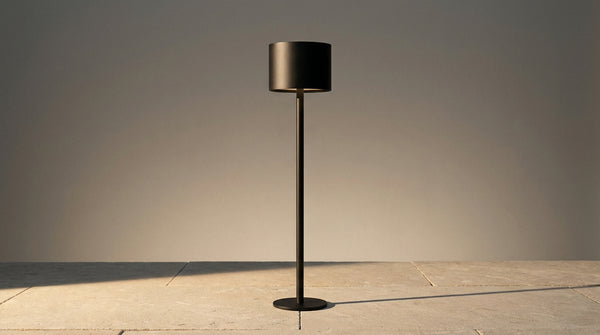
How to refresh an old lampshade: the method, step by step
This article is also available in French: Relooker un vieil abat jour
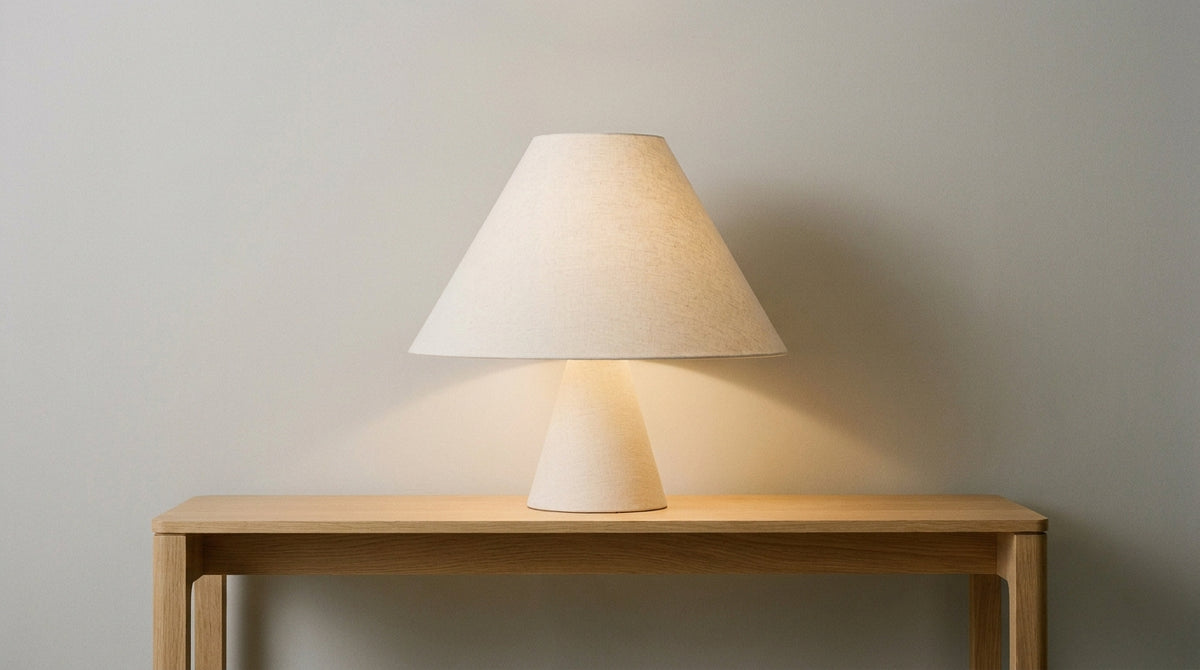
Roll the fabric out flat, measure the height of the frame, then cut a rectangle that overhangs by 3 cm at the top and bottom. Glue edge to edge, smooth with a warm hairdryer, fold the returns inwards. An old lampshade gets a new face in one evening, without taking the lamp apart.
How do you cover an old lampshade with fabric?
Check the frame first: two straight rings and the refresh will hold. Then stretch a fine fabric, linen or cotton, edge to edge, with 3 cm of overhang at the top and bottom. Glue without overlapping, fold the returns in, leave to dry flat.
A fabric that bubbles almost always betrays a dusty ring or a bead of glue that is too generous. This check is what decides between refreshing and replacing: if the rings are straight, renovating a lampshade rather than replacing it avoids an unnecessary purchase. On the range side, 789 designer lampshade references are listed as of 28 September 2026, from bedside size to the large cone of a floor lamp: the right diameter exists.
Choosing the fabric: linen, cotton or velvet
Linen brings a matte grain that softens the light, cotton stretches effortlessly, velvet absorbs the rays and deepens the mood. On a survey of 31 references from our catalogue as of 28 September 2026, linen comes out at 52% and metal at 26%.
| Material | Look | Durability | Difficulty of fitting |
|---|---|---|---|
| Linen | Matte, textured, soft light | Good, marks little | Medium, the fibre relaxes |
| Cotton | Smooth, bright, crisp shades | Fair, ages over time | Low, ideal for beginners |
| Velvet | Deep, contained light | Very good, holds the fold | High, marks when glued |
Rattan plays a different tune, more graphic and lighter. A rattan lampshade sits on a raw base or a pendant, and filters the light into irregular patterns.
Stretching the fabric without creases on the frame
Four steps, in this order, are enough to get a clean surface.
- Glue from the top and let the fabric come down, never the other way round.
- Stretch by quarter: top, bottom, left, right, before the curves.
- Warm with a hairdryer to relax the fibre without burning it.
- Fold in 1 cm on both edges, inwards, for a clean finish.
On a large format, it is better to change a lampshade's fabric in two strips than in a single piece. And if the frame is beyond saving, making a lampshade with two rings can be attempted with two metal rings and a strip of fabric.
How do you paint an old lampshade?
Paint in two thin coats, never one thick one: the material drinks the first, the second finishes the look. Spray can at 20 cm for fabric, dabbed foam brush for card. Dust and degrease first, otherwise the paint bubbles as it dries.
Which paint for which material?
The material dictates the product, and the product dictates the gesture.
- Fabric: flexible textile paint, which follows the fold without cracking.
- Card: matte acrylic, dabbed so as not to soak the fibre.
- Metal: primer then lacquer, in a light veil.
- Paper: diluted pigments, a single pass, drying flat.
The finer the surface, the thinner the coat must be. On old card or weakened paper, the lampshade to paint technique is worked dry, by dabbing, never rubbing.
Two thin coats are better than one thick one
A thick coat saturates the fibre, dries on the surface and pulls at the edges as it cools. Two thin, spaced passes give an even shade and keep the flexibility needed around the rings.
- Spray can held at 20 cm, in crossed passes.
- Foam brush for the rims and inner corners.
- Drying flat, until the surface no longer marks.
- Matte varnish optional, for a powdery finish that does not shine.
Lampshades to adopt, by room and by style
 pleated white fabric pendant, oval lampshade Ø 60 cm | Velina
 K1068RS grey linen lampshade
 Black arc wall reading light, fabric lampshade Ø60 | Noctis
 Black Scandinavian floor lamp, cork lampshade, living room reading light | Stang
 Light rattan designer chandelier | Calya
 Black Zig-Zag 4253ZW floor lamp with white linen lampshade - a unique design and functional use
See the whole selection: Lampshades: Pendant, Table Lamp and Floor Lamp
How do you clean a lampshade before refreshing it?
Dust dry with a lint roller or a microfibre cloth, then adapt the cleaning: warm water and mild soap on fabric, a barely damp sponge on card. A dusty frame makes the paint bubble and stains the new fabric. Ten minutes here save the whole job.
Cleaning a fabric lampshade without damaging it
The worst enemy is not dust, it is spilled water. Work in small areas, dab without rubbing, let it dry in the open air and never on a radiator. The details of the steps are described for cleaning a fabric lampshade.
- Lint roller over the whole surface, as a first pass.
- Warm water and mild soap, wrung-out cloth, by dabbing.
- Drying flat, shape held, in the shade.
Cleaning a card lampshade: dry
Card dreads water more than anything: a single drop leaves a permanent ring. Soft eraser, soft brush, vacuum on low setting. The procedure for cleaning a card lampshade comes down to three short steps.
- Wide brush to lift dust from the folds.
- Soft eraser on light marks, without pressing.
- Low-power vacuum, brush nozzle, at a distance.
Another marker before taking everything apart: on our survey of 31 references as of 28 September 2026, 97% state a 2-year warranty and 97% an IP20 rating, so indoor use only. A standard frame can easily be replaced if the refresh goes wrong.
If your rings are warped or your frame twisted, a restoration costs more than a replacement: browse the lampshade collection by shape and colour, or write to us via the contact page to find the right diameter.
Which lampshade for which room?
Allow a diameter close to the visible height of the base for a bedside lamp, and a large cone for a floor lamp, with the bottom edge at eye level when seated. Check the socket before the shade: 97% of our survey of 31 references as of 28 September 2026 is in E27.
Bedside lamp lampshade
A format that is too wide eats up the bedside table and crushes the light towards the wall. Aim for a diameter less than or equal to the height of the base, a light fabric that diffuses, and a bulb chosen before the shade. The question of white or yellow light is settled at this point: 2700 K for a bedroom, 4000 K for reading without strain.
- Diameter 25 to 35 cm for a standard bedside table.
- Bottom edge below eye level, once seated in bed.
- White, linen or gold, which do not absorb the output.
Floor lamp lampshade
A large conical format brings the light back down towards the floor and lights widely, without glare. Follow the rule of lampshade size relative to the lamp base: about two thirds of the base height for an upright floor lamp.
- Diameter 40 to 55 cm for a living room base.
- Oval or teardrop if the floor lamp stands against a wall.
- Thick fabric to avoid glare when seated.
For a ceiling-hung lampshade, the gesture changes: fixing a lampshade onto a ceiling socket requires a suitable collar and moderate tightening, otherwise the pendant's socket wears out.
On the colour side, safe values dominate. On a survey of 31 references as of 28 September 2026, black accounts for 52%, white 32% and gold 23%; 58% of the listed items are round in shape. Seasonal variations can be found in our selection of trending lampshades.
For a whole room, entrusting the renovation of your living space avoids multiplying shade tests on a single light. And the Designix Google listing remains available to check the house's work in one click: our Google listing.
Which lampshade would suit your interior best?
In stock · shipping costs shown at checkout · up to 30% off in your cart


Ready to turn inspiration into reality?
Tell us about your room, your style and your budget, and we will show you the pieces that truly suit your project.
Get guidance in 30 seconds →