Trending lampshades: the right shape for the right light
This article is also available in French: Abat jour tendance

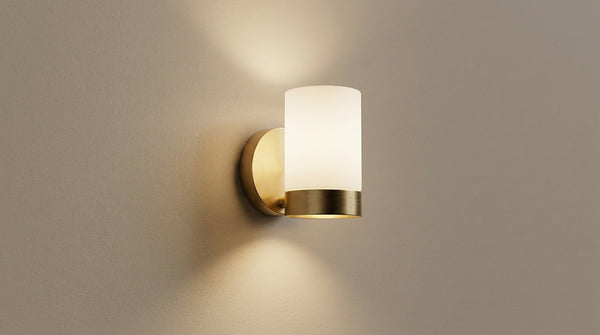
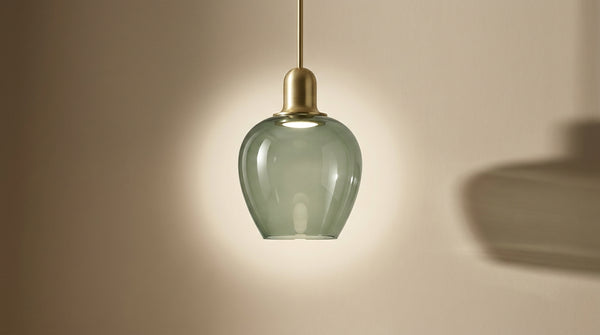
Start with the shape: a round lampshade spreads light widely, a tube directs the beam downwards, a teardrop concentrates light on a single point. The material then decides the softness: linen and fabric soften, glass and metal harden. Look at these two criteria before the colour.
A lampshade is chosen based on what you want to light. The lampshade collection brings together 789 references as of 1 October 2026, pendants, table lamps and lampshades alone: enough to compare shapes at real size before deciding.
Which lampshade shape should you choose for each room?
Shape governs how light is distributed, far more than bulb wattage. Across a sample of 31 references from the collection as of 1 October 2026, 58% carry the Round shape, 16% the Tube, 10% the Teardrop and 6% the Ball.
| Shape | What it does | Where it works |
|---|---|---|
| Round | Wide diffusion, lowers contrast | Living room, bedroom, hallway |
| Tube | Directs the flow downwards | Worktop, desk, island |
| Teardrop | Focused, concentrated | Bedside, reading |
| Ball | Soft accent lighting | Bedside table, low furniture |
Round or conical lampshade: which one for a living room?
Round softens everything: its curve bounces light towards the ceiling and walls, which lowers contrast late in the evening. Conical narrows the beam downwards, handy on a coffee table but less enveloping in a large living room. In a low-ceiling living room, the round shape remains the safe choice.
- Round: wide light, no direct glare.
- Conical: tighter flow, good fit on low furniture.
- Oval: for large volumes and elongated pendants.
Tube, teardrop and ball: for which uses?
The tube lights straight ahead, without a halo: above a worktop, it does not light the cupboards for nothing. It is the shape that suits a kitchen pendant hung over an island. The teardrop concentrates light on a page or a reading armchair. The ball lights in touches.
In a tall room, a large lampshade holds the volume better than a medium model, which disappears under the ceiling. The rule is simple: the taller the room, the larger the diameter can grow.
If you prefer to choose the whole lamp rather than the lampshade alone, bases and fittings are already matched in our selection of complete light fittings.
What is the most trending lampshade colour?
Black dominates. Across the sample of 31 references from our catalogue as of 1 October 2026, 52% carry the colour Black, 32% White, 23% Gold and 16% Grey. A product sheet may declare several: these shares do not add up to 100.
Black, white or gold: how to decide?
Black absorbs the flow and draws a sharp cone on the wall. White lets it through and lights widely. Gold reflects a warm, matte light, superb on a pale wall. So decide according to the wall behind the lamp.
- Black: strong contrast, marked silhouette.
- White: soft diffusion, ideal in a small room.
- Gold: warm halo, reflections on plaster and wood.
- Grey: neutral, it fades behind the light.
Which light tone under a dark lampshade?
Under a black or grey lampshade, colour temperature changes everything. 2700 K stays amber and warm; 4000 K turns grey and hardens the result. For a living room, stay between 2700 K and 3000 K. Details of the families are in our guide to bulb types and kelvin.
Which material for which light?
The material filters what the shape has distributed. Across the same sample of 31 references as of 1 October 2026, 52% declare Linen, 26% Metal, 23% Fabric and 13% Glass. A warm material softens, a cold material makes precise.
Linen and fabric: the cosy light
Crinkled linen and tightly woven fabric break the flow: the light loses its edge and becomes enveloping. That is what makes a room restful in the evening. To layer sources without glare, see how to create a warm atmosphere with light.
Linen is dusted dry, without aggressive products, otherwise the fibre dulls. The full method is in our article on cleaning a fabric lampshade.
Glass, metal and rattan: when light becomes sharp
Glass lets the flow through without colouring it, metal reflects and frames it, rattan cuts it into graphic shadows. A glass lampshade gives a frank, almost cold light, which suits hallways and bright rooms.
- Glass: sharp flow, no loss of brightness.
- Metal: directed and precise light.
- Rattan: graphic shadows, subdued light.
For which room and which light are you looking for your lampshade?
Designer lampshades and pendants to adopt this year
 pleated white fabric pendant, oval shade Ø 60 cm | Velina
 K1068RS grey linen lampshade
 Black arc wall reading light, fabric shade Ø60 | Noctis
 Black Scandinavian floor lamp, cork shade, living room reading light | Stang
 Designer light rattan chandelier | Calya
 Black Zig-Zag 4253ZW floor lamp with white linen shade – a unique design and functional use
See the whole selection: Lampshades: Pendants, Table Lamps and Floor Lamps
What are the pendant light trends for 2026?
Pendants are gaining in volume and material: crinkled linen, tall shapes, double tiers, plenty of black to draw a cone on the table. Large diameters hold open living rooms, tighter models stay above islands.
At what height should you hang a pendant above a table?
Allow 75 to 85 cm between the bottom of the shade and the tabletop, and raise it a few more centimetres above an island. The light then falls on the plates, not in the guests' eyes. In our selection of pendant lights, adjustable cables allow this adjustment during assembly.
- Dining table: 75 to 85 cm above the tabletop.
- Kitchen island: a few centimetres more.
- High ceiling: longer cable, wider shade.
Which trending living room lampshade should you choose?
For a living room, a tall and narrow lampshade works better than a wide model when the room is low. Round shapes and black or grey tones make up most of the selection. The full overview is in our article on the trending pendant light 2026.
These benchmarks come from our own catalogue, not from an external ranking. On the selection, buyers comment on their choices on the Designix Google listing, verifiable in one click.
Floor lamp and table lamp shades: the proportions that save the day
A lampshade depends on the ratio between its size and that of the base, not on its price. This is the point most often checked in trending lamps: two neighbouring models, two opposite balances.
On a bedside lamp, the diameter follows that of the bedside table: a shade that is too wide visually overflows. Our bedroom lighting selection shows these balances on complete sets.
What size of lampshade relative to the base?
Common benchmark: the shade takes up about two thirds of the total height, and its lower edge slightly overhangs the base to avoid a hard shadow on the base. Too narrow, it makes the base look massive; too wide, it crushes the lamp. Measurements are detailed in our article on lampshade size relative to the lamp base.
How to fit a lampshade on a lamp base?
First check the cap: across 30 completed product sheets from our sample as of 1 October 2026, 97% declare an E27 cap and 97% an IP20 protection rating. Then look at the fitting, ring or screw, and the 2-year warranty, found on 97% of these same sheets. Our guide on the lampshade for a round lamp base covers each case.
- E27 cap: the standard of the collection.
- Fitting: ring or screw depending on the socket.
- Dimmable: to check on the chosen bulb.
If you are still hesitating between two shapes, describe the room and the furniture to our advisers. To ask Designix for advice, a message is enough: they reply in a few lines, before purchase.
On the same subject
In stock · shipping costs shown at checkout · up to 30% off in your cart


Ready to turn inspiration into reality?
Tell us about your room, your style and your budget, and we will show you the pieces that truly suit your project.
Get guidance in 30 seconds →