Recessed LED spotlight 55 mm: choosing, drilling and installing correctly
This article is also available in French: Spot led encastrable diamètre perçage 55 mm
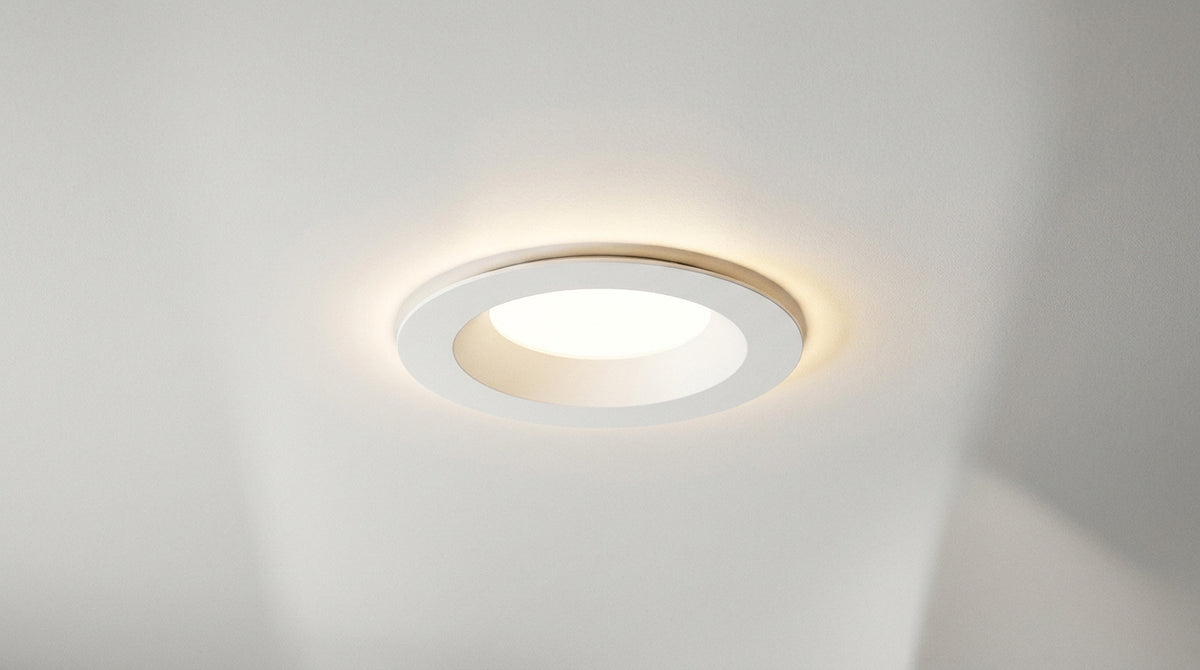
55 mm is the cut-out in the ceiling, not the diameter of the visible bezel. A 55 mm hole saw opens the passage, the spotlight clips inside and its flange covers the edge of the cut. Note these two dimensions separately, on the product and on your ceiling, before drilling.
What drill diameter for a recessed spotlight?
The hole follows the cut-out diameter stated by the manufacturer, never the overall size of the finished spotlight. Four values cover most of the market: 55, 68, 75 and 90 mm. Too small and the body will not go through. Too wide and the flange no longer hides the cut.
What the diameter changes: 55, 68, 75 and 90 mm
A large diameter offers more diffusion surface and accepts adjustable modules. 55 mm remains the format for tight alignments, and the one that forgives an approximate cut the least. Decide on the layout first, because renovating the lighting of a living room is about several aligned points rather than a single ceiling light.
| Drill diameter | What it allows | Where it is essential |
|---|---|---|
| 55 mm | Compact spotlights, tight alignments | Hallways, bathrooms, low ceilings |
| 68 mm | Most common format, standard recessed | Living room, kitchen, bedroom |
| 75 mm | More diffusion, adjustable modules | Large rooms, high ceilings |
| 90 mm | Wide diffusion, high power | Halls, mezzanines, high entrances |
On a survey of 249 references in our Spot LED collection as of 29 September 2026, 82 % are track-mounted and 18 % recessed: the format you are looking for sits in a specific family. The full collection counts 1 575 references as of 29 September 2026, enough to find a recessed LED spotlight with the right cut-out, in the finish and colour temperature you want.
The bezel diameter is not the hole diameter
The visible bezel is always larger than the hole. A spotlight with a 55 mm hole can show a noticeably wider flange: it covers the plaster and hides the irregularity of the cut. So compare two lines of the technical sheet, cut-out diameter and outer diameter, never just one.
On a low ceiling or in a hallway, a mini LED spotlight does the same job in a smaller footprint.
What is the diameter of a hole saw for a recessed spotlight?
The hole saw matches the cut-out diameter exactly: a 55 mm for a spotlight listed as 55, a 68 mm for a 68. A 50 mm blade will not let the body through, a 60 mm one opens a gap that the flange does not always cover. The product sheet is the reference.
50 or 55 mm: how to decide
- 55 mm: cut-out diameter of a standard spotlight, check to the millimetre
- 50 mm: reserved for mini spotlights and small-diameter modules
- 60 mm and above: avoid under a spotlight with a 55 mm hole, the plaster edge stays visible
- Check: measure the hole saw with a caliper, not its label
Drilling straight into a plasterboard
Drill without forcing: the hole saw should bite into the plaster, not push it. A guide bit prevents slipping at the start and a moderate speed limits chipped edges. Let the blade finish its course, the disc falls on its own.
If your ceiling is solid concrete, if the hole falls near a beam or if the room is damp, describe your ceiling to us: the answer arrives before you drill anything.
To see the level of care expected, customer reviews are public on our Google listing.
What LED spotlight power should I choose to light my living room?
A 6 to 8 W LED spotlight easily replaces a 50 W halogen: the stated power no longer helps you decide. What matters is the total flux, read in lumens, and the number of points. Multiply the sources instead of inflating a single one.
Recessed LED spotlights with a 55 mm hole


How many spotlights per room
The calculation starts from lumens per square metre, then divides by the flux of one spotlight. A living room therefore calls for several distributed points, not one oversized central module. Three reference points are enough to set your plan: the number of spotlights per m² to respect depending on the room, the light density to aim for, and the regularity of the spacing.
In the kitchen, the reasoning narrows to the worktop, where the number of lumens per m² goes up a notch to remove the shadow cast in front of your hands.
A project spanning two rooms is handled as a single framework: kitchen and dining room renovation is thought through together to avoid a break in atmosphere at the doorway.
Do 1000 lumens light well?
1000 lumens comfortably light a table, a worktop or a reading corner, not an entire room. 2000 lumens on a single point dazzle near the floor and leave the corners dark. The right question is not how many lumens in total, but how many points carry them.
To balance, set the spacing between ceiling spotlights before fixing the flux of each module.
Orientation and distance from the wall
A tight beam sculpts a wall, a wide beam washes the room without relief. Mix the two to avoid a uniformly flat ceiling effect.
The distance between a spotlight and the wall decides the result: too close, the light climbs and leaves a halo; further away, it falls on the floor. Our tips for installing recessed spotlights in a living room detail the simplest alignments to mark on the ceiling.
What is the lifespan of a recessed LED spotlight?
A recessed LED spotlight lasts several tens of thousands of hours before losing flux. It all depends on the build: a model with a GU10 bulb only needs a bulb replacement, a spotlight with an integrated LED is replaced entirely. This choice is made at purchase, never afterwards.
Integrated LED or replaceable GU10
On a survey of 247 sheets in our Spot LED collection as of 29 September 2026, 96 % declare an LED base and 3 % a GU10 base. The integrated LED simplifies installation and sealing. The GU10 keeps the advantage if you want to adjust the colour temperature later, and recognising a GU10 base avoids the mistake at the time of ordering.
On the same survey of 249 references as of 29 September 2026, 93 % are in aluminium and 96 % are guaranteed 5 years. The material conducts heat away from the LED, which partly explains the stated longevity.
When a bulb flickers or dims, replacement needs no special tool: the method is described in our guide to changing the bulb of a recessed spotlight.
Heat, glare and blue light
- Heat: the LED releases it through the back, hence the role of the heat sink and aluminium
- Glare: a spotlight aimed at the eye tires you, especially at low height
- Blue light: a temperature that is too cool in the evening delays falling asleep
- Rendering: a low-end LED flattens colours, unlike a well-dosed warm white
The remedy is simple: 2700 K to 3000 K in living rooms, and spotlights fitted with anti-glare glass. Our guide to warm light or cool light helps you decide depending on the room and the time of use.
Recessed spotlight in a wet room: which IP rating?
The IP rating is chosen by zone, not by entire room. Away from splashes, an IP20 is enough. Above a shower or a highly exposed worktop, you need an IP44, and an IP65 if the jet can reach the spotlight directly.
IP20, IP44, IP65: what each covers
- IP20: no protection against water, reserved for dry rooms
- IP44: protected against splashes from all directions
- IP65: resists water jets, suited to directly sprayed areas
- Survey: on 249 references in our collection as of 29 September 2026, 96 % declare an IP20, 2 % an IP44 and 2 % an IP65
Bathroom and kitchen: the zones to respect
In the bathroom, the IP rating is decided by the distance to the bath or shower. In the kitchen, it is the proximity to the sink and the hob that governs it. The same ceiling can therefore mix two ratings, and that is normal.
Finally, check that the chosen model exists in the desired rating: our Spot LED collection lists references by protection, material and colour temperature.
Your 55 mm recessed spotlight, which room is it for?
On the same subject
In stock · shipping costs shown at checkout · up to 30% off in your cart


Ready to turn inspiration into reality?
Tell us about your room, your style and your budget, and we will show you the pieces that truly suit your project.
Get guidance in 30 seconds →