
Distance between ceiling spotlights and wall: getting the measurements right
This article is also available in French: Distance entre spot plafond et mur
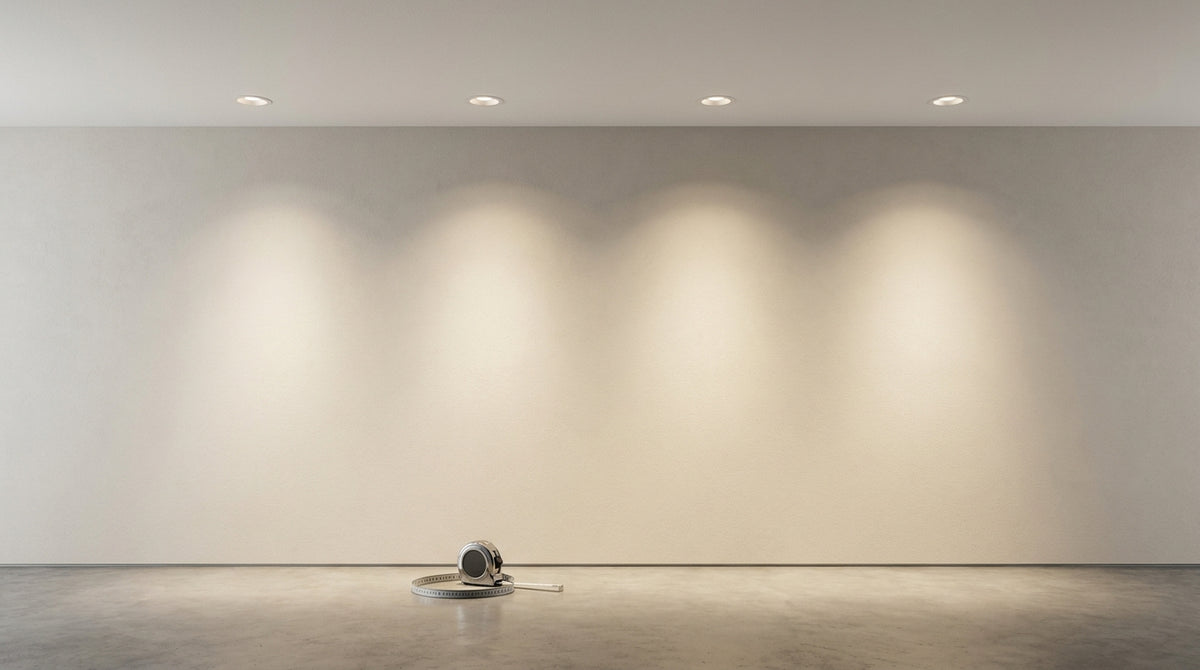
Measure the ceiling height, then multiply it by the tangent of half the beam angle. At 2.50 m with a 36° beam, allow 81 cm between the spotlight axis and the wall. At 2.40 m with a 24° beam, 51 cm. With a 60° beam, 1.44 m.
What distance between ceiling spotlights and wall?
It is calculated, not copied. A 36° beam at 2.50 m requires 81 cm between the spotlight axis and the wall. A 24° beam at 2.40 m requires 51 cm. The 50 to 80 cm ranges quoted everywhere come from these calculations, applied to different ceilings.
The beam angle rule
A spotlight projects a cone whose width on the floor depends on the angle and the mounting height. The formula fits on one line: distance between the spotlight axis and the wall = ceiling height × tangent (beam angle ÷ 2). It works just as well for framing a living room as for rethinking the lighting of a living space without multiplying light points.
How far from the wall should spotlights be placed according to ceiling height?
The higher the ceiling, the wider the cone opens, the further the spotlight axis moves from the wall.
| Ceiling height | 24° beam | 36° beam | 60° beam |
|---|---|---|---|
| 2.40 m | 51 cm | 78 cm | 1.39 m |
| 2.70 m | 57 cm | 88 cm | 1.56 m |
| 3.00 m | 64 cm | 97 cm | 1.73 m |
Wall-wash effect: what distance to graze the wall?
Go below one third of the calculated distance and the light no longer falls on the floor: it climbs up the wall. At 2.50 m with a 36° beam, the threshold is around 27 cm.
- One third: beyond that, the pool of light climbs too high and cuts off before the ceiling.
- 15 to 30 cm: the range that grazes a wall without lighting it head-on.
- Matte wall: light diffuses; on satin, it outlines every flaw.
- Two spotlights: on a wide wall, the wash stays continuous; a single point leaves an isolated patch.
How to position ceiling spotlights properly, room by room
Start from how the room is used, never from a regular grid. Spotlights go in front of the worktop, in front of the mirror, in front of the furniture, never behind the person working. The distance to the wall is deduced from the calculation, room by room.
Kitchen: how far from the worktop?
Align the spotlights with the front edge of the worktop, 40 or 60 cm from the wall depending on its depth. The cone then falls on hands and food, with no cast shadow. This setting is fixed before the ceiling is installed, when working on the kitchen and dining room renovation.
Above an island, a line of kitchen pendants replaces the row of spotlights, provided you leave 75 to 85 cm between the worktop and the bottom of the fixture.
Bathroom spotlight: which IP rating to choose?
On either side of the mirror, two wall lights are better than a front-facing spotlight: the face stays free of cast shadow.
For a spotlight in a wet zone, aim for IP44 at minimum and IP65 where splashes are strongest. Out of 157 references in our catalogue on 28 September 2026, 10% declare IP44 and 2% declare IP65: waterproofing is chosen, not assumed.
Our bathroom range has 2,656 references on 28 September 2026, enough to match a bathroom light to the tiles rather than put up with it.
Colour matters as much as the rating: under a mirror, too yellow a white dulls complexions. Our comparison on white or yellow light helps you decide according to the room.
Bedroom and hallway: what distances to the wall?
In a bedroom, the spotlight axis sits 70 or 80 cm from the wall: the light falls in front of the wardrobe, not on the paint. The hallway follows the opposite logic.
- Bedroom: 70 to 80 cm from the wall, nothing above the pillow.
- Hallway: spotlights close to the walls, spacing of about one metre.
- Near the door: a light point near the door frame keeps you from walking into the dark.
At the end of the hallway, a hallway wall light closes the perspective without dazzling.
In the bedroom, a bedroom light placed lower than a spotlight breaks up direct light and is less tiring for reading.
Which room are you installing your spotlights in?
How many spotlights per m² and how far apart should they be?
Allow one spotlight per 1.5 to 2 m² for general lighting, i.e. 6 to 8 spotlights for 12 m². With a 36° beam, the spacing is between 80 cm and 1 m: the cones overlap just enough to erase dark zones.
The surface-area method
- General lighting: 1 spotlight per 1.5 to 2 m².
- Worktop or desk: 1 spotlight per m².
- Wall to highlight: 2 to 3 wall-wash spotlights, spaced 50 cm apart.
A 25 m² living room is not handled with spotlights alone: keep half the light points for a pendant or a floor lamp, the room breathes better. The detailed calculation is in our article on how many spotlights per m².
The spacing then follows from the width of the cones: two beams should cross, never sit side by side. We detail the method in our guide on the distance between ceiling spotlights.
How many spotlights in a 12 m² bedroom?
Six 36° spotlights are enough, four in front of the bed area and two near the door. Add two more if the room also serves as an office. The exact density is in our article on spotlight density per m².
Do you need a transformer for an LED spotlight?
No, if the spotlight is rated 230 V: it connects directly. A transformer, or driver, only concerns 12 V models. The mention appears on the product sheet and on the base, check it before ordering.
Driver, transformer, 230 V spotlight: how to decide
- 230 V: no driver, direct connection, spotlight replaceable on its own.
- 12 V: driver required, often supplied, to be changed at the same time as the spotlight.
- GU10 base: interchangeable bulb; out of 140 references in our catalogue on 28 September 2026, 20% declare this base.
- Integrated LED: nothing to replace, but the module cannot be changed on its own.
Recess depth and bell: what to check
Measure the available height before drilling: a spotlight needs a technical void, and a tight ceiling calls for an extra-flat model. The bell is not systematic; it mainly protects the spotlight from contact with insulation and frames the beam. The procedure is detailed in our article on how to install ceiling spotlights.
Spotlights, bars and ceiling lights from the selection
 Applique Boule Salle de Bain Moderne | Luminance
 Applique salle de bain tube ovale | Fiye
 Applique Salle de Bain ZAMBELIS 20W CCT IP44 DESIGN Blanc Sable 25457
 Applique salle de bain dimmable | Qilo
 Spot orientable salle de bain rond | Lisio
 Applique mural noir salle de bain | Calix
See the whole selection: Bathroom Lighting, Ceiling, Wall or Mirror Lighting
Price of a ceiling spotlight: what makes the bill vary
No price fits in an article: the bill depends on the type of spotlight, the number and above all the support to be put in place. A recessed spotlight requires a technical void, a ceiling light is mounted on the existing surface. It is the volume of work that decides, not the reference chosen.
Recessed, bar or ceiling light?
| Solution | What it requires | What it changes |
|---|---|---|
| Recessed spotlight | a technical void above the ceiling | invisible fixture, directional light |
| Spotlight bar | an existing fixing point | adjustable orientation, no ceiling to redo |
| Ceiling light | a simple light point | enveloping light, reversible installation |
The ceiling light is the only one of the three solutions that can be removed without leaving a trace. If you are still unsure, our selection of LED ceiling lights covers both uses, direct or diffused light.
And when the room has never had a central point, it is better to start from the walls: our article on how to light a room without a ceiling light details the wall alternatives.
Plasterboard false ceiling: what weighs on the bill
Three items push the bill up: the surface to cover, the number of cut-outs and the finishing work after installation. A quote is built room by room, with surface area and ceiling height in hand. Simply describe your room to our advisers to leave with a costed spotlight plan, rather than extrapolating from an average found online.
In stock · shipping costs shown at checkout · up to 30% off in your cart


Ready to turn inspiration into reality?
Tell us about your room, your style and your budget, and we will show you the pieces that truly suit your project.
Get guidance in 30 seconds →




