1970s vintage lighting: choosing it room by room
This article is also available in French: Luminaire vintage années 70
Which 1970s vintage light for which room?
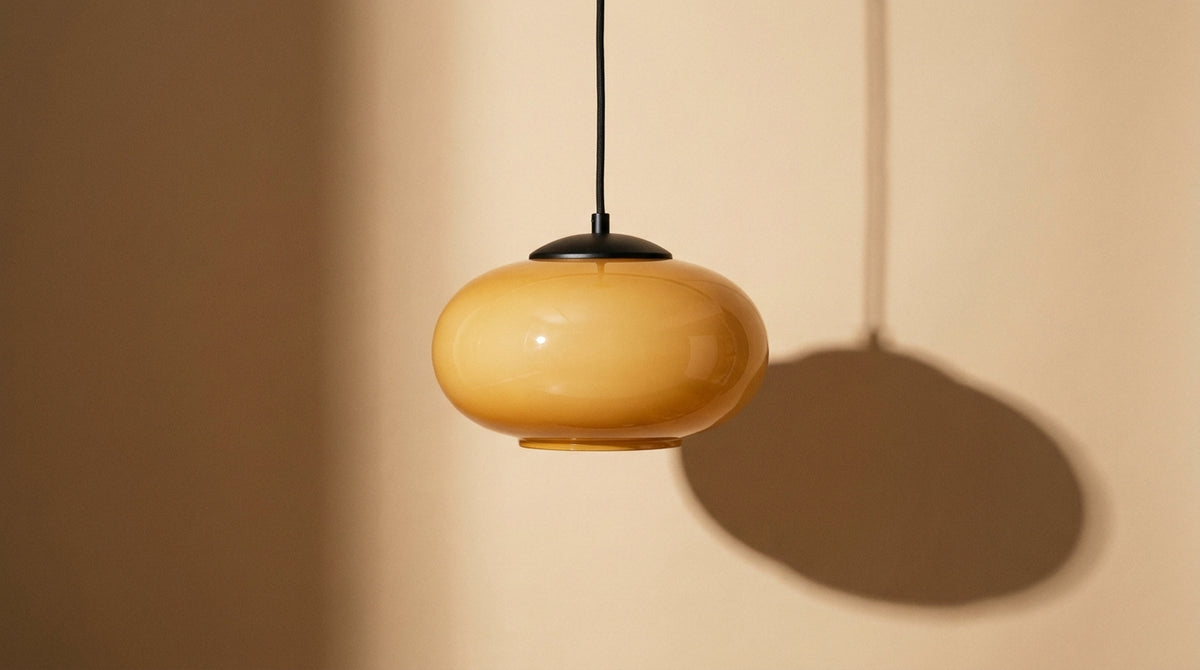
A mushroom lamp sits on a bedside table or a desk, an opal glass pendant hangs above a table, an arc floor lamp stands in the corner of a living room. The shape decides the room, not the other way round: each silhouette casts light at a different height.
| Shape | Room | Height | Light |
|---|---|---|---|
| Mushroom lamp | Bedside, desk | 40 to 50 cm | Direct, downwards |
| Opal glass pendant | Dining room, hallway | 1.50 to 1.60 m from the floor | Diffuse, no glare |
| Arc floor lamp | Living room | 1.80 to 2.10 m | Skimming above the sofa |
Opal glass pendant: dining room and hallway
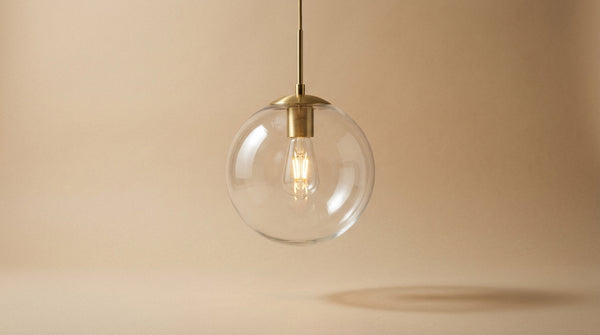
Opal glass diffuses light without ever showing the bulb, which matters above a table where you eat and work. A 30 to 40 cm globe is enough for a table seating four to six. To size the diameter to the tabletop, the guide on the dining room pendant sets out the ratios.
Mushroom table lamp: bedside and desk
The domed shade throws the light downwards and leaves the top of the shade dark. That is what makes it bearable 50 cm from a pillow. On a desk, it lights the page without glare on the screen, provided you place it on the left for a right-hander.
Arc floor lamp: the living room
The curved arm brings the source above the sofa without a base in the way. Check the counterweight and the diameter of the base: on a soft floor, a narrow base tips over. The stem height adjusts between 1.80 m and 2.10 m depending on the depth of the sofa.
These three silhouettes tell the same story, that of moulded plastic and blown glass. The retro charm owes less to the shapes than to the way they diffuse light. And for the overall mood of a room, the choice of lighting decor matters as much as the model.
How do you tell a 1970s light from a reissue?
Three checks are enough: the weight of the glass, the material of the socket and the look of the cord. A period blown glass is irregular, often thicker, and the socket keeps traces of bakelite or patinated brass. A recent reissue has perfectly regular glass and a new plastic socket.
The materials that give the period away
Period opal glass is blown, never moulded: it keeps fine bubbles and an uneven thickness. Metal, for its part, carries original paint that wears at the contact points, never a uniform powder coating.
- Opal glass: visible bubbles, uneven thickness, never smooth to the touch
- Lacquered metal: clear wear on the edges, slightly faded shade
- ABS: yellows towards honey, never stays pure white
- Chrome: micro-scratches in the direction of polishing
Across a sample of 250 references from our catalogue as of 6 November 2026, metal is stated on 82% of the listings and glass on 38% (material given on 246 listings). Glass therefore remains in the minority in a largely metal catalogue, which explains its scarcity on the second-hand market as well as in new condition. To compare shades and thicknesses, the selection of glass lamps gives a good reference point. Pieces with drops, closer to the 1960s than the 1970s, are read differently: a period chandelier is judged by the regularity of its drops, not their number.
The cap, the socket and the cord: what dates a piece
Remove the bulb before paying. An original socket is bakelite, brass or ceramic. A white plastic socket, screwed in at three points, signals recent manufacture.
- Bakelite: dark brown, matte, typical of the early 1970s
- Brass or ceramic: firm contact, often oxidised, never shiny
- Fabric cord: evenly patinated if original, shiny if new
The question of trust remains. A photo does not tell you whether the glass rings clear, or whether the socket holds. The Designix Google listing gathers buyer feedback on pieces already delivered, and can be checked in one click.
At what height should a vintage pendant hang above a table?
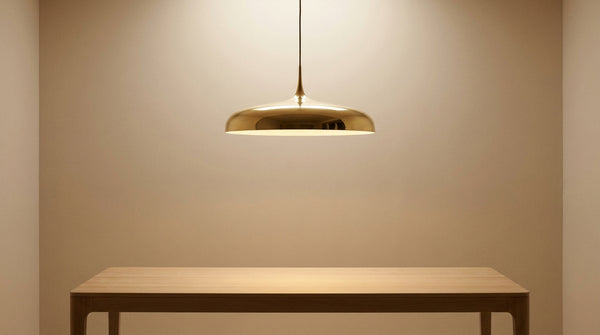
Allow 75 to 85 cm between the tabletop and the bottom of the shade, about 1.55 m from the floor for a standard 75 cm table. Below 70 cm, the light flattens faces; above 90 cm, it no longer lights the plate.
The measurement above the tabletop
The measurement is taken from the lowest point of the light, not from the ceiling fitting. A high table or a kitchen island lowers the pendant accordingly.
- 75 to 85 cm: the comfortable range for a meal
- 2.10 m: minimum clearance under the light in a walkway
- 65 cm: absolute minimum above a worktop
Hanging often requires adjusting the cord. The step-by-step guide to installing a pendant light helps you avoid cutting it too short.
And if the ceiling is low?
Below 2.30 m, a shortened cord or an offset-arm model saves the measurement. A ceiling light with a seventies feel frees up the view and gains 20 cm of clearance.
Unsure between a period piece and a faithful reissue? Send the ceiling height and the tabletop width to discuss your project with the team, and we will tell you what to hang above the table.
Can you put an LED in a vintage light?
Yes, provided you keep the original cap and a low colour temperature. A 6 to 8 W LED at 2700 K recovers the warm tint of a filament without heating the glass. A 4000 K one turns the opaline blue and breaks the mood of the room.
E27, E14, G9: the caps you come across
The cap determines everything else. Across a sample of 250 references from our catalogue as of 6 November 2026, the E27 cap is stated on 26% of the listings, the LED mention on 22% and E14 on 16% (cap given on 231 listings).
| Cap | Where you find it | Suitable LED |
|---|---|---|
| E27 | Pendants, floor lamps | 6 to 8 W |
| E14 | Small table lamps | 4 to 6 W |
| G9 | Globes, wall lights | 3 to 5 W |
2700 K or 3000 K: the choice that saves a shade
2700 K remains the closest to old incandescent light. 3000 K leans slightly towards white, which suits a work room but hardens amber glass.
- 2700 K: living room, bedside, dining room, original tint preserved
- 3000 K: desk and kitchen, sharper reading
- Filament: look close to the original bulb in a clear globe
Dimming is only stated on 24% of the sample (101 listings with the information): check this point before buying a dimmer. The guide to types of bulbs helps you cross-reference cap, wattage and temperature.
How many 1970s lights in one room, without overloading it?
Three, spread over three heights: one on the ceiling, one at mid-height, one on the floor. Beyond four, the round shapes cancel each other out and the room loses its focal point. The rule holds for a room of 15 to 25 m².
The rule of three heights
The eye needs a high point, a middle point and a low point to read a space. Stacking three pendants cancels that effect.
- Ceiling: one pendant or globe, never two in the same room
- Mid-height: a wall light or a table lamp on a piece of furniture
- Floor: an arc floor lamp or a stem, in a corner, not in the centre
The right reflex is to choose one statement piece, then let it dominate: browsing the lighting selection room by room prevents accumulation. On the same sample of 250 listings as of 6 November 2026, the IP20 rating is stated on 94% of references: these pieces stay in dry interiors. And if the whole room needs rethinking, a living room lighting project handles heights, circuits and sources as a whole.
The all-vintage trap
A fully seventies room tires quickly: the oranges compete with each other and the eye no longer knows where to rest. One piece of furniture or one period lamp is enough to set the tone, while the rest in black metal or neutral glass holds the frame. The rules for mixing lighting styles in one space apply here word for word.
In stock · shipping costs shown at checkout · up to 30% off in your cart


Ready to turn inspiration into reality?
Tell us about your room, your style and your budget, and we will show you the pieces that truly suit your project.
Get guidance in 30 seconds →