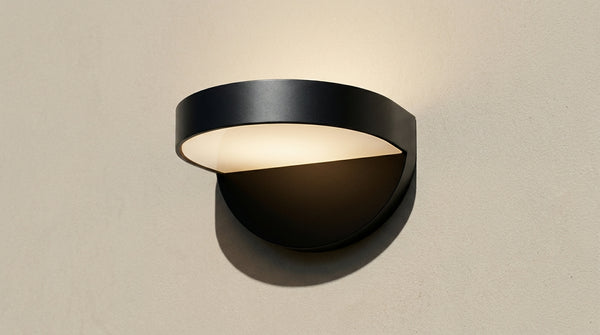
Vintage lighting: the retro charm that transforms your decor
This article is also available in French: Les luminaires vintage : un charme rétro dans votre décoration

In a survey of 115 references from our Vintage Decoration collection on 29 September 2026, 90% are IP20 and 49% are pendants. A vintage light belongs in a dry room, above a table or near an armchair, never in a bathroom. Check the socket: 35% of the survey is E27, 29% is E14.
What is the difference between vintage and retro?
Vintage means a period piece, made decades ago, carrying the wear of its years. Retro means a new piece that borrows yesterday's codes. The difference shows in the finishes, the weight of the metal and the tint of the glass, rarely in a photo.
A vintage interior is built around two or three strong pieces, never an accumulation. Our retro decoration brings together the seating, objects and lights that hold this coherence without turning the room into a flea market.
If you are starting from scratch, choose colours and materials before lighting: our vintage decor tips set out that order of work.
What does a 1950s vintage light look like?
The eye first recognises the material: aged brass, opaline glass, simple lines and slender stems.
- Opaline shade in a bell or bowl shape, off-white
- Tapered stems in brass or gilded metal, without ornament
- Small-diameter globes, staggered along an arm
What does a 1970s vintage light look like?
The 1970s change the vocabulary: chrome replaces brass and volumes grow.
- Polished chrome and brushed steel on the bases
- Smoked or white glass globes, clustered together
- Long-armed floor lamps, taller than they are wide
What are the characteristics of the vintage decor style?
In a survey of 115 references from our Vintage Decoration collection on 29 September 2026, 83% declare metal and 59% glass. Black dominates the colours at 49%, ahead of white at 43% and gold at 28%. The vintage look therefore rests on three materials and two shades, not on one specific object.
This survey covers 115 records from a catalogue of 3816: it describes a strong trend, not a rule. It is also what simplifies the choice, since vintage lighting remains recognisable in almost every room.
Ball, round, tube: which shapes dominate?
Three silhouettes carry most of the style in the same survey: the ball at 36%, the round shape at 30% and the tube at 23%.
- Ball for a pendant above a table or an island
- Round for ceiling lights and wall lights, which blend into the wall
- Tube for long rooms, hallways and entrances
To move beyond these three families, browse all the lighting families: the material mixes are more varied there.
Pendants, wall lights and vintage lamps from the collection
 Plafonnier Osier | Qira
 Lampe Chevet Design Moderne | Ulti
 Lustre Chic et Moderne | Lueur Fluxion
 Lustre Art Déco Moderniste YALO - Design Spirale Chrome Doré LED
 Suspension Luminaire XXL | Tela
 Suspension Luminaire Vintage Industriel | Vilo
See the whole selection: Vintage Decoration, Retro Decoration and Old Decor
Which room should you install a vintage light in?
The living room comes first, declared on 80% of the survey of 115 records on 29 September 2026, ahead of the bedroom at 64%, the kitchen at 57% and the dining room at 52% (a record can carry several). One room is enough to introduce the style.
In a living room, light is spread across three points rather than one:
- Pendant above the table, for meals
- Floor lamp near the sofa, for reading
- Wall light on the supporting wall, for atmosphere
If the project goes beyond lighting, our page on living room renovation covers the whole room, from the floor to the light sources.
In the bedroom, the bedside lamp does the work: it gives little light, but it frames the eye. Our vintage bedroom ideas show how to combine it with a low pendant.
Above a table, the chandelier structures the room. A dining room chandelier in glass and gilded metal stays legible even when the table changes.
Which room are you looking for your vintage light in?
Which vintage lamp do you recognise at first glance?
A wide silhouette, a metal collar, a globe held by three fastenings: a vintage lamp is recognised by its structure, not its colour. Three families appear in almost every interior, and their authenticity is checked through specific details.
Three unmistakable silhouettes
- The globe on an arm, spherical, freestanding or hanging
- The metal cage, whose ribs let the bulb show
- The articulated arm, curved, inherited from old desk lamps
These codes appear in small format on the wall: our wall lights take up the metal collar and blown glass of the floor-standing models, with the same restraint.
What gives away a copy
Glass that is too thick, metal that rings hollow, a visible screw on the base. On signed pieces, these three points can be checked in a minute.
The best-documented case remains the curved-stem lamp: our guide to recognising a genuine Pipistrello lamp details the dimensions of the base and the finish of the glass.
The same logic applies to chandeliers: fake bronze or brass chandeliers are spotted by weight and assembly, two points a photo never shows.
Socket, protection rating and height: how to hang it without mistakes?
Three values decide everything: the socket, the protection rating and the installation height. In our survey of 115 records on 29 September 2026, 35% are E27, 29% are E14 and 90% show an IP20. Check these three lines before confirming a model.
E27 or E14 socket: which should you plan for?
The socket determines the bulb, and therefore the light. Nearly one reference in three in the survey calls for an E14, smaller, and not an E27.
| Criterion | E27 | E14 |
|---|---|---|
| Socket diameter | 27 mm | 14 mm |
| Share of the survey (115 records, 29 September 2026) | 35% | 29% |
| Where you find it | Pendants, floor lamps | Wall lights, accent lamps |
The technology follows: 75% of the survey is declared LED, and the LED filament recovers the warm tint of original bulbs. Our guide to types of bulbs helps you decide between models.
Then there is colour temperature, which depends on use: warm in the evening, more neutral in a kitchen. This comparison of white or yellow light gives the useful reference points.
IP20 and the bathroom: why the survey stops at dry rooms
90% of the surveyed records declare an IP20, against 1% at IP44 and 1% at IP65 (survey of 115 references, 29 September 2026). IP20 protects against contact, not moisture.
- Living room, bedroom, dining room: IP20 is enough, with no constraint
- Kitchen: outside the splash zone, IP20 remains acceptable
- Bathroom: aim for at least IP44, outside the shower zone
- Terrace: IP65 for a genuinely exposed space
A badly placed vintage light costs more in rework than in hardware: if you are unsure about location or height, the team answers in a few words from our page to contact us.
At what height should you hang a pendant above a table?
Allow 60 to 80 cm between the shade and the tabletop: any lower and the light flattens faces, any higher and it scatters.
- 75 cm table: shade around 1.50 m from the floor
- Kitchen island: 75 to 85 cm between the worktop and the light
- High ceiling: plan for a chain or an adjustable cable
On the wall, the logic changes: our article on the height of a wall light gives the reference points room by room.
Before confirming, the company's Google listing gathers buyer feedback, updated continuously.
On the same subject
In stock · shipping costs shown at checkout · up to 30% off in your cart
Ready to turn inspiration into reality?
Tell us about your room, your style and your budget, and we will show you the pieces that truly suit your project.
Get guidance in 30 seconds →