Lighting kit: composing the light of every room
This article is also available in French: Kit éclairage
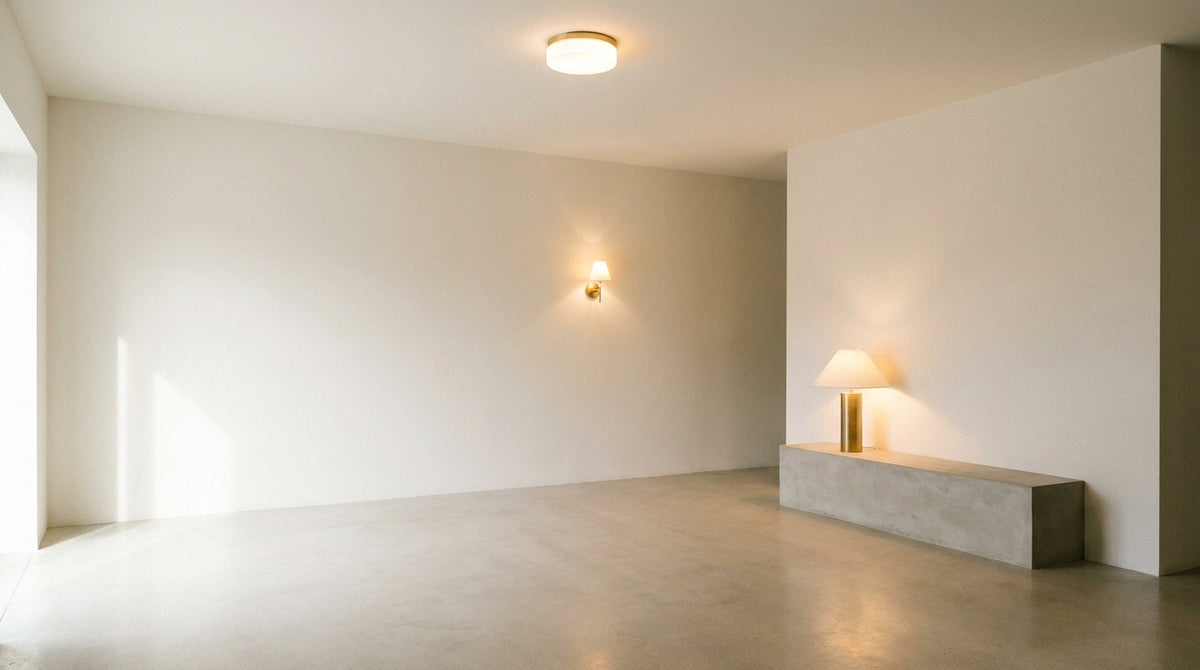
Build your kit in layers: a general source, a task source, an ambient source. Aim for around 100 lumens per m² for the general layer, then spread the rest. A successful kit is judged by the sum of its sources, never by the power of a single fixture.
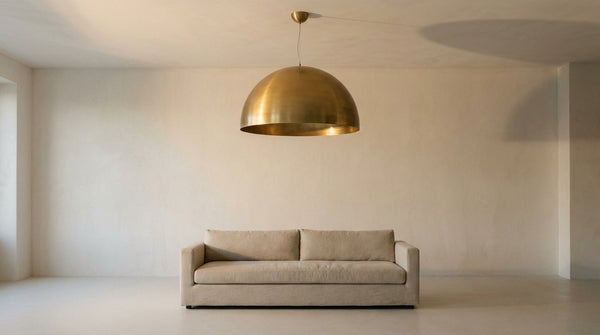
A living room rarely fails because one fixture is too weak. It fails when everything comes from the ceiling, at the same height, in the same colour. That imbalance is almost always fixed with a turnkey lighting plan for a living room: three points, three uses, one single mood.
What are the 3 types of lighting?
Three layers are enough: general lighting lights the whole room from the ceiling, task lighting concentrates light where you read or cook, ambient lighting shapes the volumes. A lighting kit combines all three at the same colour temperature. Without that unity, the eye sees an assembly of lamps, not a room.
- General: ceiling light, panel or large pendant, around 100 lm per m²
- Task: reading wall light, desk lamp, under-cabinet spotlights, 300 to 500 lm at the point of use
- Ambient: floor lamp, table lamp, indirect strip placed high up
- Accent: small adjustable spotlight, tightly focused, for a wall or a work of art
These roles are chosen within a single family of finishes and colours. One designer light repeated twice in the same room makes more of an impression than four different models.
What is ambient lighting?
It is the light that serves no purpose and changes everything. It lights the walls rather than the floor, at eye level. Successful ambient lighting deliberately leaves darker areas: that contrast is what gives depth.
What is accent lighting?
A brushstroke of light, not a wash. It isolates a wall, a material or a frame, with an output clearly above the ambient light around it. Well balanced, accent lighting visually enlarges a dark room. The remaining question is how much light to plan for each layer.
How many lumens should a lighting kit provide?
Allow around 100 lumens per m² for the general layer, then add the extras. A 25 m² living room therefore needs around 2,500 lm on the ceiling, plus a source near the sofa and one in a corner. Add up the sources: it is the sum that lights the room, not the most powerful one.
In an attic room, a high ceiling or a tiled kitchen, the method changes. You then work in lux on the worktop rather than lumens on the floor, as explained in our guide to calculating the lighting you need.
Is 1000 lumens enough to light well?
Yes for a room of 8 to 10 m² as general lighting: 1,000 lm covers a study, a hallway or a reading corner. Below 400 lm, you are no longer lighting, you are adding decorative light. For a 25 m² living room, keep the 1,000 lm as a local source, behind the sofa or on a low unit.
Cool white or warm white: which lights the most?
Cool white, around 4,000 K and above, appears brighter at equal power, but it mainly lights whiter. Warm white, between 2,700 K and 3,000 K, delivers the same amount of light with a softer rendering. In a home, stick to these values and increase power rather than kelvins. The full scale is detailed in our article white or yellow light.
If you would rather start from a selection that is already consistent in bases and temperatures, the simplest way is to talk about your project: we shape the kit room by room before any purchase.
A lighting kit room by room
One room, one kit: each use calls for its own heights, bases and ingress protection. The living room takes low pendants and floor lamps, the kitchen requires directed, washable sources, the bedroom prefers wall lights at the bedside, the staircase calls for discreet guidance lighting. The lighting kits collection already brings these sets together, with matching bases and temperatures.
| Room | Main layer | Extra | Reference |
|---|---|---|---|
| Living room | Large pendant | Floor lamp, table lamp | 2,700 K, diffused output |
| Bedroom | Wall light or low pendant | Bedside lamp | 2,700 K, dimmer |
| Kitchen | Pendant above the island | Under-cabinet spotlights | 3,000 K, IP44 in wet areas |
| Staircase | Staggered wall lights | Low-level guidance | Low output, motion detection |
Which light for the kitchen?
Above an island, a kitchen pendant hung between 75 and 80 cm from the worktop lights your hands without dazzling your face. Choose a GU10 base if you want to direct the beam.
Under the wall units, it is task lighting that makes the difference day to day. An LED bar or three spotlights are enough, provided they stay at the same temperature as the pendant.
How do you light a bedroom without a ceiling light?
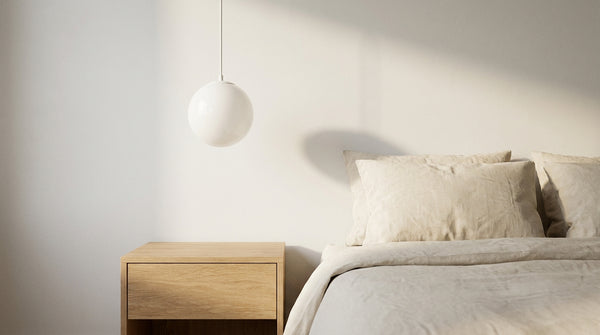
Two wall lights at bedside height, a table lamp on the dresser and one low point are enough to cover the room. The wall acts as a reflector. Our method to light a room without a ceiling light details the heights, also useful in rented accommodation.
Three-point lighting kit, photo kit, trailer kit: don't confuse them
The term "lighting kit" also refers to photo studio sets, trailer light bars and illuminated construction boxes. These products light a scene or signal a vehicle; they do not furnish a room. A home kit is recognised by three things: its bases (E27, E14, G9, GU10), its colour temperature and the use it serves.
Three-point lighting kit
In photography and video, three-point lighting lines up a key light, a fill light and a backlight. In interior decoration, the same word describes three sources in one room, with the same logic: a dominant light, a fill, an accent. The principle transfers very well to a living room.
DIY lamp kit
A kit of spare parts (socket, cable, ceiling rose, shade) lets you assemble your own pendant. Check three things: the cable length you need, the weight of the shade and the bulb base. Our guide to making a pendant light walks through the assembly step by step.
Assemble your kit yourself or have it installed?
A pendant on an existing hook needs no chasing: that is the simplest case. A recessed light, a wall light or a track requires an electrical supply in the right place, and that is where everything is decided. If the conduits are not in place, it is better to plan the project before drilling; our lighting advice details the cases for each room.
Which lighting kit suits you?
What are the drawbacks of LED bulbs?
Three real limits: an entry-level LED flickers, ages by turning green and cannot be repaired. It dislikes heat, which shortens its life in a poorly ventilated spotlight. Finally, dimming only works if the bulb and the dimmer are compatible, and that is the most common mistake in a kit.
Are all LEDs compatible with a dimmer?
No. You need a bulb labelled dimmable and a dimmer designed for low loads. Otherwise, the light flickers or buzzes halfway through the range. The rule is simple: the models grouped in the E27 dimmable bulbs section are designed for this operation, and the rest are not.
Do LEDs get hot?
They get hot at the back, around the heatsink. In a recessed spotlight insulated under glass wool, the heat cannot escape and the lifespan drops. Leave air around the module, or choose a model designed for insulated spaces.
In stock · shipping costs shown at checkout · up to 30% off in your cart


Ready to turn inspiration into reality?
Tell us about your room, your style and your budget, and we will show you the pieces that truly suit your project.
Get guidance in 30 seconds →