Lighting exposed beams: 7 ideas that transform the room
This article is also available in French: Idee eclairage poutre apparente
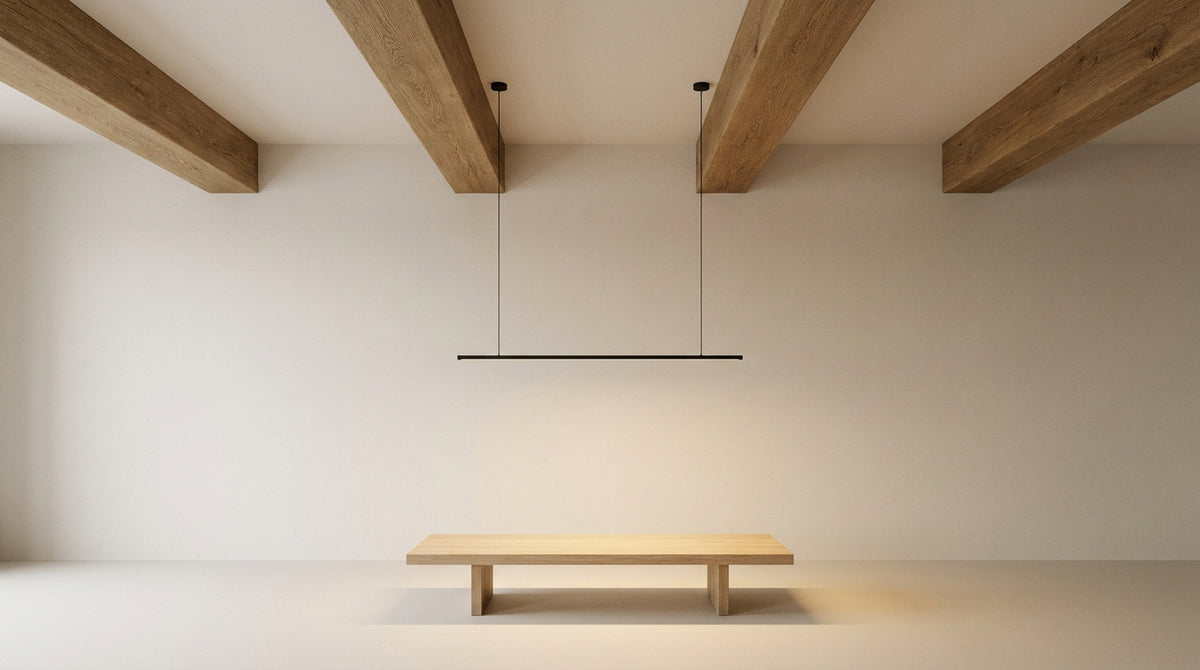
Hang the light on the sides of the beam, never underneath. Two adjustable spotlights placed in the bays between the beams, aimed at the wall, light the room without losing a single centimetre of height. An LED strip set in the upper groove of the beam gives it relief. Count on three different sources rather than a single ceiling line.
How do you light a room with beams?
Light the walls and the floor with spotlights set between the beams, add an LED strip in the upper groove for relief, and keep a low lamp for ambience. The beams stay visible, the room gains depth, and the ceiling height does not move by a millimetre.
An exposed beam quickly costs you thirty centimetres as soon as you hang a bulky volume on it. By spreading the light over several low points, you light better with less power. That is the guiding principle of our design lighting, chosen for its compact volumes that slip between two beams without hiding them.
- Three sources minimum per room: one for the floor, one for the wall, one for ambience
- No low point below 1.90 m in a circulation area
- No grazing beam aimed at the face of the beam, which flattens the grain
LED lighting and exposed beam: where to start
Start at the top. A profile or an LED strip set on top of the beam lights the ceiling by bounce: the wood stands out and nothing hangs in the field of view. A survey of 250 references from our catalogue, taken as of 30 September 2026, shows that 78% carry the LED mention and 24% a dimming function.
In the same survey, 46% are pendant mounts, 32% wall-mounted and 8% surface-mounted. Nearly half are therefore installed somewhere other than the ceiling, which suits beams well. Cases of irregular ceilings are detailed in our article on which ceiling light with beams.
Spotlight on exposed beam, the most discreet solution
An adjustable spotlight set in the bay between beams almost entirely disappears. Aim it at the wall or the floor, never at the wood: grazing light burns out the light tones and flattens the material.
Allow one spotlight every metre in a hallway, and one every 60 to 80 cm in a living room. A compact surface-mounted model avoids drilling into an old beam, sometimes too thin for a recess. Our selection of adjustable spotlights covers both cases.
The layout rules, spacing and distance to the wall, are set out step by step in the guide to installing recessed spotlights in the living room.
When the beams are irregular or the ceiling drops low, the lighting plan is drawn up room by room. That is the work carried out before a renovation of your living room, where each source is positioned before the first drill hole.
Which light fixture under a beam?
A pendant, provided you shorten it. Allow 75 to 85 cm between the lower face of the beam and the bottom of the shade above a table, and 2.10 m of clear passage in a hallway. An adjustable-cable model can be corrected in a minute, whereas a fixed rod imposes its length.
Pendant under an exposed beam, at what height?
The height is measured from the lower face of the beam, never from the ceiling. This is the most common mistake: the cable is set from the ceiling, and the pendant hangs too low because the beam is 20 cm thick.
| Use | Height below the lower face of the beam | Effect |
|---|---|---|
| Above a dining table | 75 to 85 cm | Faces stay lit, no one is in shadow |
| Above a kitchen island | 80 to 90 cm | The worktop stays clear |
| In a hallway | 2.10 m minimum | No one has to duck when passing |
| In an entrance | 2.00 m minimum | The light marks the arrival without getting in the way |
A pendant light with an adjustable cable absorbs the ceiling variations of an old room. For finish, brass and matte black metal hold the contrast with dark wood. Our range of brass pendants plays that card without overloading the ceiling line.
Pendants and ceiling lights that coexist with a beam
 Basic form Gold pendant light
 Basic form Gold pendant light
 Basic form Gold pendant light
 Velora Brown outdoor light
 Bobi 2-light black pendant
 Gentor 4-light white pendant
See the whole selection: Lighting, Home Lighting, Online Lighting Store
Light fixture for a low ceiling with a beam
Below 2.20 m, forget anything that hangs. The solution becomes wall-mounted or surface-mounted: wall lights aimed at the ceiling, track spotlights fixed between the beams, or an LED strip at the top of the wall.
A wall light is mounted around 1.70 m from the floor, or at shoulder height if it serves as a reading light. The precise reference points are in our article on the height of a wall light. Below 2.20 m, a flush LED ceiling light also does the job when no beam crosses the area.
If your beams are irregular or the ceiling drops below 2.30 m, have the layout approved before drilling: this is exactly the kind of trade-off we settle with you beforehand, when you come to talk about your project.
How do you highlight exposed beams?
Light the beam, not the room. A strip slipped into the upper groove, a dimmer to lower the intensity in the evening, and a grazing beam that follows the length of the wood are enough. The beam becomes a decorative feature, no longer just a construction constraint.
LED strip in the beam groove
The upper groove is the space between the top of the beam and the ceiling. A strip placed there lights the ceiling by bounce and draws a regular halo along the wood. The strip itself stays invisible.
- IP20 is enough indoors, on a dry ceiling away from water
- 2700 K to 3000 K for a warm rendering on raw wood
- 60 LEDs per metre minimum, otherwise the light points show on a white ceiling
- Aluminium profile if the strip touches a surface: it dissipates heat
- Remote power supply in the loft or a duct, never on the face of the beam
Our selection of LED strips covers both temperatures. The full installation, power supply and connectors included, is detailed in the guide to installing an LED strip on the ceiling.
Ceiling lighting with exposed beam: the measurements that matter
A grazing beam placed 10 or 15 cm from the wood reveals its grain. Closer, it creates a hot spot; further away, it lights the wall and the beam disappears into shadow.
This technique belongs to accent lighting, the territory of the spotlight: you do not light to see, but to show. Adjustable intensity changes everything in the evening, and the same source can move from one role to another. In the survey of 250 references, only 24% carry the dimmable mention: that is the criterion to check before shape or colour.
For temperature, stay between 2700 K and 3000 K in a wooden living room. Above 4000 K, oak turns grey. Our guide on white or yellow light details the rendering of each value.
How do you dress a ceiling with beams?
You dress the ceiling by contrast, not by camouflage. A light ceiling under dark beams gives height; the opposite crushes it and brings the ceiling closer. On the lighting side, below 2.20 m, only wall-mounted and surface-mounted fittings remain comfortable to live with.
What colour to paint a ceiling with beams?
- White ceiling, raw beams: the room looks taller, the wood remains the focal point
- All in off-white: the volume expands, the beams read through their shadow
- Dark ceiling, light beams: enveloping effect, best kept for large rooms
- Tone-on-tone beams: the ceiling becomes a continuous surface again, useful in a small room
Keep the same family of white on the wall and the ceiling. Two different whites are immediately noticeable at the junction. Another option when height is lacking: remove the central point and compose differently, as in our article on lighting a room without a ceiling light.
Light fixture on a wooden beam: brass, matte black or white
| Finish | On which wood | Effect |
|---|---|---|
| Brass | Raw oak, dark wood | Warms the room and reflects the light |
| Matte black | Pine, fir, light wood | Strong contrast, workshop feel |
| White | Already painted wood | Blends into the ceiling, discreet |
| Raw metal | Grey wood, old oak | Industrial accent without overload |
Our selection is reviewed by buyers, and the reviews published on our Google listing can be consulted freely before choosing.
What is the number one constraint of your beamed ceiling?
The 7 lighting ideas at a glance
Adjustable spotlights in the bays between beams, strip in the beam groove, adjustable-cable pendant, wall lights, surface-mounted track, low supplementary lamp and dimmer. Seven moves, none of which touches the beam itself.
Related reading
In stock · shipping costs shown at checkout · up to 30% off in your cart


Ready to turn inspiration into reality?
Tell us about your room, your style and your budget, and we will show you the pieces that truly suit your project.
Get guidance in 30 seconds →