Pool lighting: the 3 layers that change everything
This article is also available in French: Idee eclairage autour piscine
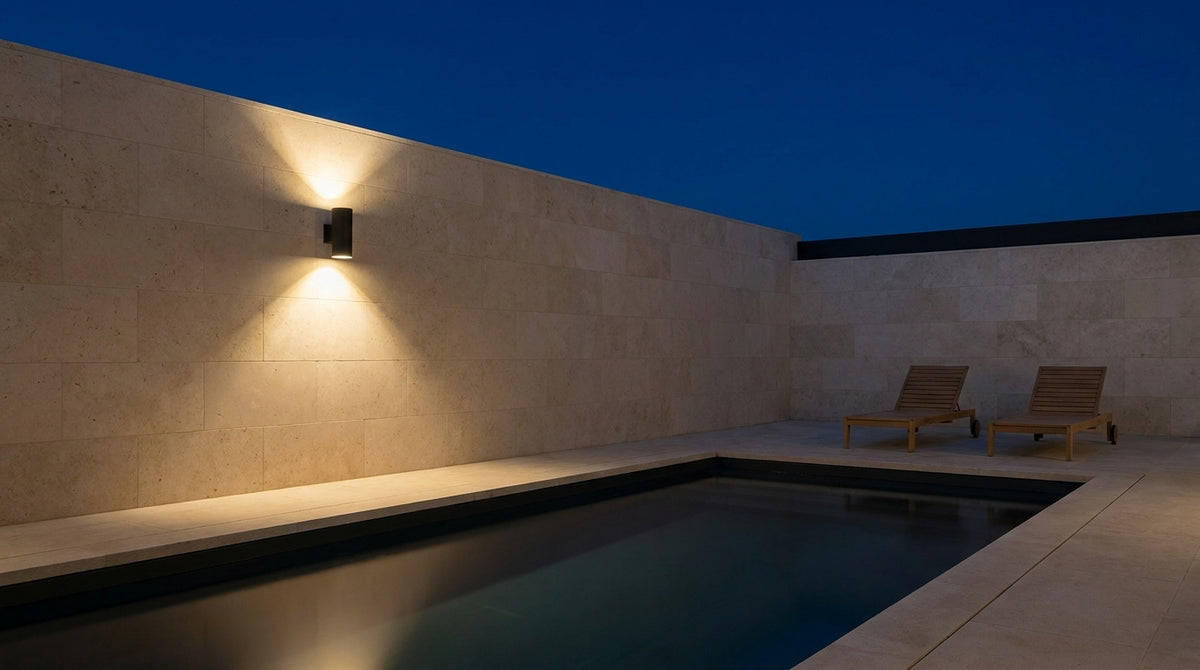
Count three layers, not one floodlight: low-level markers that guide your steps, ambient light on low walls or in beds, then a light aimed at the water for the reflection. Plan two lighting levels, one for walking, one for entertaining. Between 2700 K and 3000 K, and IP65 minimum at the poolside.
How do you light around a pool?
Three light sources placed at different heights: that is what separates a lit pool deck from a lit courtyard. The eye travels down from the wall to the ground, then back up to the water, and the garden becomes a room. For a project carried out in one go, the balcony, terrace and garden lighting project sets out the levels and cable routes before the work begins.
The three layers of lighting around a pool
Each layer has a precise job. Mixing the three gives you either a stadium courtyard or an area too dark to walk barefoot.
- Path markers guide your steps along the pool, out of the line of sight.
- Vertical ambient light outlines a low wall, a facade or a tree trunk.
- Water light comes from a floodlight aimed at the surface.
- The second lighting level switches everything off except the path, to end the evening quietly.
| Layer | Role | Indicative height | Rating |
|---|---|---|---|
| Path markers | Guide steps, secure the pool surround | 40 to 80 cm, in-ground or as a bollard | IP65 |
| Vertical ambient light | Outline the low wall, the wall or a bed | 1.20 to 2 m, aimed downwards | IP65 outdoors |
| Water light | Create the reflection and mark the depth | At pool level, towards the surface | IP67 |
For wattages, the article on terrace lighting around a pool details the areas covered.
One last point: if the floodlight that lights the water is still halogen, switching it to LED changes both the consumption and the colour of the reflection.
Which colour temperature should you choose outdoors in the evening?
Stay between 2700 K and 3000 K. Below that, the light turns orange; above it, it bleaches the foliage and turns the pool deck into a car park.
- 2700 K for stone, wood and period facades.
- 3000 K for concrete, pale tiles and grey coping stones.
- A single tone across the whole pool: mixing two temperatures is immediately visible.
These reference points tie in with the rest of the garden: a warm outdoor atmosphere relies on the contrast between direct and indirect light.
What decoration ideas work for the area around a pool?
The low wall, the seating and the beds do more for the atmosphere than the number of spotlights. Light what is already there: the side of a coping stone, a retaining wall, an olive tree. The pool deck looks bigger as soon as the light outlines it instead of covering it.
The low wall, the most worthwhile spot
One wall light every 2.50 to 3 m draws a continuous line without lighting empty space. The catalogue lists these models under outdoor wall lights, with aluminium bodies and glass diffusers.
- Aimed downwards: the wall receives the light, not the sky.
- Even spacing: otherwise dark gaps break the line.
- Aluminium or treated steel: chlorine and damp air attack everything else.
The seating and the dining area
A dining area by the water is treated like an outdoor dining room. A garden LED string light strung between two posts often creates the pool of light that is missing above the table.
- Suspension height: 70 to 80 cm above the tabletop, out of the guests' line of sight.
- Weatherproof string lights: strung between two fixed points, never on a branch.
- Motion detection on the access path, so you are not hunting for the switch with wet hands.
Under a covered structure, the logic stays the same: lighting a pergola relies on two low points and one well-placed high point.
Outdoor lighting and low-wall lights for pool surrounds
 Wall light | Kena
 Wall light | Lumière Agile
 Wall light | Valara
 Wall light | Zovira
 Wall light | Vivora
 Wall light | Dorven
See the whole selection: Wall light, Wall Lamp and Designer Wall Lighting
How do you design the poolside without glare?
Light what is looked at, not what is walked through. A source visible from the table or the living room window spoils the evening. The eye should see the light resting on a material, never the light point itself.
Marking the paths
One bollard every 3 to 4 m is enough, provided it lights the ground and not the eyes. Steps come first, that is where falls happen. These guidelines on lighting a garden path apply to the whole surround.
- Low bollard rather than a recessed spotlight, easier to reposition.
- Wide beam to avoid patches and harsh shadows.
- Motion detection on the route from the house.
The catalogue offers outdoor bollards for terraces in both spike and wall-mounted versions.
Solar lighting around a pool: what is it for?
Solar suits path marking and ambient light, not lighting the water. A well-exposed bollard covers a summer evening with no trench to dig, and solar LED outdoor lamps solve the problem for a pool that is already built.
- Path markers and string lights: solar is in its element here.
- Shaded areas: avoid, the recharge cannot keep up.
- Submersible floodlight: out of the question, it stays on the mains.
On the wall side, solar lights with motion detection also install without cable, provided they stay in full sun.
Which plants should be uplit around a pool?
Grasses, agaves and slender trunks respond better than a dense hedge. Lit from below, a plant becomes a silhouette; lit from the front, it stays a bush. It is the transparency of the foliage that makes the difference.
Grasses, agaves and low perennials
A small in-ground spotlight, 30 to 50 cm from the base, is enough for a clump of stipa. The beam rises through the stems and creates a volume that daylight never shows.
- Grasses: foliage that filters the light and draws lines.
- Agaves and prickly pears: crisp edges, excellent backlit.
- Grazing light: a very low angle to stretch the shadows.
Trees and specimen plants
On a tree, two points are enough: one at the base lighting up the trunk, one in the canopy if it is high. The silhouette must stay readable from the house, and enhancing a terrace, garden and balcony often comes down to three well-placed points.
- Olive, maple, magnolia: pale trunk, excellent in grazing light.
- Mounting distance: 60 cm to 1 m from the trunk depending on the beam width.
Which IP rating and which mounting around a pool?
Aim for IP65 for everything left exposed, IP44 only under an overhang or a pergola, and IP67 for a floodlight in contact with water. The mounting follows the same logic: wall-mounted when there is a support, surface-mounted otherwise.
IP44, IP65, IP67: which should you require at the water's edge?
The first digit protects against solids, the second against water. An IP44 withstands splashes, an IP65 jets and driving rain, an IP67 temporary immersion. Around a pool, IP44 is only justified under shelter.
- IP44: under a roof overhang, a canopy, an enclosed pergola.
- IP65: low-wall light, bollard, in-ground floodlight.
- IP67: fixture in contact with water or in the splash zone.
Out of a sample of 247 references in our catalogue as of 5 October 2026, 91% state IP20, 5% IP65 and 2% IP44. That explains the difference you feel with an indoor fixture: seals, tempered glass and anti-corrosion treatment cannot be improvised.
When the rating is the main criterion, start from an already filtered selection, such as IP65 outdoor wall lights.
Warranty and certification: what the listings state
Warranty is the second criterion to read. On the same sample as of 5 October 2026, 93% of the 247 references state a 2-year warranty, and the CE mark appears on almost every listing. An outdoor fixture stays outside all year: the warranty period says a lot about the care taken over the seals.
On the installation side, wall-mounted dominates in this sample, which fits a pool surround. Without a vertical support, installing outdoor lighting on a spike means planning the cable route before filling in.
Do you have your configuration and IP rating in mind? Describe your pool and your constraints via the contact page, and we will put together a quantified selection.
What is your layout around the pool?
In stock · shipping costs shown at checkout · up to 30% off in your cart


Ready to turn inspiration into reality?
Tell us about your room, your style and your budget, and we will show you the pieces that truly suit your project.
Get guidance in 30 seconds →