Lighting every room well: the interior lighting guide
This article is also available in French: Bien éclairer chaque pièce : le guide de l'éclairage
How do you calculate the lighting for a room?
Multiply the floor area by the lumens per square metre needed for the use, then spread the total across several sources. A living room needs 100 to 150 lm/m², a kitchen 250 to 300 above the worktop. The result is checked by eye: two soft shadows are better than one dazzling point.
This calculation gives a rough guide, not a prescription. A 20 m² room that needs 2 500 lumens does not need a single 2 500 lumen fixture: three 800 lumen sources, aimed differently, produce more comfortable light. That is the principle behind our lighting collection, where formats combine from one room to the next.
How many lumens per m² depending on the room?
The benchmarks below cover general lighting, to be completed with a directed source.
| Room | Indicative need | Best choice |
|---|---|---|
| Living room | 100 to 150 lm/m² | variable intensity in the evening |
| Kitchen, worktop | 250 to 300 lm/m² | directed light, without cast shadow |
| Bedroom | 50 to 100 lm/m² | warm white below 3 000 K |
| Bathroom | 200 to 300 lm/m² | IP44 minimum within 60 cm of the basin |
Why do lux matter more than wattage?
A watt measures energy consumed, not light received. An 8 W LED can light as much as a 60 W halogen. Lumens say what the fixture produces, lux what the surface receives. That is the whole difference between lux and lumens, and it avoids the classic trap: buying powerful instead of buying suitable.
If you would rather have the lighting plan checked room by room before buying, you can write to us: we answer on heights, colour temperatures and protection ratings, not on a catalogue.
What are the 3 lighting layers to plan for?
Three layers complement each other: general, functional, ambient. The first makes the room usable, the second lights the precise action, the third sets the atmosphere. Remove one and the room stays lit, but flat. It is the combination, not the power, that changes how it feels.
- General: on the ceiling, it covers movement and is switched on first.
- Functional: on the worktop or desk, it lights the action.
- Ambient: at 1.20 m or lower, it warms the walls and corners.
General lighting
A LED ceiling light placed in the centre is rarely enough on its own, but it remains the base: the layer you switch on when you wake up and switch off last. Check the dimming before buying, not after. Out of 247 references in our catalogue on 5 October 2026, 29% state variable intensity.
Task and accent: what the other two layers change
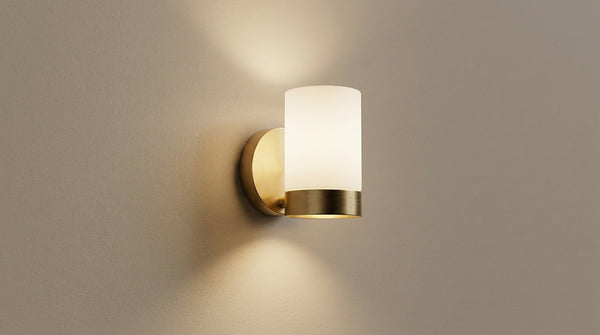
Task lighting lights what you are doing, not the room: it is what removes the shadow of your hand on the chopping board. An adjustable wall light combines both roles, lighting a wall and serving as a reading light.
The third layer, ambient lighting, is judged by the way it shapes materials rather than by the number of lumens. A glass globe and a linen shade do not render the same at equal power.
What lighting for each room, in practice?
One room, one approach: in the living room, three points and variable intensity; in the kitchen, light directed onto the worktop; in the bedroom, warm white placed low; in the bathroom, IP44 above the basin. Mounting height often matters more than the stated power.
The living room
The living room needs three sources, not one: a ceiling light or pendant, a table lamp near the sofa, a third in the opposite corner. To light a living room in three layers, no source should be visible from the sofa without being adjustable.
A dining room chandelier also works in a living area open to the dining room, provided the fixture is lowered to 70 or 80 cm above the tabletop. Too high, it lights the ceiling; too low, it gets in the way of the eyes.
The kitchen and dining room
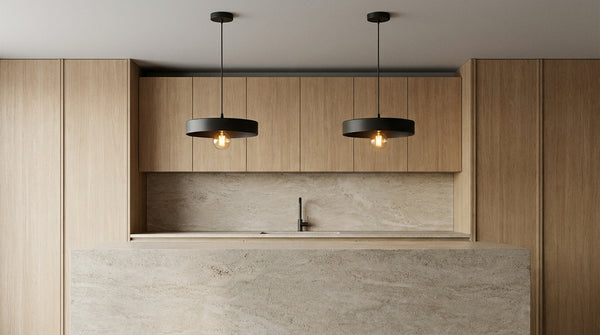
Above the worktop, light falls in front of you, never behind you. That is the principle of task lighting: a source 45 or 60 cm from the wall, under the upper cabinets, removes the shadow of your hands.
For the table, allow for a kitchen pendant at 70 or 80 cm above the tabletop, centred on the axis.
- Height: 70 to 80 cm over a table, 45 to 60 cm over a worktop.
- Temperature: 3 000 to 4 000 K, more neutral than the living room.
- Cap: E27 for a pendant, GU10 for an adjustable spotlight.
The bedroom
In the bedroom, light is placed low: two wall lights at 1.20 m on either side of the bed, aimed at the book and not at the face. The question of which light for sleeping is settled with 2 700 K and an intensity that drops towards the end of the evening.
Where do you lack light most at home?
The bathroom
In a wet room, the protection rating comes before aesthetics: IP44 minimum near the basin, IP65 if the fixture receives splashes. To light a bathroom without seeing two faces in the mirror, place two sources on either side, at eye level.
How a fixture holds up over time in a damp room is best judged from user feedback. Our Google listing makes them available in one click.
When several rooms connect within the same home, an overall plan avoids duplicate purchases. You can entrust your lighting project to the workshop and start from a plan per room.
The Designix selection for lighting every room
 Wall light | Kena
 Wall light | Lumière Agile
 Wall light | Valara
 Wall light | Zovira
 Wall light | Vivora
 Wall light | Dorven
See the whole selection: Wall light, Wall Lamp and Designer Wall Lighting
What lights best: several sources or just one?
Several weak sources spread out light better than a single powerful point. The test takes one hand: place it at working height and look at the shadow. Sharp and black, the light comes from one place. Soft and multiple, the room is properly lit.
The cast shadow test
- Single shadow: one source only, to be completed with a second point.
- Two shadows: correct distribution for reading or cooking.
- No shadow: light too diffused, no material is revealed.
This test replaces the question of power. A very powerful fixture that casts a sharp shadow under the table will remain less comfortable than three modest, well-placed sources.
Cool white or warm white: what temperature changes
Warm white, around 2 700 K, leans towards amber and flatters wood, linen and skin. Cool white, at 4 000 K and above, makes whites sharper but hardens natural materials and tires the eyes at the end of the day. The choice between white or yellow light is made by use, not by taste.
In a home, the temperature stays between 2 700 K in the living room and bedroom, and 3 000 to 4 000 K in the kitchen and bathroom. Mixing two temperatures in the same room is immediately visible.
How do you bring brightness into a dark room?
Light the surfaces, not the floor. A light wall, a ceiling or a large curtain that receives light reflects far more than lighting directed downwards. Aim upwards or at the wall, and multiply the points rather than increasing power.
Light the surfaces, not the floor
- Ceiling: an indirect source bouncing upwards brightens the whole room.
- Wall: lighting the back wall visually enlarges the space.
- Textile: a light curtain crossed by light becomes a source.
A floor lamp adjustable towards the ceiling does this work without drilling anything, and moves when the room changes use.
And if the room has no ceiling light?
Without a ceiling connection, light is built on the walls and furniture: a wall light high up, a table lamp on a shelf, a strip stuck under a shelf. Two 500 lumen points are better than a single 1 000 directed downwards. A dark room is treated by adding points, never by replacing.
In stock · shipping costs shown at checkout · up to 30% off in your cart
Ready to turn inspiration into reality?
Tell us about your room, your style and your budget, and we will show you the pieces that truly suit your project.
Get guidance in 30 seconds →