
Installing a black ceiling light: a step-by-step guide
This article is also available in French: Transformez votre Espace Installation Facile d'un plafonnier noir
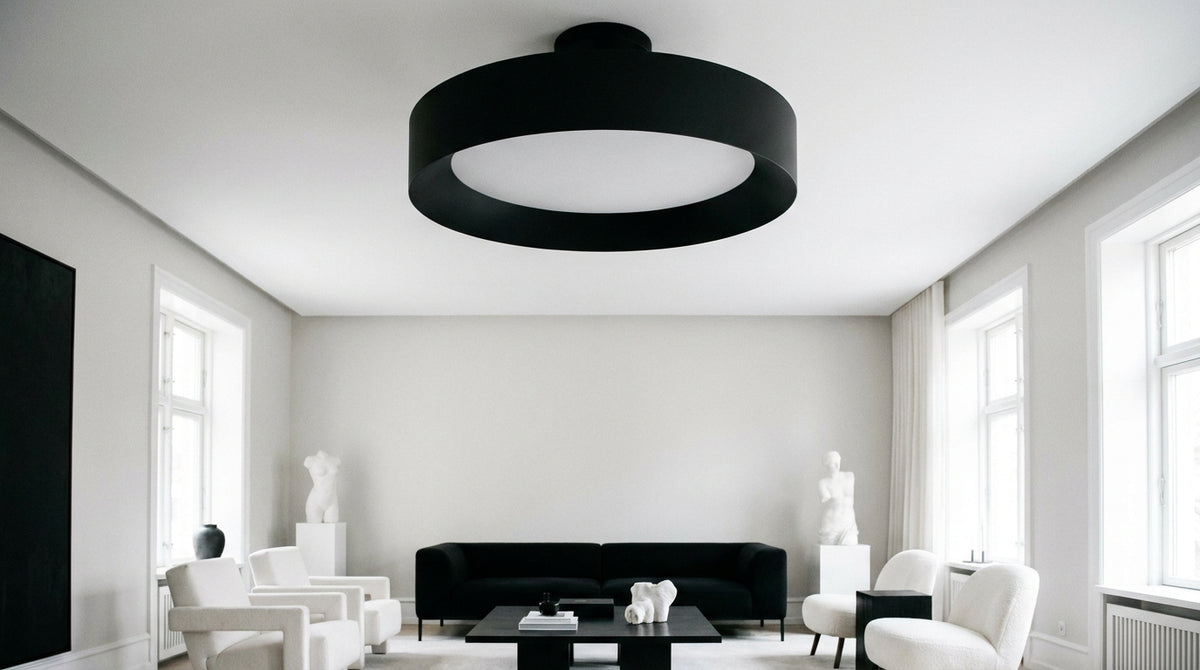
A black ceiling light can transform a room in one fell swoop, but installing it yourself can be daunting: cutting the power, identifying the wires, and mounting it without cracking the ceiling. With the right method and a suitable model, the task is well within reach for a careful DIY enthusiast.
The ceiling is the surface you look at when you lift your eyes, yet it is often the last one we pay attention to: caring for what you see when you look up changes the atmosphere more than any piece of furniture. In terms of selection, the Designix black ceiling light collection includes 1,080 items as of September 14, 2026—plenty to find a calibrated size before you pick up the screwdriver.
How to install a ceiling light?
Cut the power at the main circuit breaker, then verify the absence of voltage with a tester before touching any wires. Identify the live, neutral, and earth wires, connect them to the terminal block or DCL plug, fix the mounting bracket to the ceiling, and clip the fixture on once the connection has been checked.
The detail that ensures everything goes smoothly lies in the order of steps:
- Cut and verify. Circuit breaker off, tester placed on each wire to confirm they are dead.
- Locate the wires. Live (red or brown), neutral (blue), earth (green and yellow).
- Connect. To the terminal block or DCL plug, matching each color.
- Fix the bracket. Using anchors adapted to the ceiling material, whether concrete or plasterboard.
- Clip on and restore power. Then test that it turns on.
Connecting the wires is the stage where most people doubt themselves: following the step-by-step ceiling light wiring guide resolves most hesitations regarding colors and connection direction.
A heavy model or one with multiple arms requires a reinforced mounting point. In this case, it is better to install a heavier lighting fixture with a mounting system sized for its weight.
Once you have the method in mind, if the ceiling lacks a DCL box or if any doubt remains about the connection, it is best to check with our team before drilling.
Which type of ceiling light is easiest to install?
The simplest option is a surface-mounted, IP20-rated ceiling light with a standard GU10, E27, or E14 base. It screws directly onto the bracket without needing ceiling cutouts or recessing. A compact, round model can be installed alone in minutes, and an integrated LED light source even avoids the need to replace bulbs.
Pendant mounting, however, requires managing cable length and counterweights: it is more decorative but less straightforward. For a first project, stick to surface-mounted models.
Our easy-to-install black ceiling lights
 Black and natural braided bamboo 4-spot ceiling light, 73 cm bar | Timor
 Black bamboo cage ceiling light, openwork sphere Ø 31 cm | Sumba
 Black LED ceiling light, Ø 38 cm designer ring with dimmer | Ringlede
 Black ceiling light with gold interior, 2 adjustable spots | Carré
 Large Modern LED Ceiling Light, Powerful and Adjustable | Lumière Zenith
 Wave Ceiling Light | AuroreLux
As for the bulb, the base determines the choice of compatible light sources: this guide on which bulb base to choose prevents you from buying a bulb that will never fit. For an already integrated, energy-efficient source, our LED ceiling light range removes the question entirely.
Can you install a ceiling light without a DCL box or drilling?
Yes. Without a DCL box, you can connect directly to a terminal block with a cable clamp, provided the supply is secured. Without drilling, you can use high-load adhesive mounts for a light model, or redirect the cable to a wall outlet using a hook suspension.
Redirecting the cable remains the most reliable solution when there is no ceiling power outlet: you start from an existing wall outlet and guide the cable along a picture rail. To explore other options, here is how to light a room without a central ceiling point.
Based on 28 pendants from our catalog as of September 14, 2026, 100% are IP20, have a 2-year warranty, and are CE certified. This warranty and CE compliance are detailed by our support and after-sales service team if any technical point remains unclear.
If you are still hesitant about a model or its feasibility in your home, customer reviews on the Designix Google page provide verifiable benchmarks that are continuously updated.
Where to place a black ceiling light in the home?
Anywhere the ceiling is not exposed to water splashes. An IP20 ceiling light is suitable for the living room, bedroom, kitchen, and hallway. It should not be used above a shower or bathtub: in a bathroom, reserve it for a dry area, far from safety zones.
This is the point most guides forget: IP20 protects against solid objects, not water. Any doubt about a room can be quickly resolved with the tool below.
For which room are you looking for your black ceiling light?
The choice of model then depends on the volume and style of the room. For a living room, this guide on choosing the perfect model for your living room helps you determine the right diameter and finish.
Then there is the light itself: a warm tone calms a bedroom, while a cooler tone energizes a kitchen. This comparison of light color temperature per room helps avoid a failed ambiance after installation.
On the same topic
In stock · shipping costs shown at checkout · up to 30% off in your cart

Ready to turn inspiration into reality?
Tell us about your room, your style and your budget, and we will show you the pieces that truly suit your project.
Get guidance in 30 seconds →


