LED strip under a kitchen cabinet: install it without the kitsch
This article is also available in French: Installer ruban led sous meuble cuisine

Measure the length of each wall cabinet, run the strip set back 15 to 20 cm from the wall, powered by a 12 V driver plugged into a switched socket. Stay between 2700 K and 3000 K, aim for 8 to 12 W per metre and house the strip in an aluminium profile: the light stays even, with no visible dots.
How do you install an LED strip under a kitchen cabinet?
Fix the aluminium profile under the cabinet, set back from the edge, stick the strip inside it, connect it to the power supply and close the diffuser again. Cut on the marked points, test the light before screwing, and keep the strip out of reach of splashes from the worktop.
On a kitchen renovation project, you draw the circuits first, then the strips. The strip highlights the worktop, it never replaces the room's general light.
The choice then comes down to LED density per metre. A COB LED strip erases the light dots visible on a pale laminate, where a classic strip leaves them showing.
A well-fitted strip is invisible: it lights the worktop without glare. That is the principle of a well-lit kitchen, where every source keeps a precise role.
How do you wire an LED strip without a socket?
Two options: a socket switched by a wall switch or remote control in the base cabinet, or a driver connected to the existing lighting circuit. The strip is never wired straight to 230 V, it always goes through a 12 V or 24 V transformer.
When the length exceeds what the driver can handle, start a second segment rather than soldering two offcuts together. The method is detailed in our guide to connecting an LED strip without a connector.
What should you stick an LED strip with?
The original adhesive holds on a smooth, clean surface, never on bare wood or a dusty panel. Clean with alcohol, let it dry, then press firmly for thirty seconds.
- Aluminium profile: the most durable solution, the adhesive works inside a smooth rail
- Fixing clips: for painted or uneven surfaces, removable without marks
- Reinforced adhesive: acceptable as a stopgap, avoid near the hob
- Screws and saddles: when the strip heats up, adhesive alone eventually gives way
How do you light a kitchen worktop?
Layer two sources: a strip under the wall cabinets for task light, and general ceiling lighting for the rest. Aim for 2700 K to 3000 K under the cabinet, 4000 K if you chop or read recipes, and 8 to 12 W per metre.
Lighting the kitchen: the selection to see


The strip does not do everything. Above an island or a table, a kitchen pendant brings the light down to working height and structures the room, where the under-cabinet strip merely lights the edge of the worktop.
Which LED strip should you use to light a room?
Choose the temperature before the power. Under a wall cabinet, 2700 K to 3000 K make the kitchen warm and flattering for food. Above 4000 K, the light turns blue and tires the eyes late in the evening.
Power is calculated per metre: 8 W/m is enough on a standard worktop, 12 W/m if the worktop is dark or wide. Our article on white or yellow light helps you decide according to the room.
To light the whole space, the question is no longer the strip but the fixture. Our LED pendant collection for kitchens lists 2265 references as of 28 September 2026; in a sample of 250 of them, a 5-year warranty is stated on 78% of the product pages.
12 V or 220 V LED strip: which should you choose?
220 V simplifies long runs, 12 V stays thinner and safer under a cabinet.
| Criterion | 12 V or 24 V strip | 220 V strip |
|---|---|---|
| Power supply | External driver, housed in the base cabinet | Directly on the mains |
| Installed length | One driver per section, otherwise the light drops at the end of the run | Long runs on a single connection |
| Thickness | Very thin, slips into a discreet profile | Wider, noticeable underneath |
| Safety | Low voltage, no risk on contact | Keep to out-of-reach locations |
On a pale laminate worktop, choose a strip with closely spaced LEDs rather than a powerful one: the light should be even, not intense. Our decor and lighting tips detail each case by kitchen type.
Where should an LED strip go under cabinets?
Under the wall cabinets, 15 to 20 cm from the wall, never in your line of sight when you are standing at work. The strip sits set back from the cabinet edge so the light falls on the worktop and not in your eyes.
Under the cabinets, the light falls in a tight wash. It does not replace the kitchen light that illuminates the whole room, higher and wider.
How do you hide an LED strip?
The light shows, the strip does not. Three setups make the strip invisible.
- Recessed profile: routed into the cabinet thickness, only the diffuser sits flush
- Fin profile: screwed under the cabinet, it sets the strip back a few millimetres
- L-shaped groove: fixed to the cabinet edge, it hides the strip from the room
- Side cover: useful when the cabinet is visible from the dining room
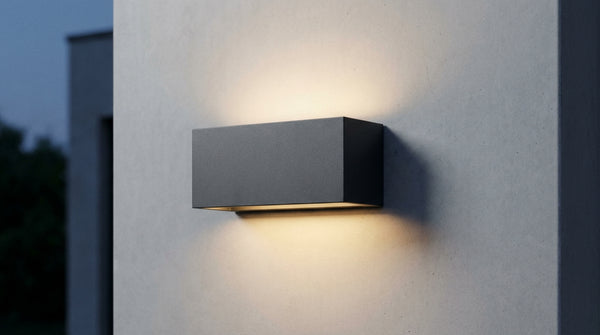
When the under-cabinet space cannot carry anything, a kitchen wall light in LED does the same job from the wall, with a more deliberate look.
How do you fix an LED strip without adhesive?
With clips, a screwed profile or saddles: three mechanical fixings that depend neither on paint nor on dust.
- Screw-on clips: every 20 to 30 cm, they hold the strip without squeezing it
- Screwed profile: the strip clips into the rail, nothing touches the cabinet
- Saddles: discreet on a cabinet edge, they come off without marks
- Trunking: to run the cable between two cabinets without drilling wide
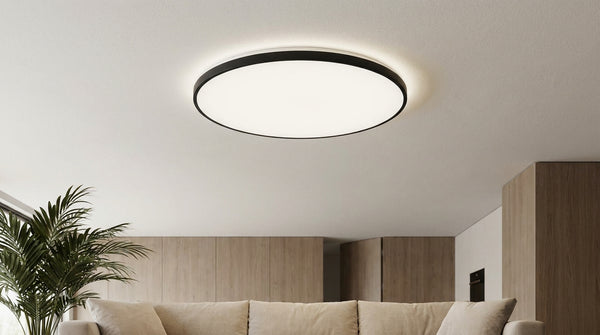
These discreet fixings let the rest of the room take centre stage. Above the worktop, a flat LED ceiling light keeps the light from dropping into your field of view.
In an open kitchen, a kitchen chandelier hung above the table creates the contrast a room full of under-cabinet lighting lacks.
Where should your under-cabinet light fall?
If the light above your island feels unbalanced, our article on multiple pendants to balance an island's light shows how to spread several points.
How much does a kitchen LED strip use and how do you make it last?
A 3-metre strip at 8 W per metre uses about 24 W, less than a 40 W halogen bulb for equivalent lighting on the worktop. Lifespan depends mainly on heat: a strip stuck on bare heats up more than one housed in a profile.
Do LED strips use a lot of electricity?
No, as long as you stay within useful power levels. Consumption is easy to work out: power per metre multiplied by the installed length.
- 8 W/m: 2 m under a wall cabinet, so 16 W, the consumption of a small bulb
- 12 W/m: 36 W over 3 m for a wide or dark worktop
- Power supply: its standby consumption remains negligible
- Dimmer: halving the intensity cuts consumption by the same amount
Do LEDs pull off paint?
Yes, when the adhesive is removed cold: it takes the paint layer with it. Warm the strip with a hairdryer, pull slowly and parallel to the surface.
On a painted cabinet or a freshly painted wall, go straight to clips or a screwed profile: the problem no longer arises.
If you would rather have the layout and power supply checked before drilling anything, our page to talk about your project is exactly for that: describe the kitchen, get an answer.
For the electrical side, our guide to wiring an LED covers the connections and the mistakes to avoid.
On the same subject
In stock · shipping costs shown at checkout · up to 30% off in your cart


Ready to turn inspiration into reality?
Tell us about your room, your style and your budget, and we will show you the pieces that truly suit your project.
Get guidance in 30 seconds →