Round ceiling light for the living room: the right size, the right light
This article is also available in French: Plafonnier rond salon
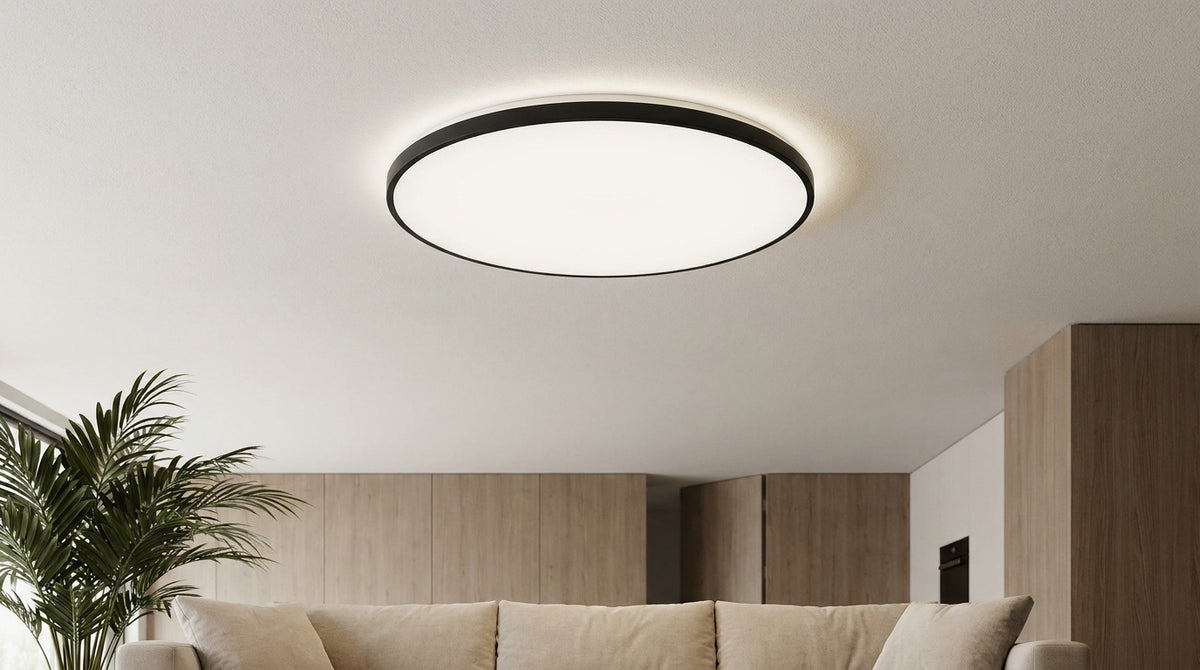
Measure the living room in metres and add width to length: the total, read in centimetres, gives the diameter of the round ceiling light. A 5 m by 4 m living room therefore calls for a model of 36 to 40 cm. This rule overestimates as soon as the ceiling drops below 2.50 m, hence the height check before confirming.
What diameter of round ceiling light for a living room?
Add the width and length of the living room in metres: the total, read in centimetres, gives the diameter of the round ceiling light. A 5 m by 4 m living room therefore needs about 40 cm. Below 30 cm, the fixture gets lost on the ceiling; above 60 cm, it overwhelms it.
Diameter cannot be read on its own: the projection matters as much as the width. A flat 45 cm round looks more discreet than a 35 cm globe. That is why the selection of ceiling lights for the living room should be compared sheet by sheet, at equal diameter.
Small living room: the round that does not overwhelm the ceiling
Under 20 m², a 30 to 35 cm round is enough, provided it stays close to the ceiling.
- Projection under 12 cm to keep some air under the ceiling
- Opal diffuser that spreads light widely, with no hot spot in the centre
- Light tone that blends into a white ceiling, where black accentuates it
- Additional sources that complement without overloading the central point
The most accurate layouts on a small surface are detailed in our guide to the ceiling light for a small living room.
Large living room: the diameter that holds the volume
Beyond 30 m², a 50 to 60 cm round holds the volume. The total-in-centimetres rule still applies, but it ignores ceiling height and the position of mouldings.
- Ceiling at 2.80 m and above can take a large diameter, or even a short stem
- Through room prefer two light points to a single very wide one
- Existing ceiling rose use it as a template rather than a constraint
In an older flat, the ceiling rose often dictates the format. Our article on the minimalist Haussmann-style ceiling light shows how to use it instead of hiding it. And the shapes that are coming back right now are gathered in our watch on the trendy living room ceiling light.
Hesitating between two diameters for your living room? Describe your room and leave with the right dimension, without ordering blind: ask for advice on the right dimensions.
At what height and at what distance should a round ceiling light be installed?
In the centre of the room, the round lights the whole space and sits at the midpoint of the living room. Above the sofa, it moves 60 or 80 cm from the backrest for reading. In both cases, the bottom of the fixture stays at least 2.10 m from the floor.
When the living room also serves as a dining room, it is the whole set of light layers that should be planned, not just the central point. Our page on the living room lighting project details this distribution.
Above the sofa or in the centre of the room?
The geometric centre suits a living room with no strong constraint. Offset it as soon as a sofa or a table occupies the middle.
- Centre of the room for general lighting, with no marked shadow area
- Offset over the sofa when reading and conversation dominate
- Aligned with the table if the living room doubles as a dining room, to avoid shadows on the plates
Low ceiling, high ceiling: what changes
At 2.40 m, a flush round with 8 cm of projection is enough: lowering it closes the room in. At 2.90 m, a model hung on a short stem brings back presence. This is where a round chandelier or a pendant takes over from the ceiling light, and our guide to lighting your living room effectively compares the two approaches.
The installation stays simple on an existing point, provided you switch off the power and check the load taken by the hook. Our tutorial on installing a ceiling light covers the steps.
Two installation heights are sometimes both defensible in the same room. Buyer reviews published on the Designix Google listing then help decide on the expected rendering.
Round ceiling lights for the living room: the Designix selection


Integrated LED round ceiling light or E27 socket: what should you choose?
Integrated LED for even light and a very flat fixture, with no visible bulb. E27 socket to change the power, the shade or a blown bulb, with a much wider choice of modules. The LED module cannot be replaced: that is the only real trade-off.
| Criterion | Integrated LED | E27 socket |
|---|---|---|
| Rendering | Diffuse, with no hot spot | Depends on the bulb chosen |
| Repair | Module to be replaced | Bulb changed in a minute |
| Dimming | Provided or not, to check on the sheet | Depending on the bulb fitted |
| Thickness | Very low | Slightly more pronounced |
Integrated LED: the flat rendering, the maintenance to plan for
- Evenness across the whole surface of the diffuser
- Saving height under a 2.40 m ceiling
- Replacement of the module to anticipate, it is not sold separately in shops
Flat models are easy to spot in our LED ceiling light selection, where the thickness is given sheet by sheet.
E27 socket: the light you can correct
An E27 socket lets you adjust the shade and the intensity without changing the fixture.
- Replaceable bulb without taking down the ceiling light
- Adjustable power according to the surface to cover
- Wide choice of temperatures, from warm white to neutral white
The right rating is explained in our article on bulb power for a living room, and compatible modules are grouped in the E27 cap bulbs.
What light temperature for a living room?
2700 K for a warm living room, 3000 K for a slightly crisper white. 4000 K and above cools the room: the light drifts towards the office and dulls wood, linen and brass. The shade is chosen before the power, it changes the rendering more.
2700 K or 3000 K: what the eye sees
- 2700 K an amber halo, ideal in the evening and on warm materials
- 3000 K a crisp white that keeps relief on coloured walls
- Dimming more useful than chasing lumens, to go from dinner to reading
To compare the two shades side by side, our article on white or yellow light details the cases.
Why 4000 K cools a living room
A cold white desaturates fabrics and deepens shadows on faces. Keep it for work rooms: kitchen, office, workshop. To gauge the amount of light without raising the temperature, the useful reference remains the lumen calculation: our article on how many lumens for a living room gives the method by surface.
Materials and colours: what stands the test of time
Black metal and patinated brass age well and clean with a dry cloth. Opal glass diffuses without glare, but keeps marks. Matte white stays the most discreet on the ceiling, gold accentuates a moulding.
Black metal, brass, opal glass
- Black metal structures a white ceiling, shows dust on matte finishes
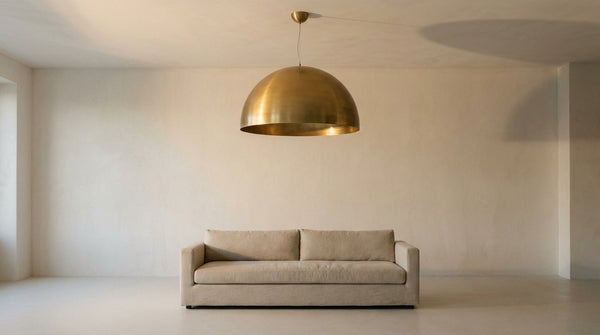
- Brass patinates and warms a living room in natural shades
- Opal glass softens the light, requires cleaning without abrasive products
Black finishes are chosen according to the light in the room, not just the style: our guide to the black ceiling light for the living room details this point. The shades coming back this season are gathered in the 2026 ceiling light trends.
The real maintenance of a round ceiling light
- Dusting with a microfibre cloth, twice a year, with the power off
- Removable diffuser for washing in warm water, without detergent
- Fixing points to be checked once a year on an old ceiling
In stock · shipping costs shown at checkout · up to 30% off in your cart


Ready to turn inspiration into reality?
Tell us about your room, your style and your budget, and we will show you the pieces that truly suit your project.
Get guidance in 30 seconds →