Two-ring lampshade: make it or choose it
This article is also available in French: Comment faire un abat jour avec 2 cercles
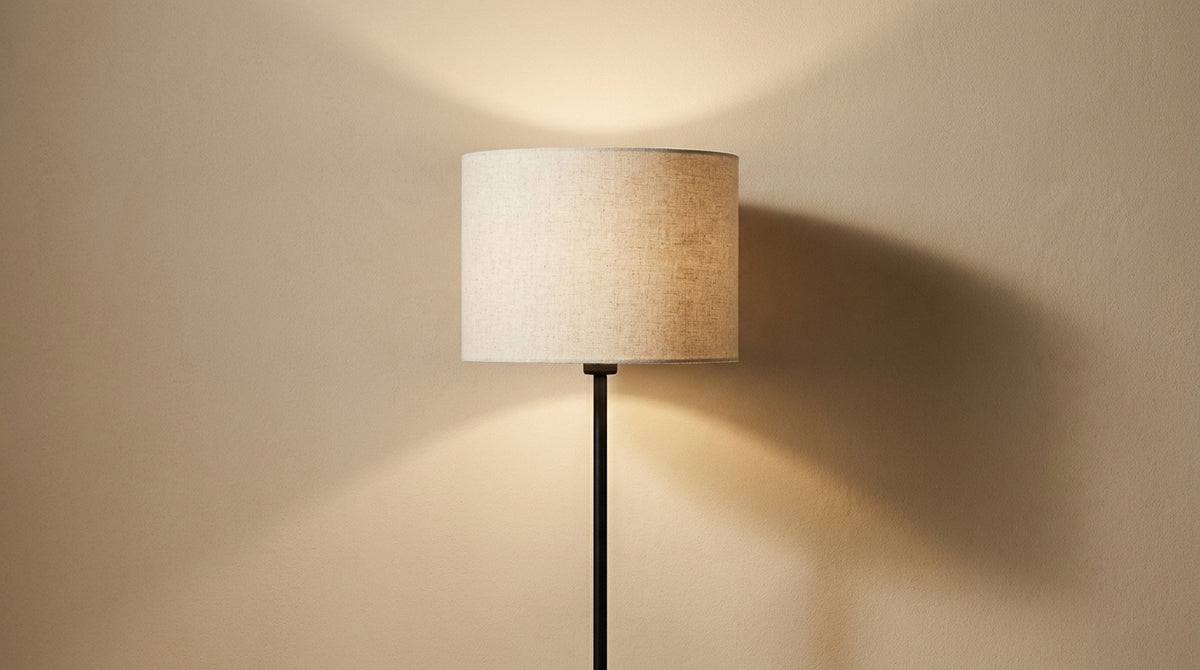
Cut the polyphane strip to the desired height, close it around two rings of the same diameter, E27 ring facing up. Aim for a height close to the diameter of the large ring: any taller, the frame opens into a slack cone and light escapes from the bottom.
What is a two-ring lampshade, and why is it enough?
Two rings joined by a rigid strip form the simplest lampshade frame there is: a cylinder. The top ring carries the ring that holds the socket, the bottom one holds the stretched skirt. No welding, no bending: the shape holds through the tension of the strip.
How to make a lampshade yourself?
Start from a frame that is ready to assemble. The ring is already welded at the right diameter, and that is precisely the hardest step to get right by hand.
- Top ring: it carries the central ring, usually for an E27 socket
- Bottom ring: bare, it sets the diameter of the skirt
- Polyphane strip: glued to both rings, it locks the shape
- Clothes pegs: they hold everything while the glue sets
Across a survey of 27 references from our lampshade collection as of 27 September 2026, the E27 socket appears on 96% of the listings and the IP20 rating on 96%. That collection brings together 789 references on the same date: the ringed cylinder remains the format that screws on anywhere.
Before gluing, look at the base. A tall cylinder sits well on a slender stem, a wide cone calls for a solid base. Our home lighting is often chosen for its base, with the lampshade coming afterwards.
How to make a wire lampshade?
Bend two metal wire rings of the same diameter, then join them with vertical struts, tied or welded. For a cylinder, two rings are enough: the rigid strip acts as the strut.
- 2 to 3 mm wire: rigid enough not to deform when tightened
- Three struts: the minimum for a cone, unnecessary for a cylinder
- Socket ring: to be salvaged from an existing frame, never improvised
Wire requires a clean weld, a rare tool in a home workshop. If the urge is to make rather than repair, our guide to redoing or choosing your lampshade breaks down the steps without welding.
How to make a lampshade with 2 rings?
Wrap the polyphane strip around the two rings, adhesive side facing inwards, with 2 cm of overlap. The ring with the socket ring goes at the top. Allow a height close to the bottom diameter for a cylinder, a third less for a cone.
Across the table and pendant lampshades in our selection, this assembly comes up on the Rond, Goutte and Tube shapes. The gesture does not change, only the proportion varies.
What can you do with polyphane?
Polyphane is a rigid, translucent plastic sheet, sold with an adhesive backing. It acts as the structure: glued to both rings, it holds the shape and diffuses the light without filtering it.
- Structure: the strip replaces the metal struts
- Diffusion: translucent, it lets light through while softening it
- Support: fabric and paper are glued on top, never underneath
- Cutting: with scissors, a clean line with no chipping on the edges
What can replace polyphane in lampshades?
Thin cardboard, stiffened Japanese paper and woven raffia can replace it, each with its own limit.
| Material | Light rendering | Durability | Difficulty |
|---|---|---|---|
| Adhesive polyphane | Neutral, uniform | Good, does not deform | Low |
| Thin cardboard | Amber, warm | Average, sensitive to humidity | Low |
| Japanese paper | Soft, highly diffusing | Low, tears when cleaned | Average |
| Raffia or wicker | Strong cast shadow | Very good | High, requires a frame |
To tint polyphane or cardboard, paint is applied before assembly: a lampshade to paint takes a thin coat, never once glued, otherwise the drips dry in the folds.
Fabric is what makes the most projects fail. Glued flat, it wrinkles as it dries. Apply the polyphane strip well stretched, then smooth the fabric from the centre outwards. For a second life at low cost, changing the fabric of a lampshade costs less than a new frame.
How to calculate the dimensions of a lampshade?
Take the diameter of the bottom ring as your base. For a cylinder, the strip height equals that diameter. The length to cut follows the circumference, that is the diameter multiplied by 3.14, plus 2 cm of overlap for gluing.
- Bottom diameter: it gives the height of a cylinder
- Strip length: diameter multiplied by 3.14, plus 2 cm
- Top diameter: identical for a cylinder, smaller for a cone
- Base height: the lampshade takes up about half of it
The most closely watched proportion remains the lampshade size relative to the lamp base: too short, the lampshade squashes the lamp, too long, it crushes it.
Which material for a lampshade?
Linen dominates by far. Across the same survey of 27 references as of 27 September 2026, linen appears on 52% of the listings, metal on 30%, fabric on 26% and velvet on 15%.
- Linen: visible weave, warm light, dusted with a brush
- Metal: light directed up and down, immediate care
- Velvet: strong absorption, best kept for rooms without direct sunlight
- Fabric: the easiest material to stretch over a cylinder
A fabric lampshade is cleaned dry, without products. Our method for cleaning a fabric lampshade avoids the mistake that stains the weave.
How to lengthen a lampshade?
Three levers, from the simplest to the most involved: raising the socket on a base
In stock · shipping costs shown at checkout · up to 30% off in your cart


Ready to turn inspiration into reality?
Tell us about your room, your style and your budget, and we will show you the pieces that truly suit your project.
Get guidance in 30 seconds →