Black and white pendant lights: contrast that structures the room
This article is also available in French: Suspension noir et blanc
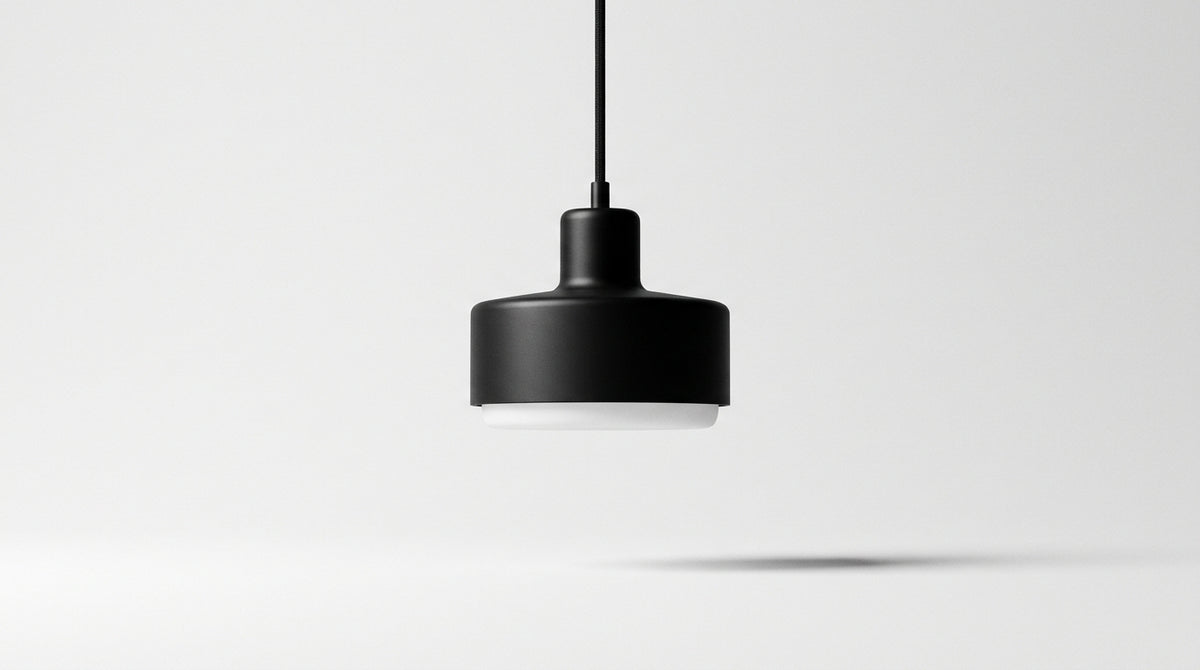
Set the drop between 75 and 85 cm above the tabletop, and leave 2.10 m clear under the shade in a walkway. Choose a model with an E27 socket: you keep the choice of bulb, and therefore of colour temperature. Black and white is not about the colour of the fixture, but about the way it carves out the light.
What is a black and white pendant light?
A pendant light is a fixture held to the ceiling by a cable or a rod, whose light is concentrated downwards, onto a specific area. A chandelier diffuses in every direction, with several sources. Black and white is not added to the room: it draws a silhouette in it.
Pendant or chandelier: what difference does it make in practice?
A pendant light illuminates a table, an island, a reading corner. A chandelier lights the whole room. One makes a cone of light, the other a luminous ceiling, and the choice comes down to use before style. Our lighting and decoration advice breaks this down room by room.
The line blurs with multi-globe models: they light widely while remaining suspended. To decide, look at the number of sources and the shape of the shade, not the product sheet. A dedicated article explains how to tell a chandelier from a pendant light using concrete cases.
Which shapes and materials for a black and white pendant light?
The material decides how hard the result looks. Matte black metal absorbs light and deepens the contrast; a white shade reflects it and softens it. Black and white is therefore chosen through the pairing of shape and material, rarely by colour alone.
- Tube: a long silhouette, made for an island or a worktop
- Globe: diffuse, it lights widely and forgives small spaces
- Arc: the cable curves, the light moves without drilling the ceiling
- Black metal: sharp contrast, light directed downwards
- White or opal glass: soft light, few reflections on the walls
Across a survey of 135 pendant lights in our catalogue as of 15 November 2026, black and white are declared on 99% of the product sheets, metal on 39% and glass on 25%. The duo is not a seasonal trend: it is the backbone of the catalogue. The white/black collection counts 277 references on the same date, and the white/black shades form its graphic core.
How do you adjust the height of a pendant light?
Measure from the bottom of the shade, never from the ceiling: allow 75 to 85 cm above a table, 2.10 m in a walkway, and never less than 2 m above a circulation floor. A cable that is too long is shortened while keeping a few centimetres of slack in the box.
At what height should you hang a pendant light above a table?
| Configuration | Drop under the shade | Reference |
|---|---|---|
| Round table of 100 to 120 cm | 75 to 85 cm | A single fixture 40 to 50 cm in diameter |
| Rectangular table of 180 cm | 75 to 80 cm | Two or three aligned points, spaced a third of the length apart |
| Island or worktop | 75 to 90 cm | Above eye level, never in front of it |
| Hallway, walkway | 2.10 m from the floor | Nothing to bump into, diameter under 25 cm |
Over a round table, the width of the shade should extend 20 cm beyond the tabletop on each side so that the plates stay lit. Over a large dining table, a dining room chandelier covers the whole length better than a single short piece.
How do you offset a pendant light when the fixing point is off-centre?
The fixing point stays at the centre of the box, the shade is offset by 20 to 40 cm. Three solutions are enough, without touching the ceiling or redoing the wiring.
- Offset ceiling rose: the plate screws onto the box, the cable runs to the desired point
- L-shaped bracket: rigid, it holds a heavy shade without swinging
- Angled hook: discreet, it is used when the offset stays under 30 cm
A model with an adjustable cable can still be corrected after installation: the length is adjusted with a clamp, without cutting. A height-adjustable pendant light is thus adjusted in two minutes, once the furniture is in place.
If the room is already furnished and only the light point remains to be decided, the selection of living room pendant lights can be browsed by diameter and by material.
Black and white pendant lights: the selection to compare


Which pendant light for each room?
In a bedroom, aim for diffuse light and a closed shade, so as not to dazzle from the bed. In a hallway, the drop goes to 2.10 m and the fixture stays narrow. Under a low ceiling, a short pendant or an offset model replaces the long shade.
Which pendant light for a bedroom?
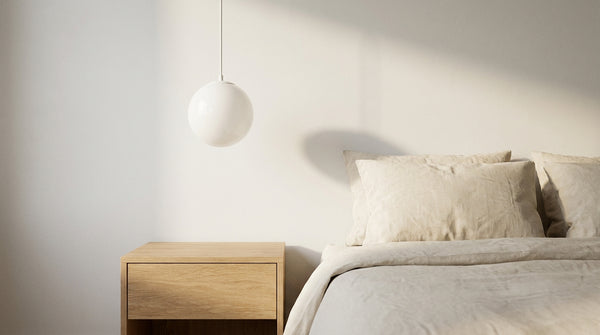
A bedroom copes badly with a cone directed at the pillow. Allow a shade 30 to 40 cm in diameter, white or opal, and a drop that leaves the bed clear. The light should fall on the walls, not in the eyes.
- Opal white: soft light, no hard shadows on the walls
- Diameter 30 to 40 cm: the right proportion above a 140 or 160 bed
- E27 socket: lets you go from a warm light to a more neutral one without changing the fixture
For a more enveloping result, a white pendant light in the bedroom is placed 90 cm above the floor on each side of the bed, or a single one in the centre. White shades give this result without metallic reflection.
Which pendant light in a hallway?
A hallway needs grazing light and zero obstacles. The pendant often loses out to the wall light there: if you install one, keep 2.10 m clear under the shade and a diameter under 25 cm.
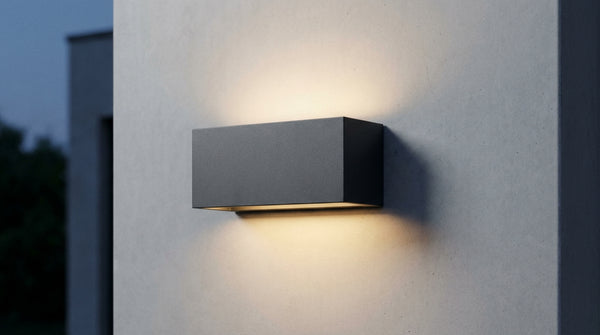
In a narrow hallway, hallway wall lights take over: they light the walkway without hanging anything in it, and black and white gains sharpness there.
Which pendant light with a low ceiling?
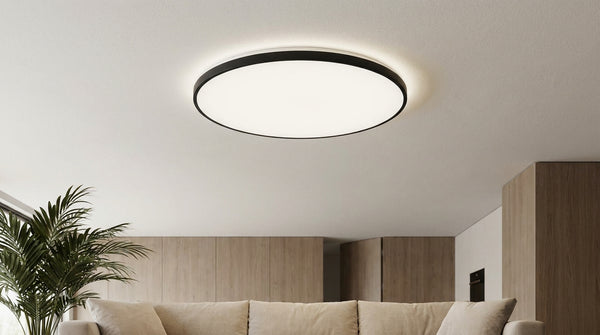
Under 2.40 m, the pendant stays short: 20 to 30 cm of drop above a table, and never above a walking area. An offset model or an LED ceiling light frees up the height without giving up the contrast.
In a living room under a slope, it is better to multiply low points than to have a single central fixture. A living room lighting project is then drawn with the slope, not against it.
How do you install a pendant light on a DCL box or without a ceiling rose?
Cut the power at the breaker, unscrew the box cover, connect live and neutral to the terminal block, then screw the plate onto the two screws of the base. Without a box, a cable must be brought from an existing point, conduit included, and the connection redone.
How do you install a pendant light on a DCL box?
The DCL box is a standardised base screwed to the ceiling, with three terminals and two spacing screws. The pendant is fixed to it in a few minutes, without drilling a new hole.
- Breaker off: check that there is no voltage before unscrewing
- Terminal block respected: live, neutral and earth in the order of the base
- Plate aligned: the two screws of the box act as a guide
The full method, screw by screw, is described in our guide to installing a pendant light on a DCL box, including the case of an old base without spacing screws.
How do you hold a pendant light to the ceiling without a ceiling rose?
Two options depending on the support: a hook with a plug in concrete, or a ceiling rose screwed into an anchor suited to plasterboard. The weight of a pendant stays low, but the cable must be held so it does not pull on the terminals.
- Plasterboard: toggle anchor, never a simple plug
- Concrete: hammer-in plug, threaded hook
- Wood: wood screw straight into the joist, not into the board
The connection step is the same as for any suspended fixture; our tutorial to install a suspended ceiling fixture covers the wiring part. If in doubt about the support, a Designix adviser settles it before drilling, and our Google listing gives the workshop address in Vaulx-en-Velin.
On the same survey of 135 references as of 15 November 2026, 96% show a 2-year warranty and 93% are surface-mounted. Two benchmarks that matter when choosing between two similar models.
In stock · shipping costs shown at checkout · up to 30% off in your cart


Ready to turn inspiration into reality?
Tell us about your room, your style and your budget, and we will show you the pieces that truly suit your project.
Get guidance in 30 seconds →