How to choose your lighting: a room-by-room method
This article is also available in French: Comment Choisir son Eclairage de Manière Avisée ?
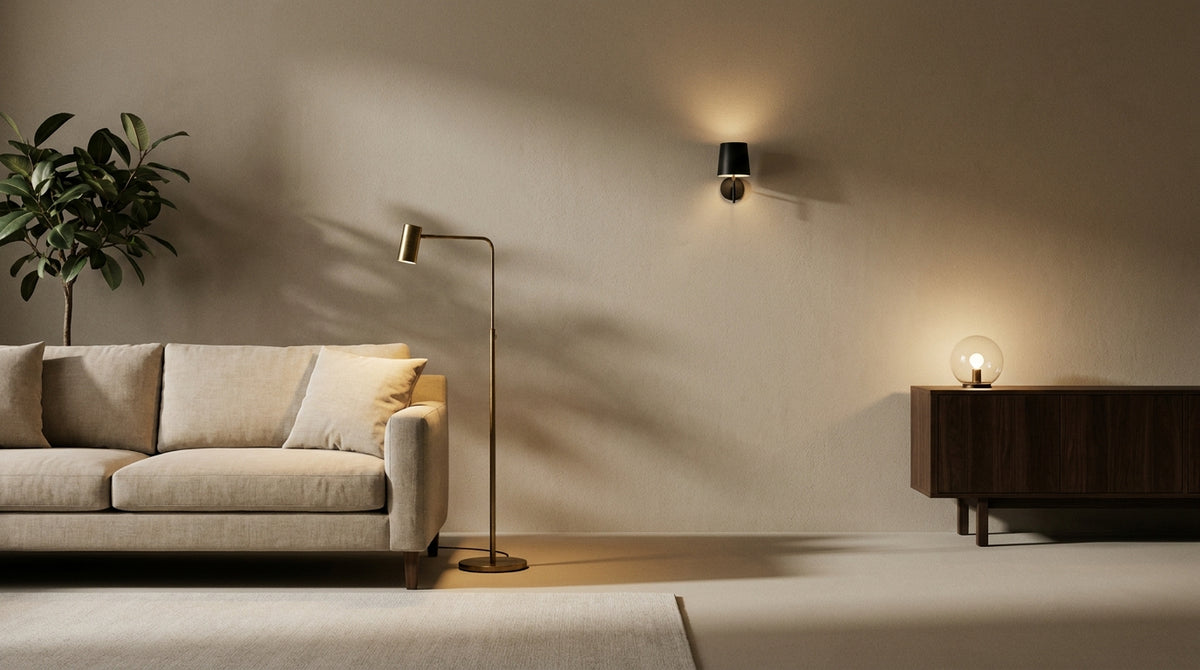
Add up the lumens suited to the surface you want to light, then spread them across several sources placed at different heights: a pendant above the table, a floor lamp in the corner, a wall light on the wall. Three layers (ambient, task, accent) beat a single central fixture, however powerful.
What are the 3 types of lighting?
Three layers cover every use: ambient lighting, which sets the general level in the room, task lighting, which lights a specific action such as reading or cooking, and accent lighting, which highlights a wall, a picture or a material. A single fixture can play two roles.
Our catalogue holds 25,950 light fixture references as of 30 September 2026, sorted by room, style, colour and ingress protection. That depth changes one thing: you compare on the spot, without opening ten tabs. Browsing the lighting collection is enough to set up the three layers of a room.
How do you create ambient lighting?
This is the layer that decides how a room looks. Aim for 2700 K to 3000 K, a diffuse flux and a moderate intensity: the light should bathe the volumes without drawing hard shadows on the floor.
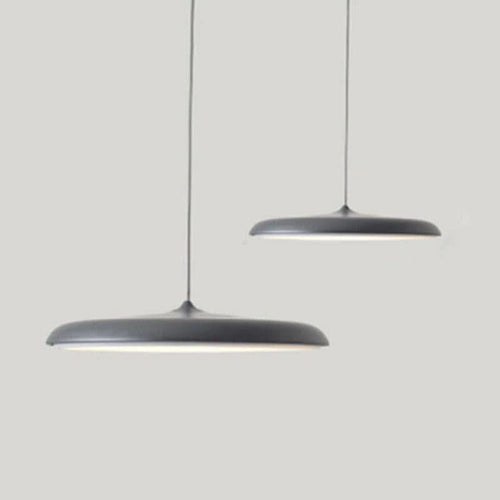
A fairly wide pendant light fills this role better than a narrow point. For the basic principles, the article on what ambient lighting is details the various cases.
What does task lighting involve?
A directed flux, placed less than a metre from the surface in use: worktop, desk, bedside table. Allow 4000 K to stay sharp on text or a cut. Our task lighting guide gives the distances for each use.
What is accent lighting for?
A brushstroke of light that points to an object, a plant, a material or a wall. 2700 K, narrow flux, higher intensity than the ambient layer: that contrast is what creates depth. See accent lighting for the aiming angles.
| Layer | Role | Temperature | Where to place it |
|---|---|---|---|
| Ambient | General level, without hard shadows | 2700 K to 3000 K | Ceiling, large pendant |
| Task | Light a specific action | 3000 K to 4000 K | Worktop, desk, bedside |
| Accent | Highlight a volume | 2700 K | Wall, niche, plant, picture |
A fixture can cover two layers at once, never all three. If the choice stays unclear, the article on choosing the right type of lighting goes through each case.
Which room do you want to sort out first?
What is the best lighting for a living room?
The best living room lighting is multiple. Allow one general source on the ceiling, one reading source near the sofa and one accent point, so three distinct points. For 20 m², aim for 2,000 to 3,000 lumens in total, spread across these sources rather than concentrated in the middle of the ceiling.
The classic trap is still the single fixture in the middle of the room: it lights the floor, leaves the corners dark and tires the eyes when reading. Our article on lighting your living room effectively details the mounting heights, and a well-diffusing living room ceiling light handles the general layer.
How many lumens to light a 20 m² living room?
Allow 100 to 150 lumens per m², so 2,000 to 3,000 lumens for a 20 m² room. A very bright room painted white drops to 100 lm/m², a dark living room rises to 150. The precise calculation, room by room, is explained in our method to calculate the amount of lighting needed.
Three sources rather than one central point
Mounting height matters as much as flux. Here is the distribution that works most often:
- Ceiling light or pendant for general ambient light, placed in the centre of the living area
- Floor lamp in the corner opposite the sofa, 40 cm from the wall to avoid the halo effect
- Wall light or table lamp at shoulder height for reading
- One accent point on a wall or shelf, switched on alone in the evening
A glass diffuser softens reflections and suits this layering well; the selection of glass light fixtures gathers models of this type.
Fixtures picked out for each room
 Basic form Gold pendant light
 Basic form Gold pendant light
 Basic form Gold pendant light
 Velora Brown outdoor light
 Bobi 2-light black pendant
 Gentor 4-light white pendant
See the whole selection: Lighting, Home Lighting, Online Lighting Store
What is the difference between IP44 and IP65?
IP44 resists water splashes from all directions. IP65 also withstands water jets and dust ingress. In a bathroom, IP44 is enough outside the shower zone; outdoors, exposed to driving rain or near a pool, go up to IP65.
IP20, the catalogue's default rule
In a survey of 250 references from our catalogue as of 30 September 2026, 94% carry an IP20 rating, 4% IP65 and 2% IP44. In other words, the vast majority of indoor fixtures are not protected against water, and that is normal: bedrooms, living rooms and offices do not need it.
Bathroom and outdoors: when to go up a rating
- IP20: everywhere else, dry rooms
- IP44: above a bathroom sink or mirror
- IP65: terrace, facade, poolside, very damp room
- IP67: possible immersion, rare use in interior decor
If the ingress protection rating and colour temperature still feel abstract for your room, send us its surface area and use: we will reply with the right choice, and you can contact us directly.
Are 1000 lumens enough?
1000 lumens light a small room of 8 to 10 m² or a reading area correctly. It is on the low side for a 20 m² living room. The figure alone decides nothing: mounting height, diffusion and the number of sources weigh as much as the flux stated on the packaging.
Lumens, kelvins, base: the three figures on the spec sheet
Three data points are enough to settle most hesitations:
- Lumens: the total flux, to be added up across all the sources in a room
- Kelvins: the tint of the light, warm around 2700 K, neutral around 4000 K
- Base: the shape of the fitting, E27 leading on 30% of the survey of 250 references as of 30 September 2026
The mounting declared in the same survey confirms the trend: 46% pendant and 32% wall-mounted. The adult bedroom wall light remains the most requested wall format for a bedside without a table.
Colour temperature: 2700 K or 4000 K?
2700 K for relaxation rooms, 4000 K for action spaces (kitchen, office, bathroom). Avoid mixing the two in the same room a few metres apart: the eye spots the difference immediately. The full comparison white or yellow light details the results by room type.
How do you match your light fixtures for a coherent decor?
Settle on one family of materials and two shades at most, then vary within them. Black metal and glass, brass and white, wood and rattan: a room takes three matching sources far better than five unrelated pieces. Coherence comes from repetition, not variety.
One family of materials, two or three shades
A survey of 250 references from our catalogue as of 30 September 2026 shows the dominant note: 88% declare metal, 42% glass, 41% iron. On the colour side, 57% are gold, 55% black, 48% white, and one spec sheet can carry several shades. That leaves plenty of combinations open, all in the same direction.
For a dining room, a dining room chandelier in fine metal completes a wooden table without weighing it down. A designer table lamp, in the same material, is enough to create the link with the neighbouring living room.
The mistakes you pay for with a replacement
- Height: a wall light too low dazzles, too high it lights empty space
- Tint: two different kelvins in the same room show at first glance
- Base: an unsuitable bulb forces you to buy everything again
- Dimming: a non-dimmable fixture cannot fix an overly strong ambience
The height of a wall light is set to within a few centimetres. When two models are still level, the verifiable review left on our Google listing often helps more than a product description.
In stock · shipping costs shown at checkout · up to 30% off in your cart
Ready to turn inspiration into reality?
Tell us about your room, your style and your budget, and we will show you the pieces that truly suit your project.
Get guidance in 30 seconds →