Changing an LED bulb on a track light: the right move
This article is also available in French: Comment changer une ampoule led sur une rampe
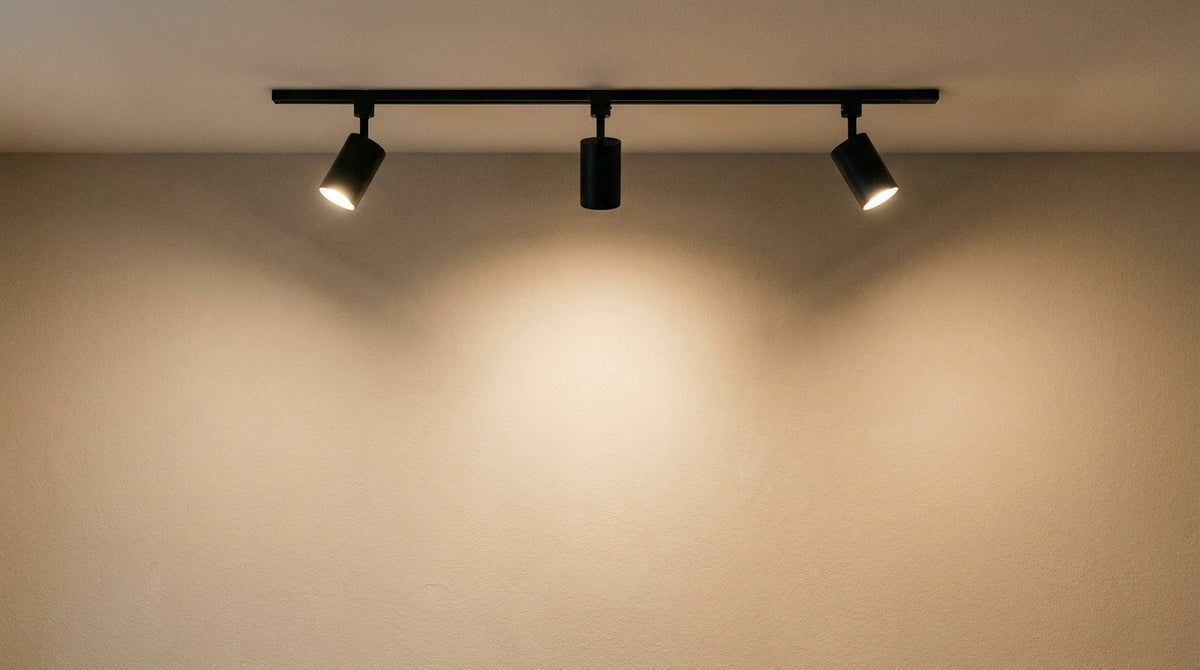
First check whether your bulb unscrews: push a GU10 bulb gently towards the holder, then twist a quarter turn. If nothing moves, the LEDs are soldered and it is the module or the fixture that gets replaced. Switch off the power before any handling.
How do you change an LED bulb on a track light, depending on its base?
Each base has its own move: the GU10 is pushed towards the holder then twisted a quarter turn, E27 and E14 are unscrewed by hand, the G9 is pulled straight out of its socket, the G4 is unclipped. Allow one minute per bulb on a four-spot track light.
Switch off the power before you start, and never use a screwdriver to lever out a stuck bulb: the glass gives way before the socket. If you are fitting out several homes or a site, our Designix professional space groups the references and quantities in a single order.
How do you identify the base without removing the bulb?
Measure the diameter of the socket: a wide screw base is an E27, a narrow one an E14. A flat bulb with two short pins is a G4, a model with pins is a GU10. The guide to identifying a bulb size gives the measurements in millimetres.
Unsure about the whole family? The feature on bulb types and bases covers screw, bayonet and pin models, with the associated wattages.
What is the exact move for each base?
| Base | Move | Avoid |
|---|---|---|
| GU10 | Push towards the holder, then a quarter turn anticlockwise | Pulling without having twisted |
| E27 and E14 | Unscrew by hand, without gripping the glass | Tightening like a furniture screw |
| G9 | Pull straight out of the ceramic socket | Handling a burning socket |
| G4 | Unclip the pin holder, from the front | Bending the pins sideways |
Refitting is done without forcing: the bulb should stop by itself. For the most common format on adjustable track lights, GU10 LED bulbs are chosen by beam, not just by base.
Should you switch off the power before changing a bulb?
Yes, at the circuit breaker, not just at the switch: a track light can stay live via a neighbouring circuit. Switch off, check by trying to turn it on, then let it cool. A GU10 base or ceramic socket that has just been working stays hot for several minutes.
What should you do when the bulb refuses to unscrew?
A pin that is not re-seated blocks the quarter turn, and forcing it breaks the glass. Push the bulb fully towards the holder before twisting, without jerking. If the glass is already cracked, switch off the power and clear the socket with insulated pliers.
On a recessed spot, the blockage often comes from the trim and not from the bulb: the technique for changing a spot bulb without clips avoids peeling the ceiling paint.
When the source is set deep in the socket, the recessed spot method covers the full move, spring and collar included.
Is it possible to change an integrated LED bulb?
No, not like a bulb: the diodes are soldered onto a strip or a module, nothing unscrews. There are only two outcomes, replace the module if the manufacturer supplies one, or change the track light. The diagnosis comes before getting out the drill.
Your track light, which of these situations is it?
How do you know whether the problem comes from the LED or the fixture?
Switch on the track light and count the spots that are off: just one, it is the source; the whole line, the fault is upstream, power supply, transformer or switch. A tired LED often goes off intermittently before failing completely.
The lighting principle stays the same: understanding how an LED works explains why a diode embedded in a sealed module cannot be replaced on its own.
When the fault is neither the bulb nor the contact, the checks for repairing a fixture save you from buying a track light for nothing. Replacing a whole track light costs more than a bulb, and the track spot range groups the models where the source stays accessible.
If your track light lets nothing unscrew, the replacement goes through the fixture or its module: describe your model to us, the team replies from the contact page with the matching reference.
How do you get exactly the same light back?
Note the colour temperature and the wattage before throwing away the old bulb. The same base does not mean the same rendering: a 2700 K placed next to a 4000 K is immediately visible on a track light, and the difference in output makes one spot dimmer than its neighbours.
Warm white or neutral white, how do you decide?
A living room in the evening calls for 2700 K, a worktop or a hallway rather 3000 to 4000 K. A rail that mixes two temperatures stands out at once, even without looking at the spots.
The choice also depends on the colour rendering index: white or yellow light details the cases room by room, from the living room to the bathroom.
Our selection markers
- warranty 2 years on 73% of the selection
- certification CE on 100% of the selection
- material Glass on 61% of the selection
- technology LED on 100% of the selection
In stock · shipping costs shown at checkout · up to 30% off in your cart


Ready to turn inspiration into reality?
Tell us about your room, your style and your budget, and we will show you the pieces that truly suit your project.
Get guidance in 30 seconds →