
Choosing your light bulbs: the ultimate guide to getting it right
This article is also available in French: Le choix des ampoules guide complet pour ne plus se tromper
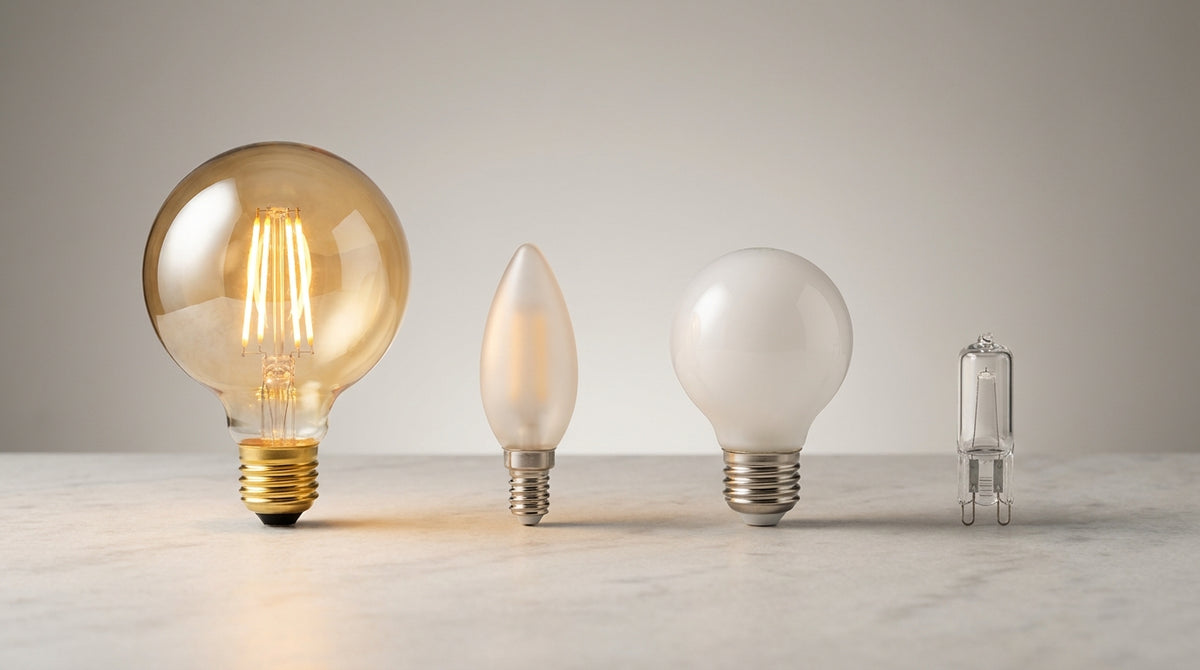
Facing a shelf of light bulbs, everything looks the same, yet two models at the same price can enhance a room or make it look dull. The wattage displayed on the box has not been a reliable indicator since the shift to LED.
This guide singles out the only questions that really matter when buying. For an overview of the families before you get started, browse the different types of light bulbs.
And if you are already looking for a specific model, the designer bulb collection can be filtered by base and room, which shortens the search.
How to choose a light bulb without making a mistake?
Check four points, in this order: the base (the fitting, E27, E14, G9, GU10 or G4), the lumens (the actual amount of light), the color temperature in Kelvin (warm or cool), and the dimmability if you like to adjust the intensity. These four benchmarks rule out almost all errors.
The base determines compatibility: a bulb with the wrong base simply won't screw in. Lumens and Kelvins decide the ambiance. Dimmability, on the other hand, depends on your installation.
One final tip: opt for LED, which generates little heat and lasts a long time. If you are still hesitant, this guide on switching to all-LED details the benefits of the shift.
Unsure about the base or power before ordering? You can always ask our team a question, and they will direct you to the right product.
Which base to choose: E27, E14, G9, GU10 or G4?
Look at the base of the old bulb or the socket: it is the only non-negotiable piece of information. The E27 is the large screw base, the E14 is its slim version, the G9 and G4 are pin bases, and the GU10 is a bayonet-style spotlight. Note the reference before buying.
This variety is reflected in our catalogs. Based on a survey of 33 references in the Designer Bulb collection on September 20, 2026, the E27 base dominates (42%), ahead of the G9 (27%), the G4 (24%), and the E14 (15%). This collection contains 282 references as of September 20, 2026.
For recessed spotlights, the GU10 is the standard, and removing it requires a precise touch: here is how to change a spotlight bulb without straining the clip.
Which light fixture do you want to equip?
Lumens or watts: how to read the true power?
Trust the lumens, not the watts. The lumen measures the light emitted, while the watt measures energy consumed. With LEDs, an 8 to 10-watt bulb provides as much light as an old 60-watt bulb. Therefore, look for a number of lumens, around 800 for a main light source.
To size lighting for a room, add up the lumens according to the surface area and usage. Our article on calculating necessary lighting provides benchmarks room by room.
In the aforementioned survey, all 33 references were LED, CE certified, and IP20 rated, suitable for dry indoor use. You can find these features in the boutique's selection of LED bulbs.
Warm white or cool white: what color temperature for each room?
Color temperature is measured in Kelvin. Below 3000 K, the light is warm and golden, ideal for the living room and bedroom. Around 4000 K, it becomes neutral, perfect for the kitchen or an office. Beyond that, cool white is best suited for workspaces.
The right tone depends on the activity, not a single rule. To decide between ambiance and function, compare white or yellow light according to each use.
Then there is the question of dimming. If you want to adjust the intensity throughout the evening, choose dimmable bulbs, designed for use with a dimmer switch.
Be careful, not all bulbs can be dimmed, and a model not designed for it will buzz or flicker. This comparison between dimmable bulbs prevents that mistake.
Which bulb for which room?
Start with the usage. The living room and bedroom call for a diffused warm white, the kitchen for a clearer neutral white, and the bathroom for a protected bulb with sharp light near the mirror. Choose the base and lumens first, then refine the color temperature.
In our catalogs, the living room remains the most served room. For a complete plan, our guide to lighting every room properly combines main sources and accent lighting.
When choosing a model, an outside opinion is reassuring: the reviews published on the Designix Google profile provide a concrete overview of customer choices.
Our designer bulbs to choose according to your room


Keep this logic in mind with every purchase, and you will never make a mistake again: to apply it to the whole house, see how to choose your lighting methodically.
Related topics
In stock · shipping costs shown at checkout · up to 30% off in your cart

Ready to turn inspiration into reality?
Tell us about your room, your style and your budget, and we will show you the pieces that truly suit your project.
Get guidance in 30 seconds →


