How to change the bulb in your bathroom mirror: the method
This article is also available in French: Changer ampoule miroir salle de bain
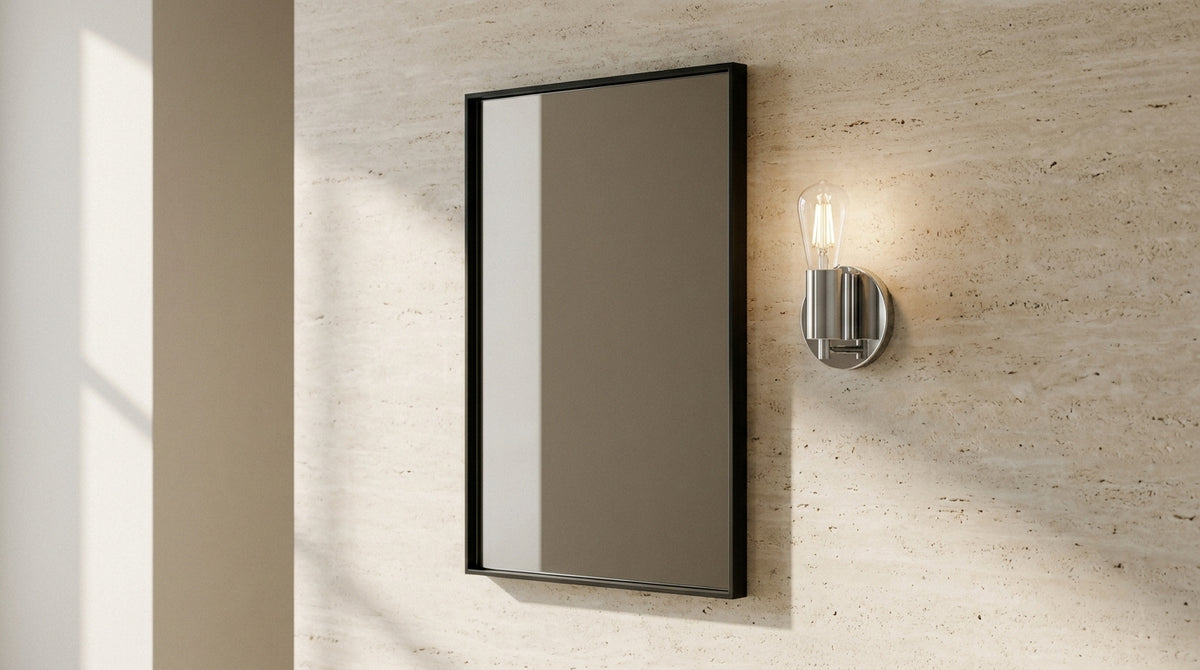
First, locate the socket. If it is visible behind the cover, the bulb can be replaced in thirty seconds with a standard E14 or E27. If the light comes from a flat block bonded to the glass, the unit is sealed: only replacing the fixture, or its driver, will solve the problem.
How do you know if the bulb in your bathroom mirror is replaceable?
Three cases, not four. A visible socket behind a cover: the bulb unscrews. A flat LED module held by a bezel: the unit is sealed but the driver, often separate, can be replaced. An LED strip embedded in the glass: nothing can be replaced individually.
Doubt almost always comes from the same place: the cover hiding the fixing. One screw, two clips, and the answer is clear. Our bathroom lighting covers all three families, from mirrors with exposed bulbs to all-LED models, with the socket stated on each product page.
Visible bulb or integrated LED: the ten-second test
Run your hand under the mirror, directly below the lit area. Four signs are enough to decide.
- Exposed socket: you can feel the holder, the bulb unscrews by hand.
- Screwed bezel: two or four screws around the edge, the light source is behind.
- Smooth, cold surface: no access, it is a sealed LED module.
- Cable to a box: a separate driver powers the module and can be replaced.
Can a sealed LED mirror be repaired?
Sometimes, but never like a bulb. The module is not sold separately; it is the driver, or the complete unit, that gets replaced. The procedure to change the LED in a bathroom mirror depends on how it is fitted: bonded, clipped or screwed.
If you are redoing the room, it is worth choosing a model whose bulb can be changed. To light a bathroom like a spa, what matters is three light sources placed at different heights, not a single light block.
Which socket is hidden behind a bathroom mirror?
E14 in most mirrors with exposed bulbs, E27 on wider models, GU10 when the lighting is adjustable, G4 or G9 on small units. The socket is written in two parts: the letter gives the family, the number the diameter in millimetres.
Which type of bulb does your bathroom mirror or wall light use?
| Socket | Where you find it | What it changes |
|---|---|---|
| E14 | Mirror with exposed bulb, wall light on either side | Small screw thread, available in all colour temperatures |
| E27 | Wide mirrors, ceiling fixtures | Large screw thread, more choice in designer bulbs |
| GU10 | Adjustable lighting on a rail or on a mirror | Twists a quarter turn, bought in pairs |
| G4 / G9 | Small units, originally halogen | Fine pins, delicate fitting, LED required |
Not sure what you have in your hands? The exact format is engraved on the socket, and there is a simple method to identify an E27, E14 or GU10 socket without dismantling anything.
GU10 deserves a separate mention: it is used in most adjustable lights above the basin, and the bulb in a bathroom spotlight can be changed without tools if you know which way to turn it. As for replacements, E27 bulbs remain the easiest to find in both LED and filament versions.
When two mirrors look identical in every detail, buyer reviews settle it better than a spec sheet. The Designix Google listing keeps them up to date.
Which bulb to fit instead: colour temperature, IP rating and dimming
Aim for 3000 K for a flattering skin tone, 4000 K if you apply make-up in front of the mirror, IP44 minimum around the basin, and a dimmable bulb if the mirror already has a dimmer. Wattage matters less than colour temperature: an LED uses a fraction of the halogen it replaces.
Bathroom mirrors and wall lights with replaceable bulbs
 Modern Bathroom Sphere Wall Light | Luminance
 Oval tube bathroom wall light | Fiye
 ZAMBELIS Bathroom Wall Light 20W CCT IP44 DESIGN Sand White 25457
 Dimmable bathroom wall light | Qilo
 Round adjustable bathroom spotlight | Lisio
 Black bathroom wall light | Calix
See the full selection: Bathroom Lighting, Ceiling, Wall or Mirror Lights
White or warm light in front of a mirror?
Warm white, around 3000 K, gives a natural complexion and suits stone or wood bathrooms. Neutral white at 4000 K lights more sharply without turning blue. The choice comes down to use: relaxation in the evening, precision in the morning. Our guide to white or warm light details each colour temperature and how it renders.
IP44 or IP65 around the basin?
The protection rating states what the fixture can withstand. Less than a metre from the shower, IP44 is enough; inside the bath area, you need to go up a level. Across a sample of 157 references from our catalogue on 1 October 2026, 10% state IP44 and 85% state IP20: protection is a selection criterion, not a given. An IP44 wall light can be fitted on either side of the mirror without worrying about splashes.
Do you need a dimmable bulb?
Only if the mirror or the switch has a dimmer. A non-dimmable LED on a dimmer buzzes or flickers at low brightness. A dimmable LED should be bought with the explicit mention on the packaging.
It pairs well with LED bathroom wall lights designed to vary brightness without turning the room into a hotel bathroom.
Once the socket is identified, all that remains is to choose the exact reference. If two models hold you back, it is possible to have your model checked before buying.
How to change the bulb without breaking the mirror or the cover
Cut the circuit at the consumer unit, not just at the switch. Then unscrew the cover, keeping the screws in a small bowl, and take out the bulb by hand if it comes, with pliers if it resists. A stuck socket is freed by turning, never by pulling.
Step 1: switch off the circuit and photograph the driver
The bathroom breaker is flipped to the down position, and you check by pressing the switch. Before closing it again, a photo of the driver and its label saves a second dismantling when ordering the part.
Step 2: remove the cover or bezel without forcing it
A cover is held by two or four screws, sometimes by clips that pinch with a fingernail. If the part resists, a plastic blade slid around the edge releases the clips without marking the glass. Never use a metal screwdriver against the mirror.
Step 3: extract a stuck bulb
A bulb screwed in for years seizes up. Rubber-tipped pliers or a washing-up glove are enough to regain grip. If the glass breaks, cut the circuit again and unscrew the remaining socket with needle-nose pliers.
When should the whole fixture be replaced?
When the LED module is sealed and dead, when the driver cannot be found, or when the mirror only lights one side of the face. A module bonded to the glass is not sold separately: the fixture goes and another takes its place. A corroded bezel forces the same decision.
- Sealed module dead: no bulb to change, the light source has failed.
- Cracked or swollen driver: box to replace, reference often missing.
- Light on one side only: shadow under the eyes when shaving.
- Corroded bezel: seized screws, risky removal for the glass.
- Bulb impossible to find: obsolete socket for which no LED is made any more.
A replacement is not limited to the mirror. Refitting a wall light above the basin is often part of a larger project, and carrying out the bathroom renovation at the same time avoids drilling the same wall twice.
Two light sources are better than one. A LED ceiling light illuminates the whole room, while designer mirrors with exposed bulbs keep the advantage of being repairable without dismantling. Glass, for its part, lasts for years without clouding, and that is what makes a glass fixture last beyond trends.
Across a sample of 157 references from our catalogue on 1 October 2026, 98% state a 2-year warranty and 100% CE certification. The bathroom collection has 2,661 references on the same date, most of which state their socket and protection rating on the product page.
In stock · shipping costs shown at checkout · up to 30% off in your cart


Ready to turn inspiration into reality?
Tell us about your room, your style and your budget, and we will show you the pieces that truly suit your project.
Get guidance in 30 seconds →