Staircase pendant light
- Tracked delivery to your country Tracked delivery
- Secure payment at checkout Multiple payment methods
- 14 days to change your mind 14-day returns
- Secure payment Secure payment


Not sure of your style? Find it in 30 seconds
A few questions, and we will show you the pieces made for you.



















Frequently asked questions
How do I choose the right product?
What are the delivery times?
Can I return an item?
Can I pay in instalments?
An interior that reflects who you are
Carefully selected pieces, shipped from our warehouses. Our team advises you before you buy, so you choose with confidence.
- Tracked delivery
- Pay in instalments, where available
- 14 days to change your mind
- Advice & showroom in Lyon, France
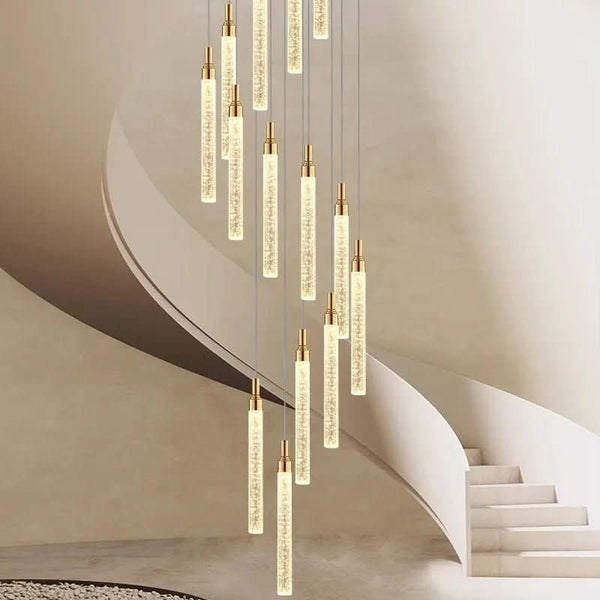
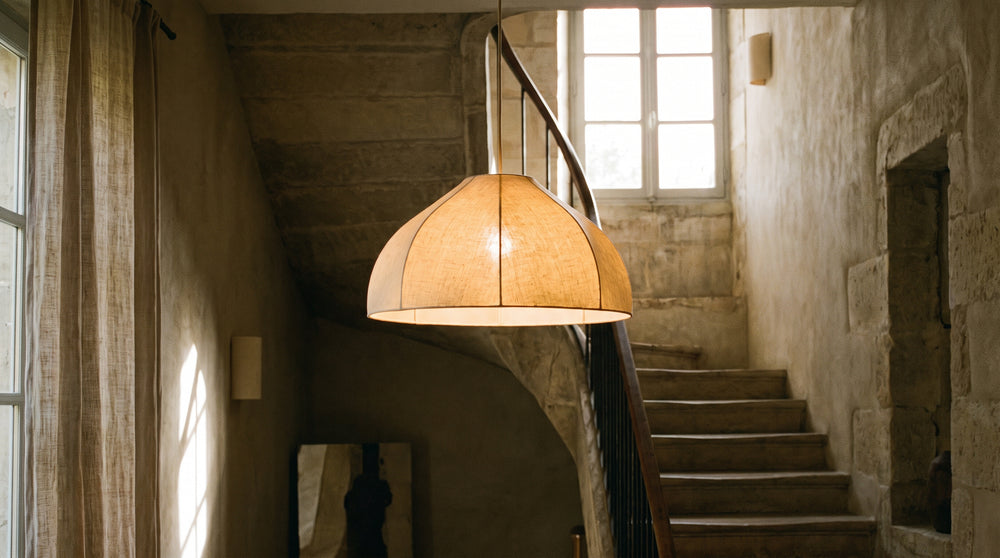
To light a staircase, start with the clear passage: the pendant hangs low enough to light the steps without blocking movement. This selection plays with silhouettes, a glass cascade, an aligned tube, a metal cylinder or a cluster of spheres, and all these pendants are IP20, so they are reserved for dry indoor rooms.
Which staircase pendant light should you choose?
Three criteria decide, in this order: the free space around the stairwell opening, the light you expect, then the material. Measure the height between the ceiling and the steps, and the width of the passage. A narrow stairwell accepts a vertical model, a large volume supports a cluster or a cascade.
Light comes next. Models with integrated LED give a regular output, with no bulb to change, while E27 and G9 sockets let you choose the bulb. To compare silhouettes, browse the design pieces of the house.
The finish closes the decision: black pendants blend into a dark stairwell, golden finishes catch daylight. A shape that reads clearly from below matters more than a detail seen up close.
Design staircase pendant
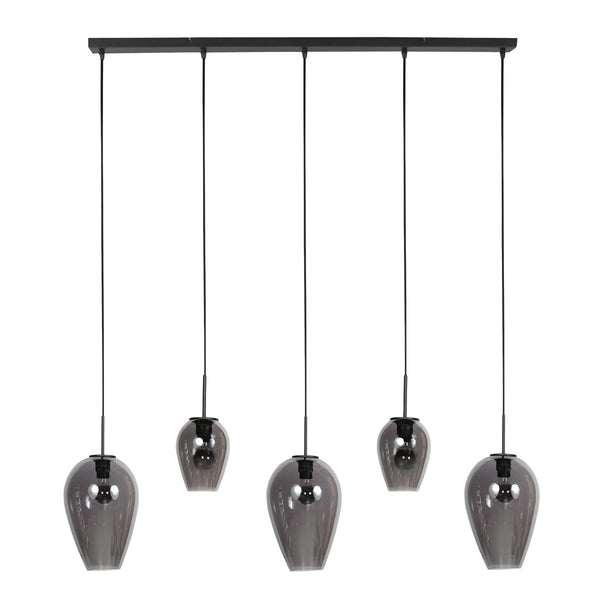
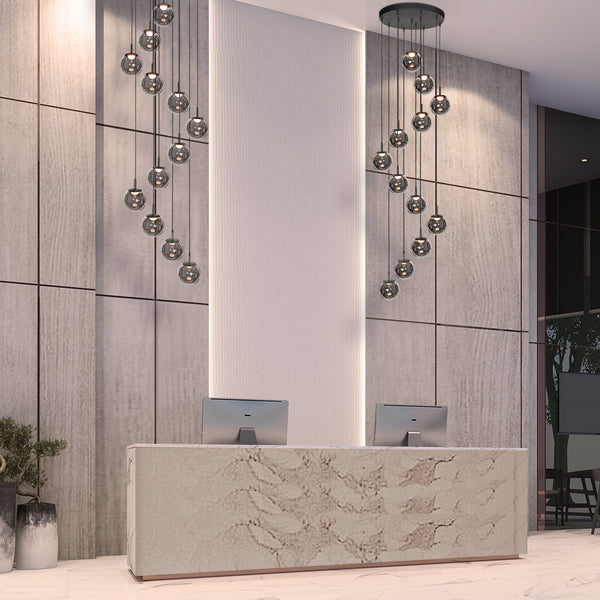
The Bollique black cascade drops its glass globes over a 60 cm diameter assembly: from the ground floor, you read a rain of light points rather than a compact object.
Original pendant light
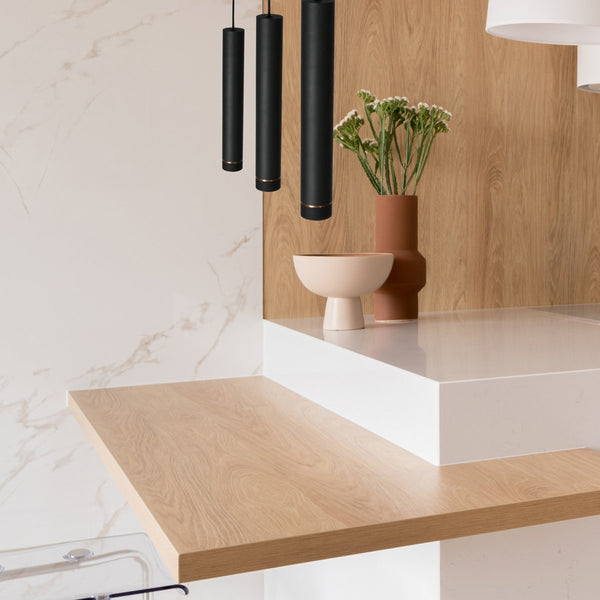
The Vantel industrial cylinder and the Quor cage pendant play the opposite: a long, fine shape that structures a vertical volume without cluttering it.
What type of pendant for a tall stairwell?
The taller the stairwell, the lower the light can hang. In this selection, the Stilla has an adjustable height up to 390 cm, the Quor up to 180 cm, and the Terralia as well as the Sillineta up to 90 cm. Adjustment is done before locking the cable.
Over a great height, choose a shape that reads from afar: aligned tubes, a cascade, a cluster of spheres. Look at the stairwells and hallways to see how these volumes behave in a vertical space.
Tall staircase pendant
A long cable lets the pendant float above the stairwell opening, without dropping to the steps. Allow for ground clearance before cutting or locking the cable.
XXL pendant for high ceilings
A large diameter is justified when the ceiling is far away: the light comes from higher up and must cover a wide area. The Sferra and its nine spheres fill this role over an open stairwell.
What shapes of staircase pendant are available?
The silhouettes listed are the tube, the round, the sphere, the square and more free forms. A sphere or a cluster of spheres creates a crisp point of light, an aligned tube draws a continuous line, a square brings a graphic pattern. The tube and the round dominate the selection, the sphere follows closely.
Sphere staircase pendant
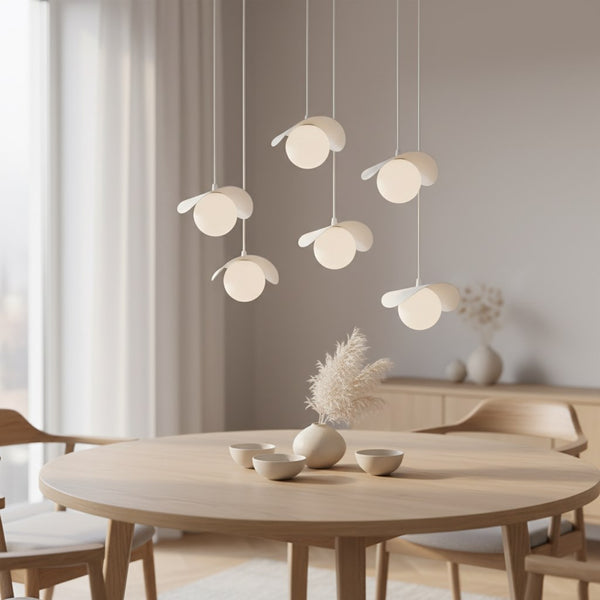
Sphere shapes give a simple design, readable from the bottom of the stairs. In a cluster, they fill a volume without hiding the light.
Square and free-form staircase pendant
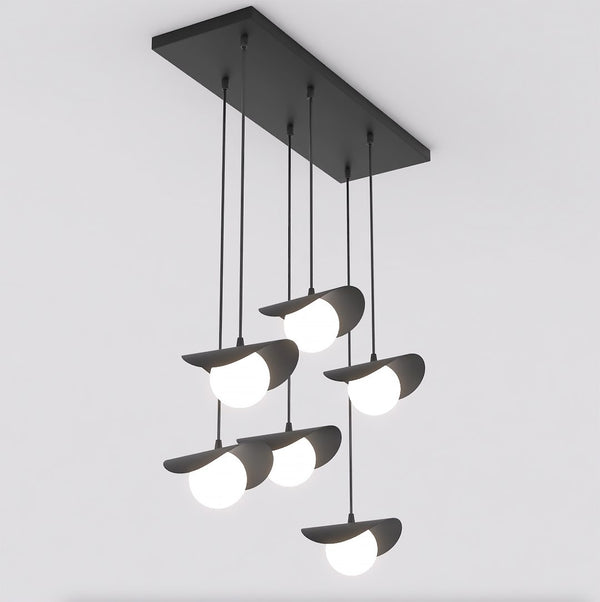
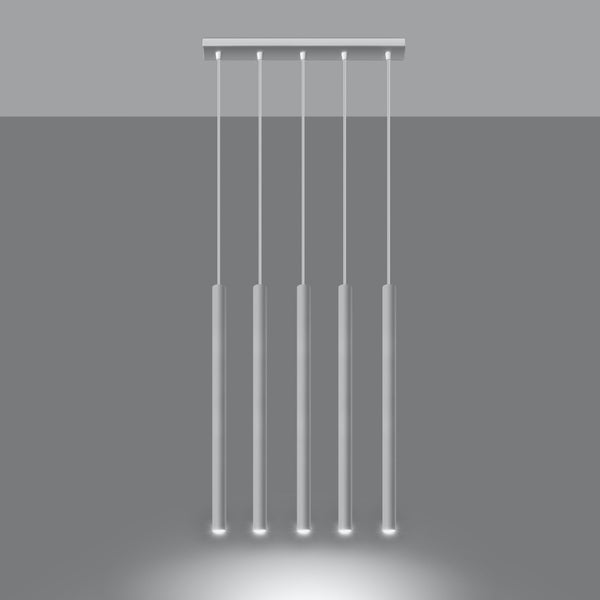
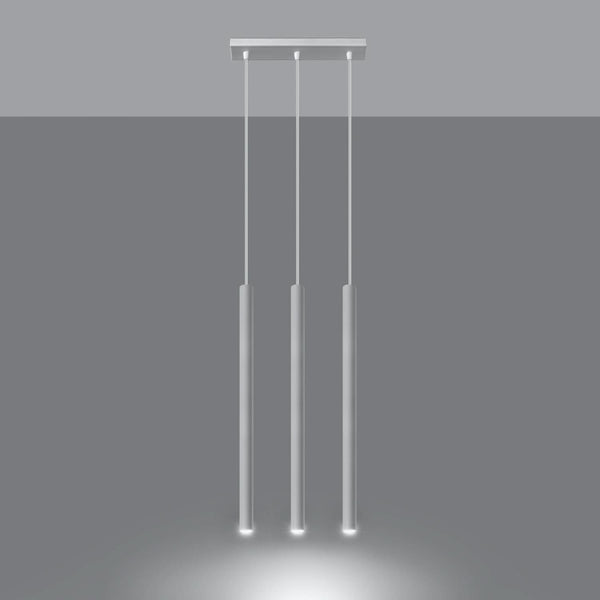
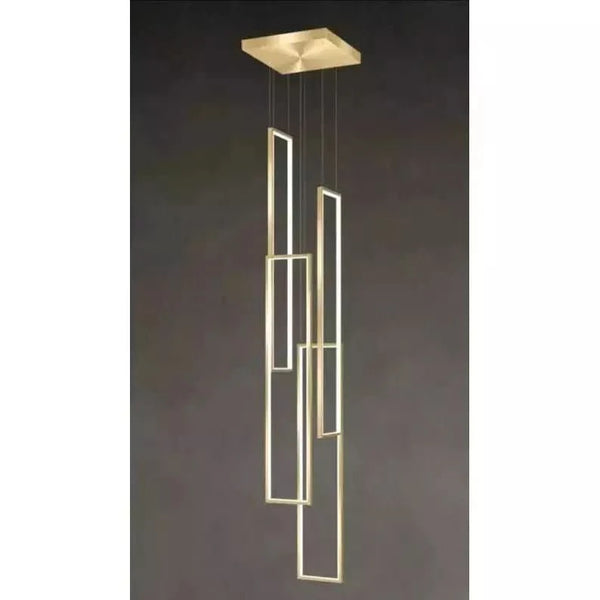
Bar-mounted assemblies, with several aligned light points, draw a clean line above the stairwell opening. This is the case with Sillineta and its five aligned tubes.
| Model | Material | Silhouette | Socket | Other suitable rooms |
|---|---|---|---|---|
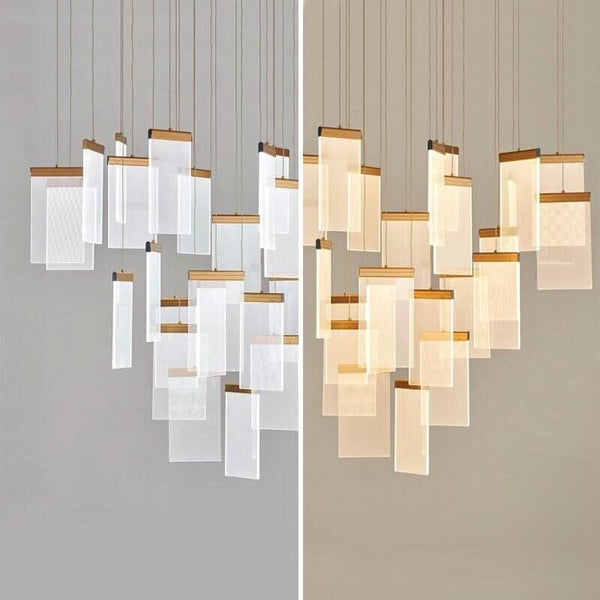
| Edy | Metal, crystal, iron, aluminium | Golden tubes with crystals | GU10 | Living room, entryway |
| Bollique Cascade | Glass and metal | Cascade of black globes | Integrated LED | Entryway, living room |
| Bollique Constellation | Glass and metal | Cluster of black globes | Integrated LED | Entryway, living room |
| Vantel | Metal and plastic | Elongated industrial cylinder | GU10 | Staircase |
| Quor | Metal and glass | Cage tube | E27 | Living room, bedroom, kitchen, entryway |
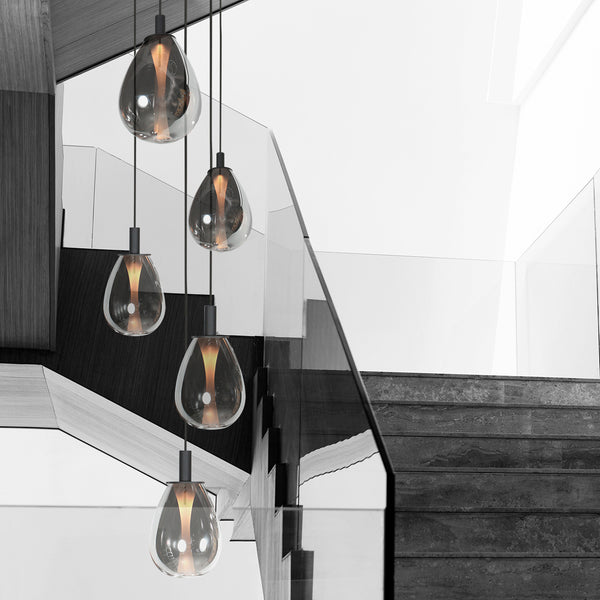
| Stilla | Glass and metal | Cascade of drops | Integrated LED | Dining room, living room |
Glass, metal or bamboo pendant: which material for a staircase?
Metal dominates the selection, alone or combined with glass, steel, iron or aluminium. Glass lets light through and does not darken the stairwell: it is the useful choice when natural light is low. A solid metal frame reflects less light but makes the silhouette stand out more.
Glass staircase pendant
Glass pendants are cleaned with a soft cloth and diffuse a less harsh light. The smoked glass of Silranano softens the glow and keeps the bulbs discreet.
Rattan or bamboo staircase pendant
This selection does not offer rattan. It does include a model in openwork natural bamboo, the Peregrin pendant, whose cluster of spheres lets light filter through. For other crafted materials, see the metal pendants.
How to install a pendant in a stairwell?
These pendants are IP20, so for dry interiors. They are fixed to the ceiling of the stairwell opening, with a cable adjusted to the height of the stairwell. Some models accept a dimmer, and the warranty is two years on most, five years on a few models. Check the support before drilling, the height is set before locking.
At what height should you hang a staircase pendant?
Low enough to light the climb, high enough not to block the passage. On a staircase, ground clearance is judged at the point closest to the steps. The cable is adjusted before final tightening.
How to change the bulb of a pendant installed high up?
With an E27 or G9 socket, the bulb remains interchangeable and can be replaced from a stable ladder. Models with integrated LED have no bulb to change, but the module is not replaceable: this is a choice to make from the start.
LED or bulb staircase pendant: which light to choose?
E27 and G9 sockets are the most common, followed by integrated LED models, then GU10 and E14, which are rarer. The most frequent light is warm white, between 2700 and 3500 K; neutral white and cool white remain in the minority in the selection. Warm white suits a lived-in stairwell.
LED staircase pendant
Integrated LED models give a uniform output and are installed without thinking about the bulb. In return, any replacement means changing the whole light.
Warm white or cool white staircase pendant
Around 3000 K, the light stays close to a filament bulb, which warms up an often dimly lit staircase. Neutral white, around 4000 K, lights an entryway more sharply. Cool white, rarer here, is reserved for workspaces.
| Socket | Presence in the selection | Bulb to provide |
|---|---|---|
| E27 | Most common | Screw bulb, interchangeable |
| G9 | Frequent | Small pin socket |
| Integrated LED | On some models | Integrated module, no bulb to change |
| GU10 | Rarer | Bayonet socket |
| E14 | Rarest | Small screw socket |
Staircase pendant or wall light for a staircase?
The wall light is fixed to the wall and frees the passage; the pendant hangs from the ceiling and lights the stairwell opening and the steps from above. In a narrow staircase, the two combine: the wall light guides your foot, the pendant lights the whole. This collection contains only hanging pendants.
Staircase wall light
Fixed at the bottom of the flight, it lights the first step without hanging into the void. It is the logical complement to a modern style pendant placed at the head of the stairwell.
Stairwell wall light
On a side wall, it avoids the shadow cast under the steps. For main lighting from the ceiling, see the pendant lights of the house.
Can a staircase pendant be used in a kitchen or dining room?
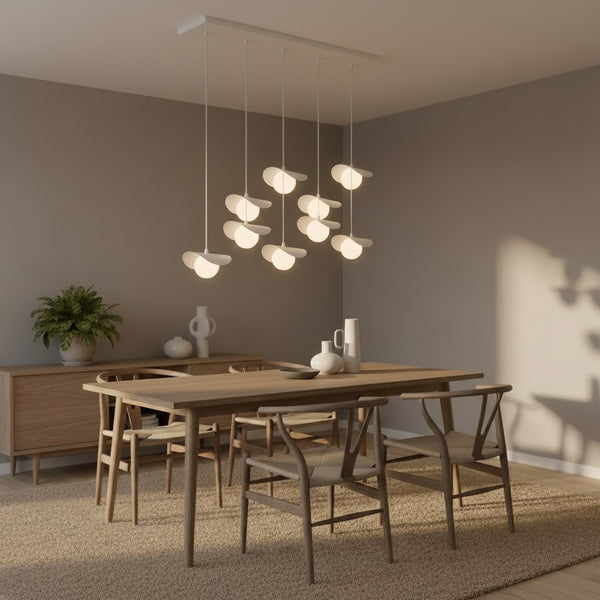
Yes. On the product pages of this selection, living room and dining room appear most often, then entryway, staircase and kitchen. Hung above an island or a table, the pendant lights a specific area without lighting the whole room.
The IP20 rating requires a dry room: these models are not suitable for a bathroom or outdoors. In a kitchen, keep the light away from water points and direct steam.
Kitchen pendant
Over an island, a bar with several light points lights the worktop. The kitchen pendant gathers the models indicated for this room.
Modern pendant for living room or dining room
Above a table, aim for warm light and a height that does not cut the view between guests. The Edy model and its golden tubes or the dining room pendant set the scene.
Secure payment, tracked delivery, returns and Designix customer service: you order with no risk. First compare all pendants, then go back to all our lights to light the rest of the house.
Frequently asked questions about the staircase pendant
What are the trends for staircases in 2026?
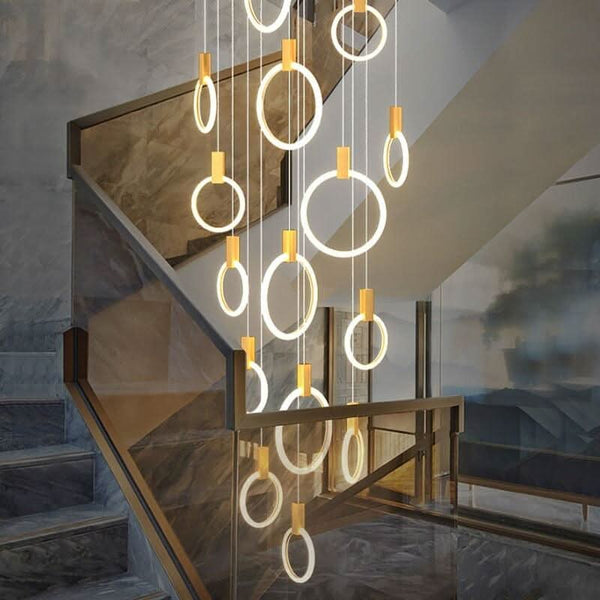
In the models available here, the recurring shapes are the tube and the round, with a strong presence of black and golden finishes. Glass appears alone or combined with metal, and some pendants include LED. These are the directions visible in this selection, not a market forecast.
How low should an XXL pendant hang in a tall stairwell?
The pendant is lowered enough to light the climb, while keeping a clear passage under the light. Some models in the collection have a cable adjustable up to 390 cm, others stop around 90 to 100 cm. Adjustment is done before the final locking of the cable.
Can an IP20 pendant be installed in a bathroom?
No. The pendants in this collection are all IP20, a rating intended for dry indoor rooms. For a bathroom, a protection rating higher than IP20 is required: these models are not suitable for that use, whatever their style.
Which socket to choose for a staircase pendant: E27, G9 or integrated LED?
E27 and G9 are the most common sockets in the selection: the bulb remains interchangeable, which makes maintenance of a high light easier. Integrated LED models have no bulb to change, but the module is not replaceable. GU10 and E14 are rarer.
Staircase pendant or wall light for a staircase?
The wall light is fixed to the wall and leaves the passage free; the pendant hangs from the ceiling and lights the stairwell opening and the steps from above. In a narrow stairwell, the two complement each other. This collection offers only pendants, no wall lights.