
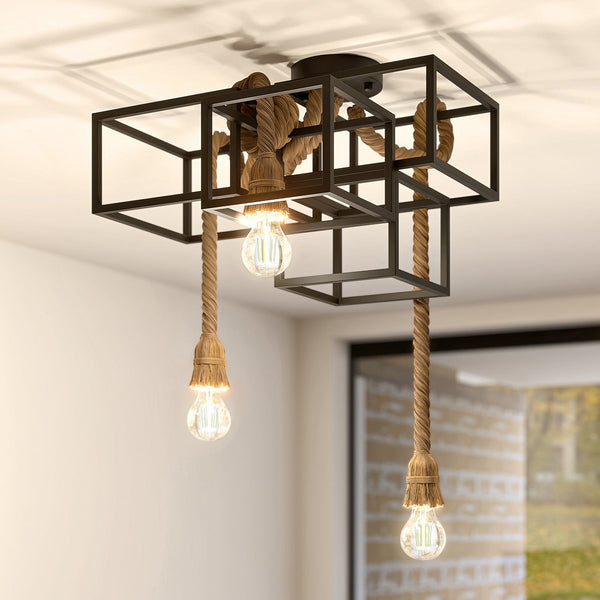
Rope ceiling light
This selection is also available in our French store: Plafonnier corde



- Tracked delivery to your country Tracked delivery
- Secure payment at checkout Multiple payment methods
- 14 days to change your mind 14-day returns
- Secure payment Secure payment
Not sure of your style? Find it in 30 seconds
A few questions, and we will show you the pieces made for you.
Frequently asked questions
How do I choose the right product?
What are the delivery times?
Can I return an item?
Can I pay in instalments?

An interior that reflects who you are
Carefully selected pieces, shipped from our warehouses. Our team advises you before you buy, so you choose with confidence.
- Tracked delivery
- Pay in instalments, where available
- 14 days to change your mind
- Advice & showroom in Lyon, France
Choose the format before the material: a large rope ceiling light in the centre of the living room, a medium model in an adult bedroom, a fine cord in a hallway. The braided rope softens the light and casts gentle shadows on the ceiling. The final result depends above all on the bulb you screw into it.
What kind of light does a rope ceiling light give?
A rope ceiling light diffuses a softened light, filtered by the braid, which illuminates without dazzling and casts gentle shadows on the ceiling. Everything then depends on the bulb: a warm filament gives a golden light, an LED bulb a more neutral and even glow. The socket is usually an E27, and the maximum wattage accepted is shown on the product page.
Rope ceiling light bulb: which model should you plan for?
First check the base on the light's product page: E27 is the most common, E14 is for small formats. Then check the free space under the shade, as a filament bulb is often longer than an LED. For a warm atmosphere, aim for a colour temperature around 2700 K; for a more neutral result in a workspace, go for 3000 to 4000 K instead. An LED ceiling light with an integrated module needs changing less often, but does not let you vary the atmosphere.
LED ceiling light or visible bulb: what result in the room?
A visible bulb is part of the design: its shape, its glass tint and the filament can be seen through the braid. An integrated LED gives a more even light, with no hot spot, and is dusted in one wipe. In both cases, the braid filters the output and softens the contrasts. Find both approaches in our ceiling lights and pendants.
Which room should you put a rope ceiling light in?
The living room calls for a large, low model to fill the volume, the adult bedroom a more discreet format with warm light, the kitchen a light that is easy to dust, placed above the table or the worktop. The fixing height matters as much as the diameter. A room of around 20 m² can take a large central model without feeling weighed down.
Living room ceiling light: which model in the centre of the room?
In a living room, the light works at the centre of the ceiling and also serves as a visual anchor. A round, slightly flattened format fills the volume without hanging too low in the room. If the room is already busy with textiles and wood, a tight braid and a natural shade hold up better than a very openwork design. To complete the lighting around a sofa, browse the living room lights.
Adult bedroom ceiling light: choosing a restful light
In a bedroom, the rope does its job as a filter: the light is less direct, which rests the eye before bedtime. A medium format on the ceiling, a natural or white braid and a 2700 K bulb are enough. Avoid a very downward-facing light directly above the bed, as it casts a shadow on your face when you read. More ideas here: the bedroom lights.
Kitchen ceiling light: above the table or the worktop
In the kitchen, you want clear light on surfaces. A tight braid, in cotton or hemp, is easier to dust than an openwork weave that traps grease. Above the table, the light sits low; above the worktop, a compact model and a fairly neutral light avoid cast shadows. See the kitchen lights.
| Room | What you are looking for | Recommended format | Rope shade |
|---|---|---|---|
| Living room | Fill the volume, softened light | Large format, flat or domed | Natural, ecru or black |
| Adult bedroom | Warm, discreet light | Medium or small format | Natural or white |
| Kitchen | Clear light above the table | Compact format, tight braid | Natural, black or white |
| Hallway or entrance | Light without clutter | Fine format, cord type | Natural |
Natural rope ceiling light: which materials and which shades?
Natural rope is woven in hemp, jute or cotton, with braids that are more or less tight and in natural, white or black shades. Wood, wicker and rattan combine with rope for more structured shapes. Each material changes the look and the care of the light. Wicker is woven in wide strands and marks the shadows more, while rope is braided more finely and stays softer.
Hemp, jute or cotton rope ceiling light: the differences
Hemp gives a tight braid and a fairly even natural shade that ages well on the ceiling. Jute is rawer and slightly mottled, which adds relief but needs regular dusting. Cotton offers a smooth cord, often white or black, softer to the touch. In all cases, clean dry: a damp product would stain the fibres.
White rope ceiling light or black rope ceiling light: what effect
A white rope blends into a pale ceiling and leaves only the shape visible, which is useful in small rooms. A black rope draws a clear contrast and structures a room with white walls. A natural shade remains the most versatile choice, as it carries through changes of style without needing to be replaced. Compare the results in the lighting catalogue.
Rope ceiling light with wood, wicker or rattan: mixing materials
A light wood frame under a rope braid brings clean lines, useful in a dining room. Wicker and rattan woven in wide strands give a more graphic design on the ceiling, best kept for rooms that can carry it. As for fixing, these combinations are often heavier than a rope ceiling light alone: check the weight on the product page. More models in the Designix lighting range.
| Material | Appearance | Where to install it | Care |
|---|---|---|---|
| Hemp | Tight braid, natural shade | Living room, bedroom | Dry dusting |
| Jute | Raw fibre, mottled look | Living room, entrance | Soft cloth, no damp product |
| Cotton | Smooth cord, white or black | Bedroom, kitchen | Soft brush |
| Fine cord | Fine braid, light design | Small rooms, hallway | Regular dusting |
| Wicker or rattan | Wide strands, marked shadows | Living room, conservatory | Soft brush |
| Rope and wood | Braid on a wooden frame | Living room, dining room | Dry cloth |
Which format of rope ceiling light should you choose for each room?
Size is chosen according to the room and the ceiling height: a large ceiling light fills a living room, a fine format suits small rooms and hallways. Better a light slightly larger than the furniture it hangs over than a model that looks lost. Above a table, allow around 75 cm between the light and the tabletop.
Large living room ceiling light: how to gauge the diameter
In a living room, the diameter is read in relation to the room and the main piece of furniture: a light that covers around a third of the length of the coffee table or dining table looks balanced. Under a low ceiling, a flat format gives the same presence without dropping into your line of sight. See the selection in the ceiling-mounted lights.
Fine cord ceiling light: when to choose a slim format
A finely braided cord gives a light design, suited to hallways, entrances and rooms where a large volume would be overwhelming. It also works above a small dining nook. Watch the wattage in these formats: a fine braid lets more direct light through, so a bulb that is too strong quickly becomes dazzling. More ideas in see the other ceiling lights.
Small format or elaborate piece: where does the budget sit
Budget is best thought of in terms of the type of construction: a simple rope ceiling light remains affordable, while a piece combining a tight braid, turned wood and careful finishes sits higher. Format plays a part too: the larger the light, the more the material used counts. Decide on the room to be lit before comparing, which avoids paying for unnecessary volume.
How do you choose an original or on-trend ceiling light?
An original rope ceiling light stands out from the classic by its shape, its braid or its mix of materials, not by passing fashions. For an on-trend living room or kitchen, simple lines and natural shades stay right when trends change. Originality comes from the design, not from a decorative detail added afterwards.
On-trend living room ceiling light 2026: the shapes that last
The models that stand the test of time remain simple volumes: flattened sphere, dome, ring. An irregular braid or a tight weave brings character without dating the light. A small touch of light wood holds up better than a strong pattern. Browse browse all the lights to see these shapes.
Modern kitchen ceiling light and on-trend kitchen ceiling light
In the kitchen, the trend is towards low, compact shapes, often in two tones: black rope on a metal frame, or natural rope on wood. These models stay readable above a worktop. The criterion that really counts remains ease of cleaning, more than the style on show. See the entire lighting range.
Ceiling light, chandelier or rope pendant: what are the differences?
A ceiling light is fixed directly to the ceiling, a pendant hangs from a cable or a cord, and a chandelier multiplies the light points. In rope, a pendant adds relief above a table, while a ceiling light illuminates the whole room. The choice depends on the available height and on what you want to highlight.
Rope pendant and rope bulb pendant: what use
A rope pendant goes above a table or a reading corner, where a low light point replaces general lighting. The rope bulb pendant, which leaves the bulb visible, plays on the filament and the braiding. A hemp rope pendant on a wooden frame suits a dining room well. Compare the families in choose a light from all the collections.
Hemp rope chandelier or ceiling light: which to choose
A rope chandelier brings together several light points and becomes the central volume of a large living room or a tall entrance. The rope ceiling light, more understated, suits rooms of standard height. So the chandelier or ceiling light decision comes down to the volume of the room: beyond around 25 m² with good height, several light points are justified. An adjustable spotlight ceiling light, meanwhile, directs light onto a worktop or a bookshelf.
How do you install and care for a rope ceiling light?
Installation is that of a classic ceiling light: switch off the power, fix the bracket to the box, connect the wires as shown in the instructions, then fit the shade. Rope is dusted dry, with a soft cloth or a brush attachment, without a damp product that would stain the fibres. A heavy model or an uncertain ceiling justifies an electrician.
E27 rope ceiling light fitting: what to check
Three points are checked on the product page before fitting: the base, the weight of the light and the protection rating. The base must match the intended bulb. The weight determines the type of plug, especially in a plasterboard ceiling. The protection rating matters in a kitchen or a damp room. For these three details, only the product page is authoritative.
Cleaning a rope light without damaging the braid
Regular dusting is enough: vacuum brush attachment on the lowest power, or a soft cloth passed over the braid. No water, no product, no damp sponge, as the fibres stain and lose their shape. A tight weave needs fewer passes than an openwork weave. In the kitchen, a tight braid cleans better than an open design. More shapes to care for here: discover the Designix lights.
How do you match a rope ceiling light with your decor?
A rope ceiling light pairs with wood, linen, ceramic and mineral shades. Avoid multiplying braided materials in the same room, and complete the lighting with a spotlight or LED ceiling lights when you need more light on a worktop. Rope plays the role of a neutral material.
Rope ceiling light with wood, linen or ceramic: the combinations that work
Light wood in the frame or the furniture responds well to natural rope. The linen and cotton of curtains or cushions extend the same family of shades. Matte ceramic or white enamel bring a firm note that balances the softness of the braid. On the other hand, a rope ceiling light, a jute rug and woven baskets in the same room quickly become too much.
Spotlight ceiling light or LED ceiling lights: when to add them
A ceiling light alone lights the room, but not effectively a worktop or a reading area. You then add a spotlight aimed at the surface to be lit, or LED ceiling lights in the passageways. The aim is not to increase light everywhere, but to direct what is missing. Find these complements in see the full lighting collection.
Reassurance and ordering
Select the room to be lit, compare the materials, then order a Designix light.
Frequently asked questions about the rope ceiling light
Which ceiling light should you choose for the living room?
First look at the volume of the room: a large rope ceiling light fills the centre, while a smaller format suits above a reading corner. The rope softens the light, so plan for a bulb generous enough to light the whole space. A flat volume avoids dropping into your line of sight.
Which ceiling light for the kitchen?
Favour a model placed above the table or the worktop, in a compact format and a tight braid that is easy to dust. The light should stay clear on surfaces so you can work without annoying shadows. An openwork weave traps grease, so avoid it in this room.
Which ceiling light for an adult bedroom?
A medium or small format is enough, with a warm-light bulb, around 2700 K, for a restful atmosphere. A natural or white braid stays discreet on the ceiling and matches the wood and textiles of the room. Avoid a very downward-facing light directly above the bed.
Wicker ceiling light or rope ceiling light: what is the difference?
Wicker is woven in wider strands, which gives a marked design and graphic shadows on the ceiling. Rope is braided more finely, in hemp, jute or cotton, for a softer, smoother result. Both play on natural material, and the choice comes down to the level of contrast you want.
Can a rope ceiling light take a powerful LED bulb?
It is the socket and the maximum wattage shown on the light's product page that are authoritative, not the brand of the bulb. An LED with the same base as the original bulb is suitable if you stay within that limit. Also check the bulb's bulk inside the shade before screwing it in.




