
Red light bulbs
This selection is also available in our French store: Ampoules coloris rouge

- Tracked delivery to your country Tracked delivery
- Secure payment at checkout Multiple payment methods
- 14 days to change your mind 14-day returns
- Secure payment Secure payment
Not sure of your style? Find it in 30 seconds
A few questions, and we will show you the pieces made for you.
Frequently asked questions
How do I choose the right product?
What are the delivery times?
Can I return an item?
Can I pay in instalments?

An interior that reflects who you are
Carefully selected pieces, shipped from our warehouses. Our team advises you before you buy, so you choose with confidence.
- Tracked delivery
- Pay in instalments, where available
- 14 days to change your mind
- Advice & showroom in Lyon, France
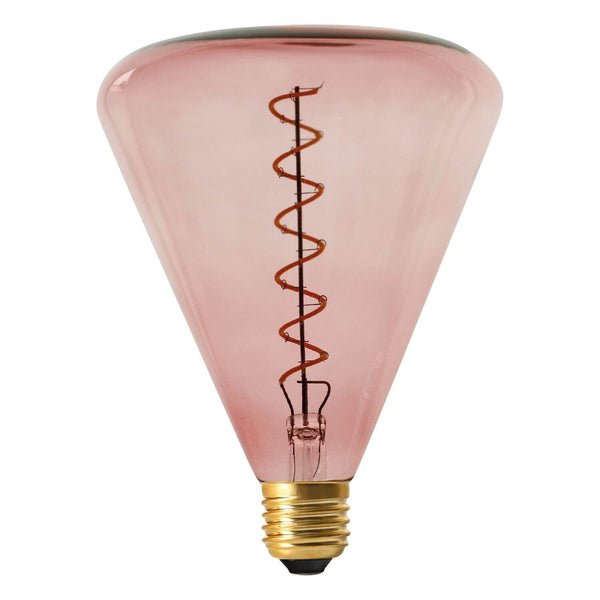
A red light bulb with an E27 base gives off a clear red glow from a warm white source of 2700 to 3500 K, to colour a bar corner, a hallway or a bedside table. First check your fixture's socket, then the 19 cm height and dimmer compatibility before screwing it in.
What light does a red light bulb give?
A red light bulb emits a red glow obtained by a tinted glass combined with a warm white source of 2700 to 3500 K. The light stays warm but takes on a clear red cast: it colours the walls, textiles and light objects it illuminates.
Red light bulbs: an ambient glow, not a work light
Count this bulb as a supplementary source, never as the main lighting of a room. Red lowers the perception of contrasts and tires the eyes quickly over a work table or a kitchen counter. On the other hand, it isolates an area from the rest of the room with a sharpness no white can give: a sideboard, a shelf, a bare wall. The rest of the room keeps its usual lighting, and it is this coexistence that makes the effect readable rather than heavy.
What the tinted glass changes in the perceived light
The tinted glass filters the light as it passes: the glow is softer than a direct coloured LED, with edges that blend into matte surfaces. The metal base stays discreet once screwed in, and the glass and metal assembly is heavy enough to screw in without play in the socket. The result depends just as much on the surface lit: a white wall reflects a vivid red, a beige wall leans towards terracotta. Test before settling on your paint choice, this is the kind of detail you cannot fix with a brush.
Where to install a red light bulb in the home?
Indoors only: the IP20 protection rating of these bulbs makes them suitable for dry rooms, not outdoors or in a damp bathroom. The bar corner, a hallway, a niche or a bedside table are its best spots, as supplementary lighting doubled with a white general light.
Living room bulbs: a corner, a bar or a niche rather than a ceiling
One red area per room is enough. On a central ceiling light, the glow falls on everyone and neutralises the other colours; in a corner, it creates a depth that white flattens. The bar corner and the sideboard are the easiest spots to get right, because you stand there, away from the glow. Plan for a fixture with an E27 socket to stay free to change the bulb, and complete with living room bulbs in white for the rest of the room.
Bedroom bulbs: night light and evening reading
On a bedside table, the red light bulb serves as a night light and a late evening light, provided it stays low and does not shine directly on the pillow. The 19 cm height means checking the shade: a narrow cylinder will not let the glow through. For reading, keep a second, directed white source, and choose bedroom bulbs rather than forcing a single bulb to do everything.
How to choose your red light bulb?
First check the socket base, then dimmer compatibility, the protection rating and the dimensions. Here everything is E27, in glass and metal, dimmer compatible, 19 cm high and 14.5 cm in diameter: enough to check that it fits under a shade.
Red light bulb E14 or E27: start with the socket
The E27 base is the large screw thread, standard on most French pendants, floor lamps and wall lights. E14 is the small format of wall lights and small lamps: if your fixture is E14, none of the bulbs in this selection will screw in, you need to look at small E14 bases. Check the socket before ordering, it is the only real blocking constraint. For everything else, start by checking the E27 base on the product pages.
Dimmer and dimensions: the two checks that avoid a return
Dimmer compatibility matters more than it seems: it lets you lower the glow for an evening, without dropping to flickering. Check that your wall switch is indeed a dimmer switch, then look at the dimmer-compatible bulbs if you are unsure. On dimensions, the 19 cm height and 14.5 cm diameter are measured including the base: under a small shade, prefer a narrower shape, like classic glass bulbs.
| Criterion | Value | What it means |
|---|---|---|
| Base | E27 | Large screw socket, standard in France |
| Light temperature | Warm white 2700 to 3500 K | Warm rendering under the red glass |
| Protection rating | IP20 | Indoors, dry rooms only |
| Dimmer | Compatible | Adjustable intensity depending on the switch |
| Dimensions | 19 cm high, 14.5 cm diameter | To check under a shade |
| Warranty | 2 years | Product coverage for the selection |
Which colour with decorative red?
Red goes with off-white, black, deep green, midnight blue and light woods. In lighting, the rule is simple: one red source per area, surrounded by neutral materials, otherwise the room turns pink and the colours cancel each other out.
What colour goes with red: the pairings that hold
Off-white lets red stand out without harshness, it is the safest pairing on a wall or table linen. Black and anthracite give a graphic contrast that suits a bar or a hallway. Light woods and rattan warm the shade, while brass reflects warm highlights under the glow. To change the tone without changing the fixture, compare with a softer amber shade.
What colour goes with dark red?
On an already dark red wall, the red light bulb largely disappears: the glow blends in and only the grazing light counts. Deep green and midnight blue then work better than white, which is too sharp. Keep the deep green variant in mind if you are looking for a plant-inspired pairing. Conversely, on light walls, choose a classic white colour for areas that must stay neutral.
| Colour or material | Effect achieved | Where to use it |
|---|---|---|
| Off-white | Red stands out without harshness | Walls, table linen |
| Black or anthracite | Graphic contrast, evening mood | Bar, desk, hallway |
| Deep green | Plant-inspired pairing, very soft | Living room, dining room |
| Midnight blue | Deep and calm pairing | Bedroom, reading corner |
| Light wood and rattan | Red warms up | Furniture, shelves |
| Brass and golden metal | Warm highlights under the glow | Pendants, wall lights |
How to wire 3 red light bulbs in parallel?
Three sockets are connected in parallel: the three live wires arrive on the same terminal and the three neutrals on the other. Each bulb then receives the same voltage from the circuit and stays independent of the others. The connection is made with the power off, on a protected circuit.
Wiring 3 bulbs in parallel: the principle in one sentence
The three sockets are supplied side by side by the same two wires, in a branch, and not one after the other. If one bulb blows, the other two stay lit: that is the whole point of this setup compared with a series connection. This type of wiring is found on a fixed string light, a three-point track or a homemade bar unit. It remains reserved for a 220 V circuit, that of your standard domestic installation, which you will find under 220V bulbs.
What to check before connecting
Switch off the breaker at the consumer unit and check that there is no voltage before touching the wires. Check that the circuit is protected and that the conductor cross-section matches the number of points planned, then tighten each terminal and identify the live and neutral. IP20 requires a dry room: no connection outdoors or near a bathtub. If in doubt about the consumer unit, call an electrician, this is not a step to improvise.
Red light salt lamp or coloured bulb: which to choose?
A salt lamp lights a block of rock salt from the inside: the light is amber, very diffuse and tied to the object. A red light bulb produces a red glow on everything it illuminates and can be changed like any bulb. The first is a decorative object, the second is lighting.
Red light salt lamp: an object, not a light source
A salt lamp does not move, cannot be directed and cannot be replaced: it sits on a piece of furniture and diffuses what it diffuses. Its light is amber rather than red, and its intensity depends on the mass of the block. You choose it for its shape and material, not to light an area. No health or ambient air benefits are to be expected, on either side.
Coloured bulbs: change the mood without changing the fixture
The red light bulb screws into a fixture you already own, moves from room to room and is replaced without tools. It is the choice that keeps the fixture in place when the urge for red passes: you will return to black coloured bulbs or a light shade without taking anything down. For fans of old shapes, filament bulbs offer the same principle with a more visible rendering in the glass.
Red light bulb 2700K or neutral white light: which temperature to choose?
2700 to 3500 K corresponds to warm white, that of ambient lamps. 4000 K leans towards neutral white and 6500 K towards the cold white of work areas. A red light bulb in this selection starts from a warm white source, which keeps a soft rendering in red.
2700K and 4000K: the difference in practice
At 2700 K, the light leans towards the warm yellow of old incandescent bulbs: it is the range of living rooms and bedrooms, and the one that pairs best with tinted glass. At 4000 K, the white becomes clearer, closer to a kitchen or an office. Under red glass, starting from 4000 K hardens the glow; rather start from 2700K bulbs to keep the softness. The reference is general, it applies to all ambient lighting.
The colour of 6500K and why it does not match this selection
6500 K gives a cold, slightly bluish white, close to outdoor daylight: it is reserved for garages, workshops and work areas. Close to red glass, this blue breaks the shade and pulls the glow towards magenta. Nothing stops you using it elsewhere in the home, but keep the red area on a warm source. The whole selection sits between 2700 and 3500 K.
Frequently asked questions about red light bulbs
What are the types of bulbs?
Bulbs are first classified by base: E27 and E14 screw, GU10 and GU5 pin, G9 and G4 smaller. Then come the technology (LED, filament) and the light colour. This selection is exclusively E27.
What should I do if my bulb turns red?
A white bulb that turns red or pink signals an internal failure, often an LED at the end of its life. It sometimes continues to light faintly, but the rendering is distorted. The safest option is to replace it rather than keep it on a main circuit.
What are the benefits of red LEDs?
In lighting terms, a red source is used to create a mood, colour a wall or highlight an object: it is not made for reading or working. No health benefits are to be expected from a decorative bulb. You choose it for its visual effect.
Red light bulb E14: does it exist?
The E14 base is a small screw thread, common on wall lights and small lamps. Coloured bulbs exist in this format, but this selection is E27. Check your fixture's socket before ordering, it is the only real constraint.
What colour to pair with red?
Off-white, black, deep green, midnight blue and light woods work with red. In lighting, keep one red source per area and leave neutral materials around it: the glow already colours light surfaces, no need to add more.
Order your red light bulb from Designix
The simplest approach is to start from the fixture you already own: E27 socket, dry room, shade wide enough for the 19 cm height. Once these three points are checked, you can compare with confidence. The Näve red E27 bulb combines the tinted glass, metal base and dimmer compatibility described above. To broaden the comparison, browse all the bulbs in the catalogue and compare the colours, or look for our fixtures to dress the room if the socket is still missing. A fixture with an E27 socket is also chosen according to the bulb you want to put in it, the reverse is more complicated.
Secure payment, tracked delivery, returns and Designix customer service support you from choice to installation.




