
Recessed bulbs
This selection is also available in our French store: Ampoules encastrables
No products in this selection.
- Tracked delivery to your country Tracked delivery
- Secure payment at checkout Multiple payment methods
- 14 days to change your mind 14-day returns
- Secure payment Secure payment
Not sure of your style? Find it in 30 seconds
A few questions, and we will show you the pieces made for you.
Frequently asked questions
How do I choose the right product?
What are the delivery times?
Can I return an item?
Can I pay in instalments?
An interior that reflects who you are
Carefully selected pieces, shipped from our warehouses. Our team advises you before you buy, so you choose with confidence.
- Tracked delivery
- Pay in instalments, where available
- 14 days to change your mind
- Advice & showroom in Lyon, France
A recessed bulb is the light source you slot into a spotlight mounted in a ceiling or partition wall: only the glow stays visible, the fitting disappears. You choose it by its base, GU10, G9, G4 or E14, by its power supply, 12 V or 220 V, and by its colour temperature, around 2,700 K or 3,000 K.
What is a recessed bulb and where is it fitted?
In a living room, a recessed spotlight casts a discreet pool of light on the floor and highlights a worktop without any fitting being visible. The source that powers it is chosen by its base, by its power supply and by its colour temperature. The fitting itself is found among our recessed lights, in a round or square version depending on the ceiling.
Which type of recessed spotlight should you choose?
The choice first comes down to the fitting: a fixed spotlight shines straight down at the floor, an adjustable spotlight turns towards a wall or a worktop. Then check the accepted base, the ceiling cut-out and the available depth before buying the source.
Recessed LED bulbs: identifying the base and the fitting
For an even pool of light in a hallway or entrance, a fixed spotlight is enough: the light falls straight and repeats from one point to the next. The socket then accepts a bayonet source, which you will find among the GU10 bulbs. Measure the ceiling cut-out and the usable depth: a shallow spotlight will not take just any model.
Recessed LED spotlight bulbs: fixed or adjustable?
An adjustable spotlight can be aimed at a shelf, a painting or a bare wall, and this grazing light gives the room relief. A fixed spotlight is better suited to a low ceiling or a room you want evenly lit. The format, round or square, is chosen on the fitting before any order.
Which base should you choose between GU10, G9, G4 and E14?
The base is imposed by the spotlight: GU10 bayonet on 220 V spotlights, G9 on small spotlights and wall lights, G4 on low-voltage spotlights with a transformer, E14 on fittings with a screw socket. A base cannot be converted from one format to another, and the fitting decides for you.
Recessed spotlight bulbs: read the label on the fitting
The label stuck behind the spotlight gives the base, the voltage and sometimes the maximum wattage. Note these three details before browsing the bulb section. The table below sums up what each base involves.
Why one base never fits another
An adapter placed between the socket and the bulb loses depth and heats up. G4 and G9 bases are slimmer, E14 bulbs screw in, and none of these formats fits the cut-out of another. Identify yours, then choose the matching source.
| Base | Type of fitting | Common use | To check before buying |
|---|---|---|---|
| GU10 | 220 V recessed spotlight, fixed or adjustable | Kitchen, hallway, entrance, directional lighting | Ceiling cut-out diameter and fitting depth |
| G9 | Small recessed spotlight, wall light, multi-socket ceiling light | Display case, low ceiling, accent lighting | Size of the base inside the fitting |
| G4 | Low-voltage recessed spotlight with transformer | Small-format recessed light, furniture, skirting board | Presence of the transformer and the bulbs it powers |
| E14 | Small recessed fitting or wall light with screw socket | Supplementary light | Socket that properly accepts a screw bulb |
Which light for which room, 2,700 K or 3,000 K?
At 2,700 K, the light leans warm and suits both the living room and the bedroom. At 3,000 K, it stays warm but more neutral, which helps in a kitchen, a hallway or an entrance. In a wet room, check the protection rating shown on the product sheet.
Recessed bulbs for a living room or bedroom
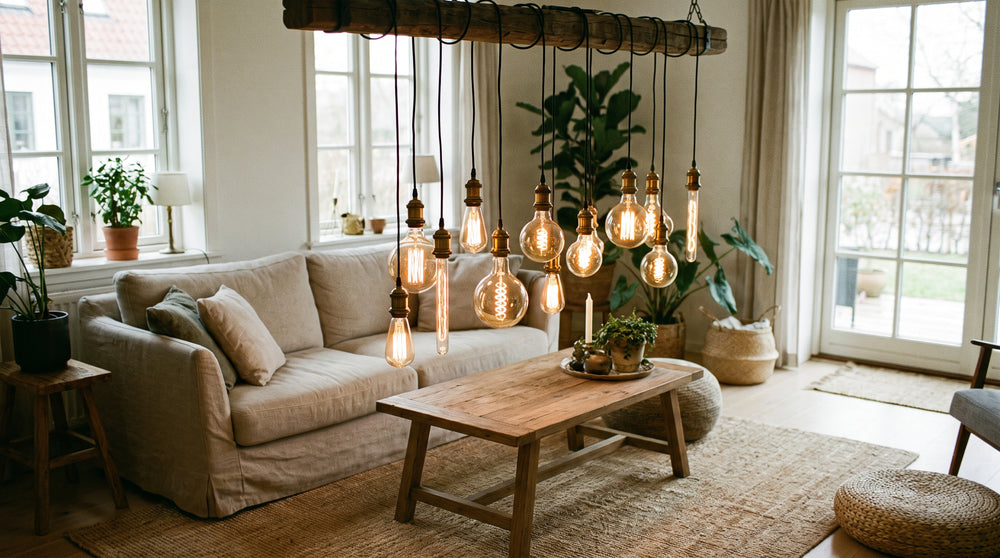
At 2,700 K, parquet and beige fabric keep their warmth, and the room lends itself to rest. 2,700 K bulbs work just as well in a living room, with the living room bulbs, as in a bedroom among the bedroom bulbs. Keep the same reference throughout the room: a cooler spotlight in the middle of a row is immediately noticeable.
Recessed bulbs in a kitchen or bathroom
At 3,000 K, tiles and stainless steel show their colour better and the worktop is clearly readable. 3,000 K bulbs suit the kitchen, the hallway and the entrance. In a wet area, the protection rating is given on the product sheet: that is what decides, not the shape of the spotlight.
| Temperature | Perceived rendering | Recommended rooms | What it changes |
|---|---|---|---|
| 2,700 K | Warm white, slightly amber | Living room, lounge, bedroom | Restful mood, close to a filament bulb |
| 3,000 K | Warmer white, more neutral | Kitchen, hallway, entrance, bathroom | Clearer reading of worktops and floors |
How do you install a recessed ceiling light?
Switch off the power at the consumer unit, locate the cable run, drill the cut-out to the spotlight diameter, connect the socket and then clip the spotlight into the ceiling. Each spotlight needs its own power supply: a 12 V spotlight goes through a transformer.
Do you need a transformer for a 12 V recessed spotlight?
Yes, a 12 V spotlight cannot be connected directly to the mains: it receives its current from a transformer, placed upstream on the line. 12 V bulbs only work with this setup. If the transformer powers several spotlights, note how many it supports before adding another.
Several spotlights on the same line: what you need to know
Several spotlights are connected in parallel from the first point, live with live and neutral with neutral. 220 V LED bulbs make the job simpler: no transformer to plan for. If the ceiling is plasterboard, the cut-out needs a suitable drill bit and a cable already run.
How do you change a recessed bulb in the ceiling?
First switch off the circuit breaker, then gently lever the spotlight ring to bring it down from the ceiling. Unclip or unscrew the bulb, fit a model with the same base, and clip the spotlight back in. Wait for the socket to cool if the spotlight has just been on, and keep the same colour temperature so the room stays even.
How do you light a room without a DCL box or drilling the ceiling?
A recessed spotlight requires a ceiling cut-out and an electrical supply: without a DCL box, you have to start from a socket or an existing light point. Without drilling, turn to a wall light, a floor lamp or a fitting that plugs into a socket.
Can you install a ceiling light without a DCL box?
Without a DCL box, the connection is made from an existing point, a switched socket or a wall light already in place. An electrician can run a line from the consumer unit, which means work in the walls and ceiling. Our selection of lights then goes on the wall rather than the ceiling.
How do you keep a light on the ceiling without drilling?
A lightweight fitting that plugs into a socket avoids both cutting and drilling. LED bulbs fit it and can be changed without tools. For a true recessed light, the cut-out is still needed: no drill-free fixing holds a spotlight in plasterboard.
What should you check before buying recessed bulbs?
Before buying, note the base of the fitting, the expected supply, 12 V or 220 V, and the colour temperature already in place in the room. Also check whether the circuit is on a dimmer: not every bulb supports it. Buying the bulb before knowing the fitting remains the most common mistake.
Recessed LED bulbs: mistakes to avoid
Mixing two temperatures in the same row is immediately visible, and a base ordered blind ends up in a drawer. Compare the shape of the glass before confirming: some modern-design bulbs are wider than average, others come in an amber finish that changes the look once switched off.
Do you need a dimmer on a recessed spotlight?
Dimming depends on the bulb and the control: you need a source designed for it and a dimmer compatible with that exact model. A dimmable LED bulb flickers less than a model not designed for it, which cuts out in bursts. If in doubt, change the dimmer and the bulb at the same time.
First choose the base from your spotlight's sheet, then compare temperatures and shapes in LED bulbs, with filament or glass models where the spotlight remains visible.
Frequently asked questions about recessed bulbs
How do you wire 3 bulbs in parallel?
Three bulbs are wired in parallel by running two wires from the first point: live with live, neutral with neutral, each on its own branch. All three light up together and stay independent if one fails. Switch off the circuit breaker before any connection.
What are the drawbacks of LED lamps?
An LED bulb does not behave like a filament bulb: some flicker on an old dimmer, others show a cooler tint than expected, and their electronics can age before the source does. Quality varies a great deal from one model to another, which is why it is worth checking the stated base and colour temperature.
How much does it cost to have an electrician fit a light?
Fitting is charged by call-out and by the number of points to connect, not counting the working height, access to the wiring and making good the ceiling. There is no single rate: ask for two or three written quotes for your home, it is the only way to get a reliable figure.
How do you install a pendant light without an electrical supply in the ceiling?
Without an electrical supply in the ceiling, a pendant light cannot be connected directly. The solution goes through an existing point: a switched socket, a wall light or a plug-in fitting.
Recessed LED spotlight bulbs: how do you choose the right one?
First identify the base of the fitting, GU10, G9 or G4, then the expected supply, 12 V or 220 V. Then choose the colour temperature according to the room: 2,700 K for a living room or bedroom, 3,000 K for a kitchen or hallway. Finally check compatibility if the circuit is on a dimmer.
Can you dim a recessed spotlight?
Dimming depends on the bulb and the control: you need a bulb designed for dimming and a dimmer compatible with that exact model. A non-dimmable bulb flickers or cuts out in bursts. If in doubt, replace the dimmer and the bulb at the same time.
Secure payment, tracked delivery, returns and Designix customer service accompany every order from start to finish.




