
Hallway Light
This selection is also available in our French store: Lampe Couloir



- Tracked delivery to your country Tracked delivery
- Secure payment at checkout Multiple payment methods
- 14 days to change your mind 14-day returns
- Secure payment Secure payment
Not sure of your style? Find it in 30 seconds
A few questions, and we will show you the pieces made for you.
Frequently asked questions
How do I choose the right product?
What are the delivery times?
Can I return an item?
Can I pay in instalments?
An interior that reflects who you are
Carefully selected pieces, shipped from our warehouses. Our team advises you before you buy, so you choose with confidence.
- Tracked delivery
- Pay in instalments, where available
- 14 days to change your mind
- Advice & showroom in Lyon, France
Use a ceiling light or a wall light as the main source, then add a table or rechargeable lamp in corners without sockets. A hallway is walked through more than it is looked at: light guides footsteps, illuminates steps and stays soft when the door opens. The distribution of light points and the colour temperature matter more than the power of a single source.
This page gathers lighting solutions for hallways, entrances and staircases, with the criteria for choosing, installing and maintaining them.
What type of light for a hallway?
A hallway is primarily lit with a ceiling light or a wall light, supplemented if needed by a table lamp. The choice depends on the width of the passage, the ceiling height and the presence of sockets. Even light avoids dark areas and reflections on walls.
Hallway ceiling light
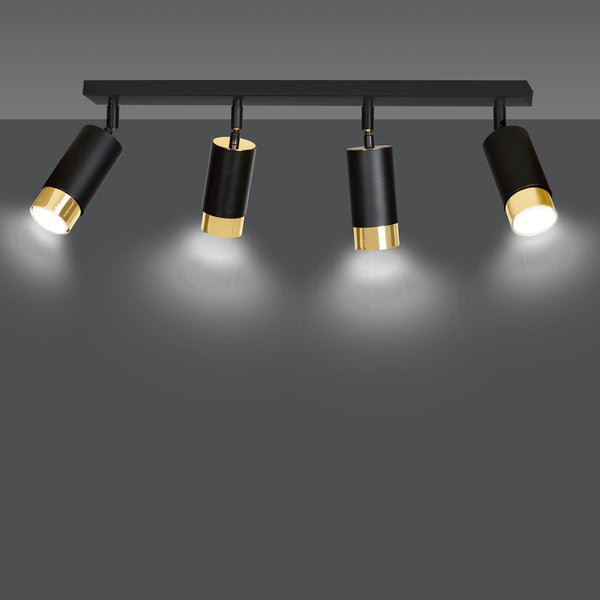
A ceiling light suits a wide passage and is placed in the centre, away from walls if it is round or square. In a long hallway, two evenly spaced points are better than a single source in the middle. A linear batten takes over when the ceiling is low, as it stays discreet and diffuses downwards. The bulb base determines which bulbs you can replace later, a point to check before buying.
Hallway wall light
A wall light saves space in a narrow hallway: it provides grazing light and does not take up the volume of the passage. It is mounted at hand height, around one metre from the floor, or lower near the first steps. Wall lights come in wired or no-work-fixing versions depending on the wall. A well-distributed hallway light makes circulation obvious, even without a central ceiling light.
| Type | Where to install | What it changes | To check |
|---|---|---|---|
| Ceiling light | Hallway, entrance | Wide light without clutter | Ceiling height, bulb base |
| Wall light | Narrow hallway, staircase | Saves space, grazing light | Mounting height, IP rating if damp room |
| Rechargeable lamp | Hallway without socket | No cable | Battery life, fixing |
| Solar lamp | Glazed or outdoor hallway | Works without mains | Exposure, brightness |
| Motion sensor | Staircase, passage | Automatic switching | Coverage, delay |
| Floor lamp | Corner of a wide hallway | Vertical accent light | Width, stability |
How to light a hallway without sockets or work?
Without a socket, you can install a rechargeable lamp fixed to the wall or ceiling, or a solar lamp if the hallway receives daylight. These solutions avoid work and are often triggered manually or by detection. Check the battery life and ease of recharging before choosing.
Rechargeable hallway lamp
This model is fixed with screws or an adhesive pad depending on the surface, then recharged from the mains or via USB. It serves as an accent source in a corner, above a console, or as emergency light during a power cut. A rechargeable lamp is well suited to rentals where walls cannot be drilled. Look at the stated duration between charges and the presence of a dimmer, useful for lowering intensity in the evening.
Solar lamp
A solar lamp works without mains, provided its panel captures daylight. It suits a glazed entrance, a skylight or an outdoor hallway. In a closed hallway, recharging becomes unreliable and a mains solution will be more dependable. Consider the IP rating if the light remains exposed to humidity. As an accent, table lamps easily complement a fixed point.
How to light a hallway staircase safely?
A hallway staircase is made safe with lighting that follows the steps: low wall light, linear batten or ceiling light with motion sensor. The sensor turns the light on as you approach and off after you pass, avoiding the search for a switch. The light should stay soft to avoid glare when descending.
Hallway staircase light
On a staircase, each flight deserves its own light point, not just the landing. A wall light placed low illuminates the step without dazzling the eye looking down, while a source at the top lights the arrival. Aim for even light: highly contrasting areas tire the eyes and cause missed steps. A model in brushed metal lamps withstands traffic well and wipes clean with a cloth.
Hallway light with motion sensor
The sensor triggers the light as soon as presence enters its field, then switches off after an adjustable time. It is placed where it covers the entire passage area, without aiming at a door or window that causes false detections. Adjust the range and delay before drilling. It is the simplest solution when hands are full.
How to connect several lamps to a single power supply?
To connect several lamps to a single supply, use a junction box or connector blocks, then run cable to each light point. A power strip can help for table lamps. Switch off the power before working and respect wire cross-sections. If in doubt, have an electrician validate the installation.
There are three families of solutions. The junction box is the cleanest: it feeds several outgoing circuits from the supply, with accessible connections for maintenance. Connector blocks suit a small fixed network, provided they are housed in an enclosure and not left exposed. A power strip remains practical for lamps plugged into sockets, never for a light wired to the wall. A remote control or wireless switch avoids running new cables between two points. Do not mix circuits and check the total supported power. If the number of outgoing circuits becomes large, call a professional. To stay within a reasonable budget, affordable models do the accent job.
Which lamp for an entrance hallway?
In an entrance hallway, a wall light or ceiling light provides a landmark as soon as the door opens. A table lamp on a console adds accent light and highlights a mirror or a catch-all tray. Choose warm light for welcome, without glare.
Entrance hallway light
The entrance needs two levels of light: general lighting that illuminates the floor and walls, then a low point near the console or coat rack. A bedside lamp repurposed from its usual role does this second job very well on a narrow piece of furniture, provided the base is stable and the light shaded. Modern-style bedside lamps pair well with a understated entrance, in black, brass or off-white.
Entrance lighting
Around 2700 to 3000 kelvins, the light stays warm and readable for welcome, without the pallid effect of a too-cold white. A frosted glass or fabric shade diffuses better than a bare bulb, which marks faces and walls. If the entrance serves as a vestibule, a ceiling point with dimmer allows you to adapt the mood between the morning rush and the evening return. The quality of light matters as much as power.
What are the lighting trends for 2026?
For 2026, hallways adopt clean lines, materials such as metal and glass, and discreet LED sources. Rechargeable or sensor lamps are growing to avoid work. Round shapes and understated finishes remain easy to match with the entrance and staircase.
Fine pendant lights above a wide hallway are also making a comeback, playing with height rather than power. A contemporary light embraces a simple silhouette and diffused light. Matte materials and design lamps with exposed structure act as visual landmarks in a long passage, provided they stay discreet on the ceiling. Black and gold finishes pair with current wall tones.
Chandelier or pendant for a hallway
Consider one if the hallway is wide and the height sufficient. Check the suspension height so as not to obstruct the passage.
How to choose a design lamp for a hallway?
A design hallway lamp is chosen for its line as much as its light: simple shape, visible material, soft diffusion. A table lamp or design bedside lamp can sit on a console, while a floor lamp suits a large hallway. Avoid models that are too wide in a narrow passage.
Design bedside lamp and table lamp
An Italian design table lamp relies on fine proportions and noble materials, without cluttering an entrance piece of furniture. Look at the total height, base width and beam direction, then choose a warm light for accent. Black finishes structure a pale wall, gold details warm a white-painted entrance. For a softer mood, look at LED bedside lamps, understated and with no bulb to change.
Floor lamp in a wide hallway
A floor lamp occupies the floor: it is therefore reserved for a fairly wide hallway or a corner, never in the middle of the passage. A floor lamp with a shade facing upwards lights the wall and visually enlarges the room. In a living room open to the hallway, it creates a useful transition, and as such joins the living room lamps. Check the stability of the base and the cable run on the floor.
How to recognise a real salt lamp?
A real salt lamp is recognised by its block of rock salt, often pink or orange, and its warm light. It serves as accent light and does not replace hallway lighting. Each piece being natural, the shade and shape vary. Place it on a stable surface, away from traffic areas.
Salt lamp, a red-orange light
The block shows veins and irregularities: reconstituted or pressed salt shows a too-smooth surface and a uniform shade. The source, often a small bulb, gives a very soft red-orange light, to be reserved for atmosphere. In a hallway, it creates a warm landmark on a console, without really guiding footsteps. Pair it with another light point rather than relying on it alone.
Salt lamp, precautions for use
Salt attracts moisture and may seep depending on the ambient air: wipe it, place it on a saucer and keep it away from fabrics. The block heats slightly when the lamp stays on for a long time. Regularly check the condition of the cord and unplug before handling. Metal lamps and white lamps remain easier to maintain for daily use.
Which light for which area of the hallway?
The need changes from one end of the passage to the other. This table summarises the type of light and the setting to aim for by area.
| Area | Need | Type of lamp | Useful setting |
|---|---|---|---|
| Entrance | Welcome, landmarks | Ceiling light or wall light | Warm light |
| Long hallway | Guidance without glare | Linear batten or ceiling light | Even diffusion |
| Staircase | Step safety | Motion sensor | Automatic switching |
| Corner without socket | Accent | Rechargeable or solar | Battery life |
| Decor | Atmosphere | Salt lamp or design lamp | Soft light |
A final general guideline: LED lighting is chosen according to colour temperature, around 2700 K for a warm mood and near 4000 K for a more neutral rendering in a passage. A well-chosen LED light consumes little and is easy to control.
Frequently asked questions
How to choose an original bedside lamp for a hallway?
An original bedside lamp can serve as an accent in a hallway if it fits on a console or shelf. Look at its shape, material and the softness of its light. It does not replace the main ceiling light, but adds a warm landmark near the entrance.
How to light a long hallway without glare?
Distribute light with several small points rather than a single too-strong source. Ceiling lights, wall lights or battens give even light. Choose warm light and avoid bare bulbs in the line of sight. The goal is to guide without creating harsh shadow areas.
Can you put a solar lamp in a hallway?
A solar lamp suits a hallway that receives daylight, or a glazed entrance. The panel must be exposed to recharge the battery. In a closed hallway, a mains-rechargeable lamp will be more reliable. Check battery life and fixing before choosing.
How to install a hallway light with motion sensor?
It is fixed to the wall or ceiling, in a place that covers the passage area. The sensor turns on as you approach and off after an adjustable time. Check the range and orientation before drilling, and switch off the power during installation.
Is a salt lamp dangerous?
A salt lamp heats slightly and may become damp depending on the ambient air. Place it on a stable surface, keep it away from fabrics and regularly check the cord. It remains an accent light, not main lighting. If in doubt, follow the manufacturer's instructions.
Move to a concrete choice
Start with the constraints of the room: presence of a socket, width of the passage, staircase or not. Then set the desired light and material, and only then the style. To compare the available families, browse the lamp collection, the contemporary models or the gold selection according to the mood of your hallway.
Secure payment, tracked delivery, possible returns and Designix customer service to guide you in choosing the light suited to your entrance or staircase.




