Crystal spotlights
- Tracked delivery to your country Tracked delivery
- Secure payment at checkout Multiple payment methods
- 14 days to change your mind 14-day returns
- Secure payment Secure payment


Not sure of your style? Find it in 30 seconds
A few questions, and we will show you the pieces made for you.




























Frequently asked questions
How do I choose the right light output?
At what height should the light be installed?
What type of bulb?
Compatible with LEDs and dimmers?

Light changes everything
From statement chandeliers to discreet wall lights, we help you choose the right brightness, height and style for every room.
- Tracked delivery
- Pay in instalments, where available
- 14 days to change your mind
- Advice & showroom in Lyon, France
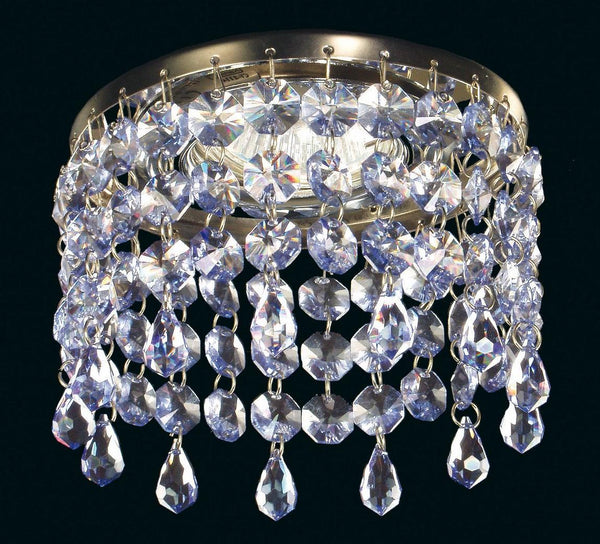
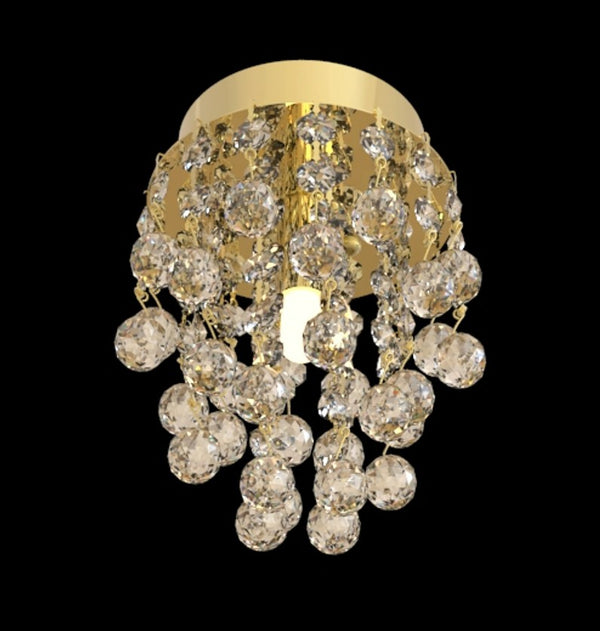
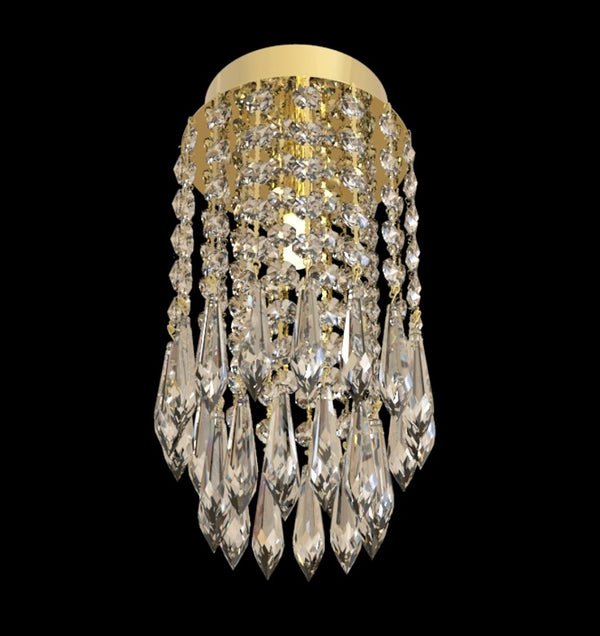
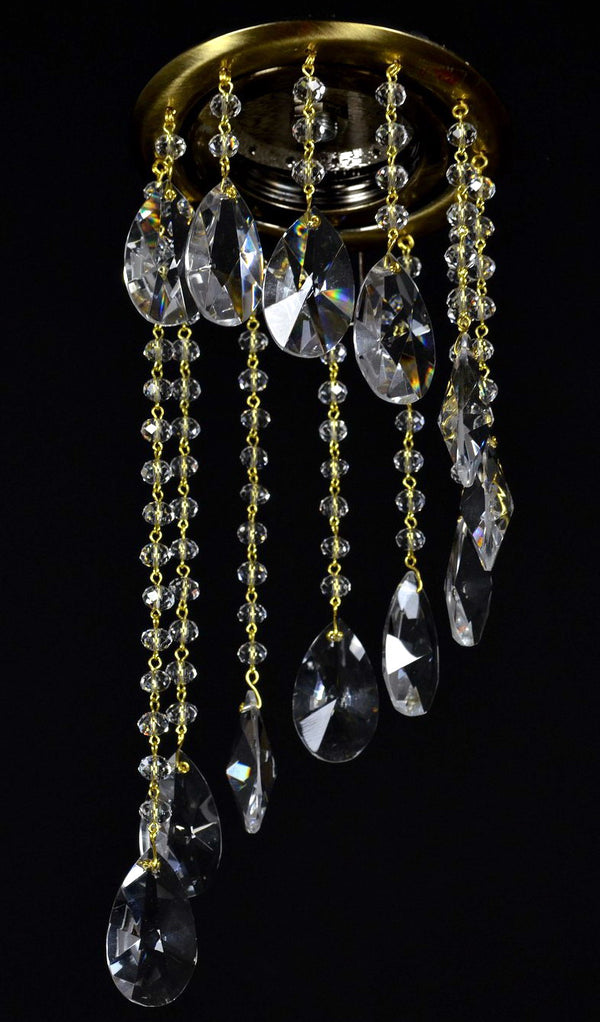
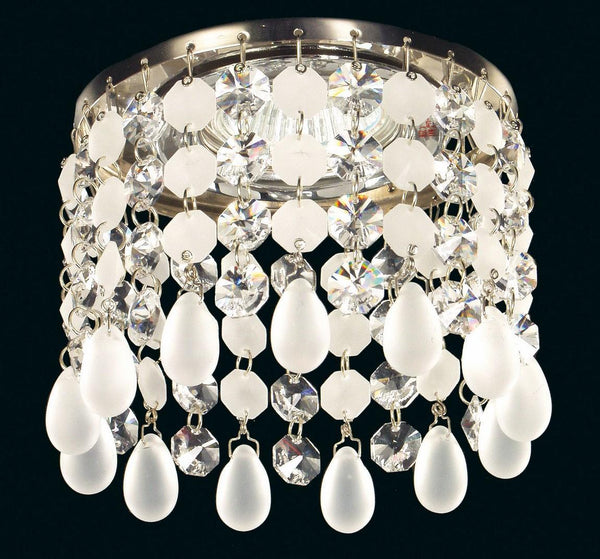
First, measure the clearance between the ceiling and the work surface, then check the socket: recessed and short surface-mounted models use GU10 at 65 mm, while cascades drop from 11 to 46 cm with G9. This collection brings together crystal spotlights with drops, beads and faceted pendants for the workshop, in a bohemian spirit with gold or silver finishes.
What kind of light does a crystal spotlight give?
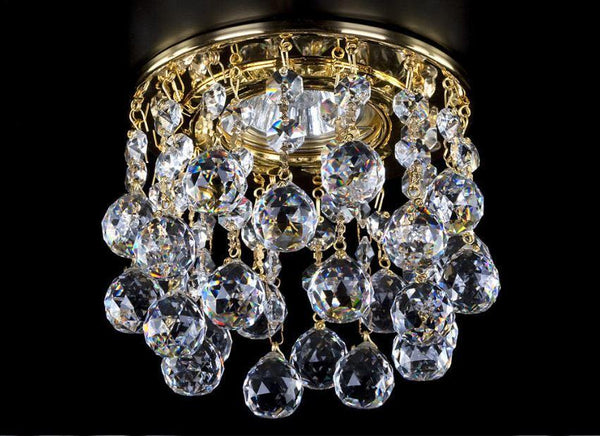
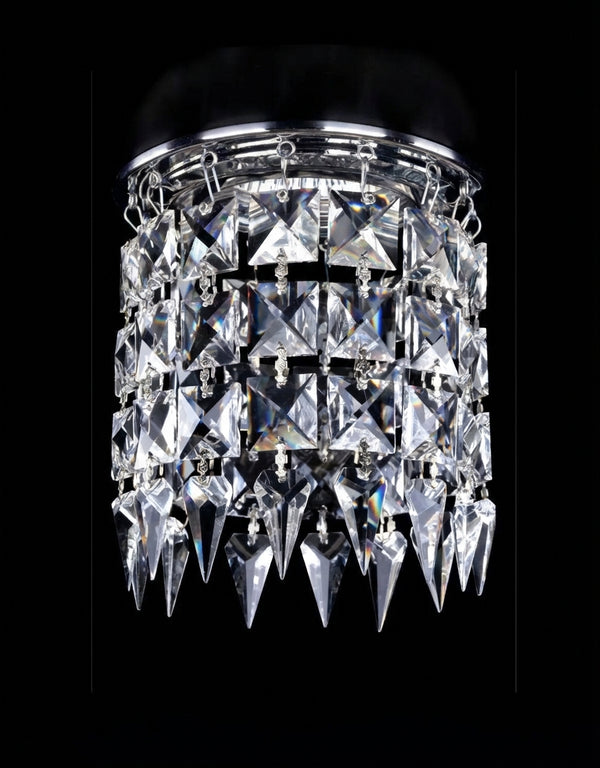
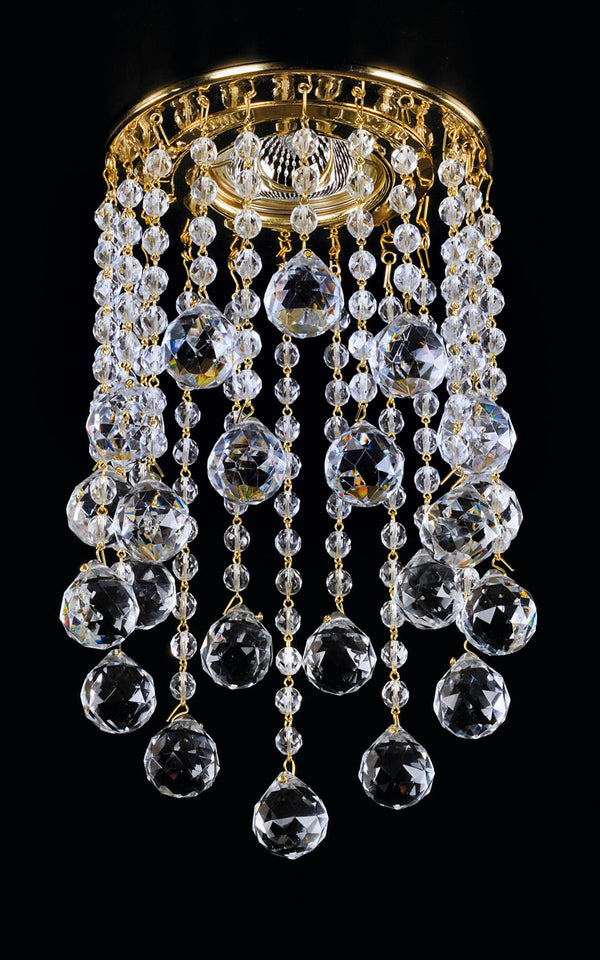
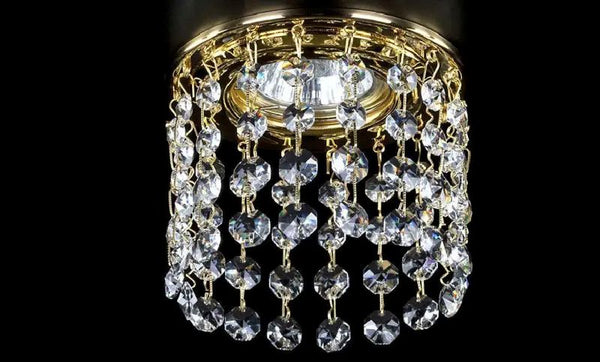
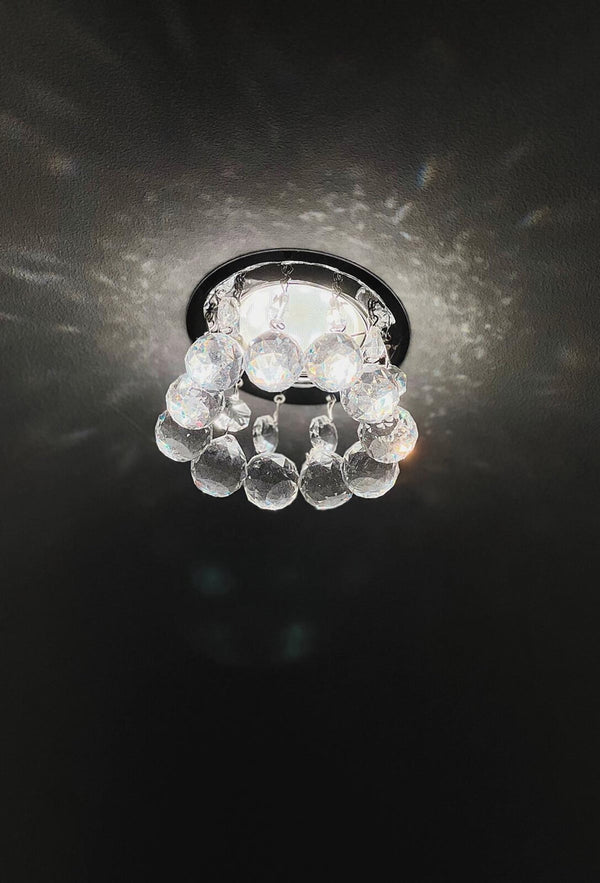
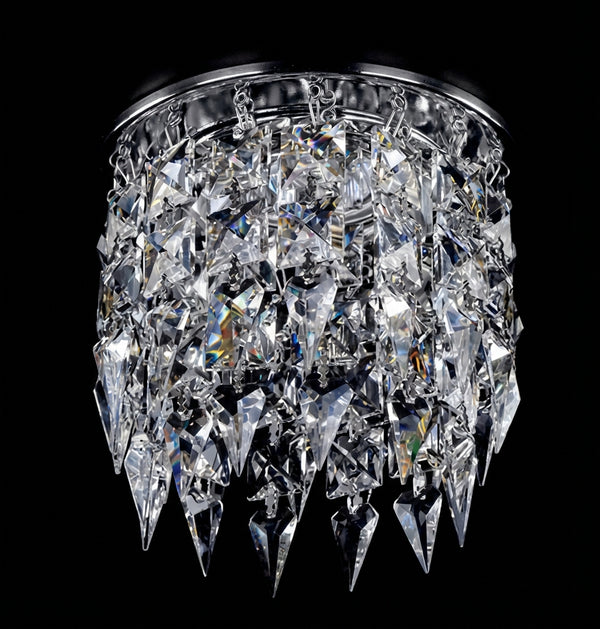
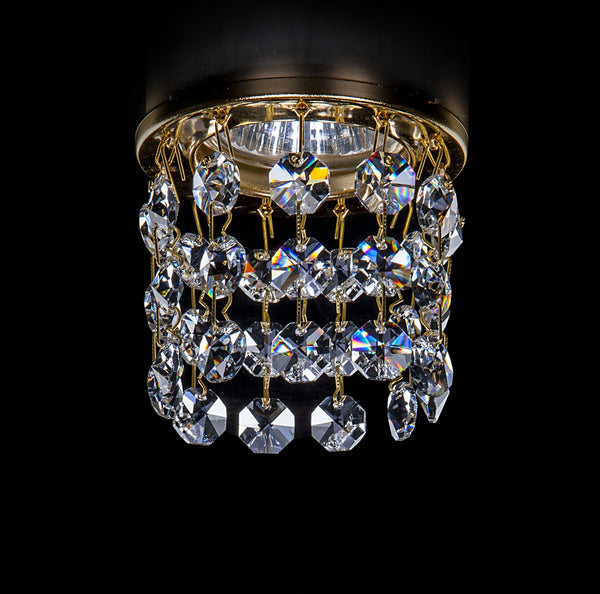
A crystal spotlight shines downwards like any other spotlight, but the drops, beads and faceted pendants cut the beam and scatter it across the walls and work surface. The light stays directional: the crystal shapes it, it does not replace it.
What the crystal changes in the result
On a short 65 mm model, the sparkle is limited to the immediate surround of the spotlight. On a cascade, the light passes through several layers of crystal before reaching the work surface: the beam is more fragmented, the shadows follow the length of the drops and move as you walk underneath. This layering is what draws people to designer LED spotlights, even more than the amount of light.
Which bulb for a crystal spotlight: GU10 or G9?
The socket is dictated by the model. GU10 is used on recessed and short 65 mm surface-mounted models; G9 is used on cascades from 11 to 14 cm in diameter. In both cases, a bulb around 2700 K brings out the facets, while a very cool light above 5000 K makes the crystal look cold. To compare all the options in the lighting catalogue, keep this temperature reference in mind.
Where to place a crystal spotlight?
The whole selection is listed for the workshop and in a bohemian style. The hanging silhouette fits above a workbench or a work table, provided you keep the necessary clearance.
In a workshop
Over a work station, a short 65 mm spotlight lights just below it and leaves the space above your head clear. A cascade lights a wider area and decorates more, but it hangs down: check that it does not get in the way of movement or wall storage. A model with drops above the workbench extends the same family as the designer spotlights.
In other rooms: living room, bedroom, hallway
With an IP20 rating, these lights suit dry rooms. A short cascade works above a coffee table or a reading corner and pairs well with the LED spotlights for the living room. In a bedroom, a low model above the bedside tables is preferable, inspired by the bedroom spotlights. In a hallway, two aligned points are enough, as in the hallway spotlights.
How to choose between a surface-mounted and a recessed spotlight?
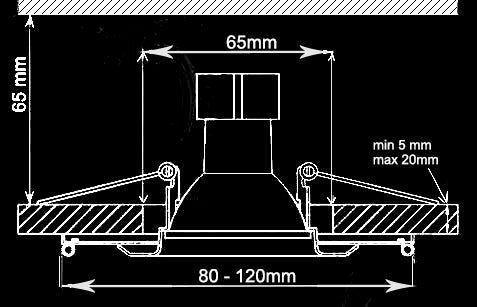
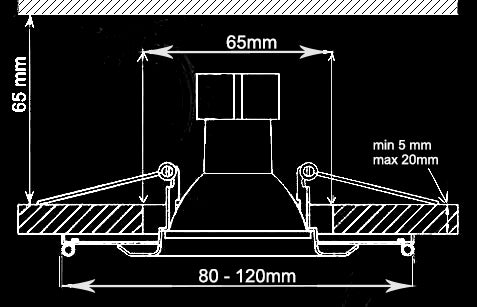
The choice depends on your ceiling and the clearance you accept. Recessed models take up 65 x 65 mm and require a cut-out of 80 to 120 mm in a support 5 to 20 mm thick. Surface-mounted models remain visible and hang down from 11 to 46 cm depending on the crystal drops.
What to check before drilling
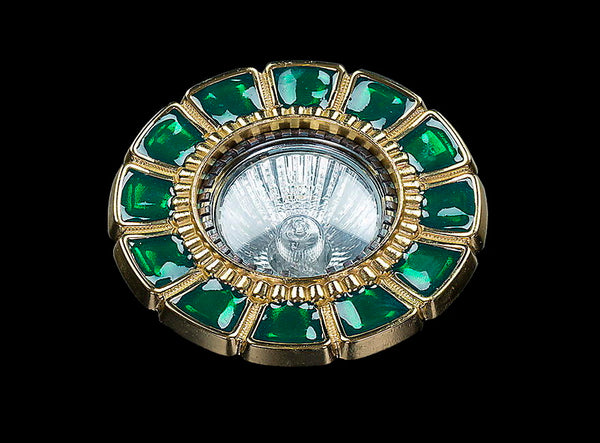
Measure the thickness of the support: below 5 mm or above 20 mm, a recessed model cannot be installed properly. If the ceiling is solid concrete, a solid slab, or if you do not want to cut, a surface-mounted model fixed by drilling does the job. The Marnorilo recessed spotlight illustrates the flush-to-ceiling version, while the recessed spotlights for living rooms show other installation options.
Clearance: how far down does a crystal cascade hang?
Short surface-mounted models with a GU10 socket hang down only 65 mm. Cascades with a G9 socket range from 11 cm to 46 cm in height depending on the model, which changes everything above a table or work surface. Take the height of the longest model you are considering and subtract it from the ceiling height before deciding.
| Installation type | Socket | Dimensions | Cut-out or drilling | Support thickness | Model examples |
|---|---|---|---|---|---|
| Recessed flush with ceiling | GU10 | 65 x 65 mm | 80 to 120 mm | 5 to 20 mm | Marnorilo, Alanorena |
| Short surface-mounted fixed by drilling | GU10 | 65 x 65 mm | 80 to 120 mm | 5 to 20 mm | Cristallor, Sornoreta, Tesnoraro, Dallia, Amoria, Karelia |
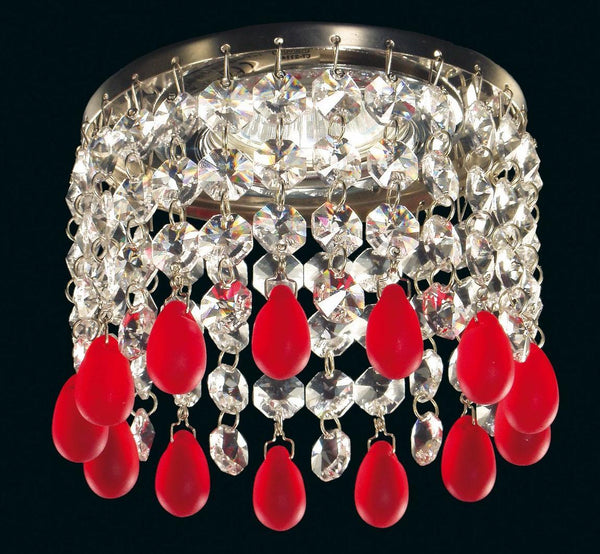
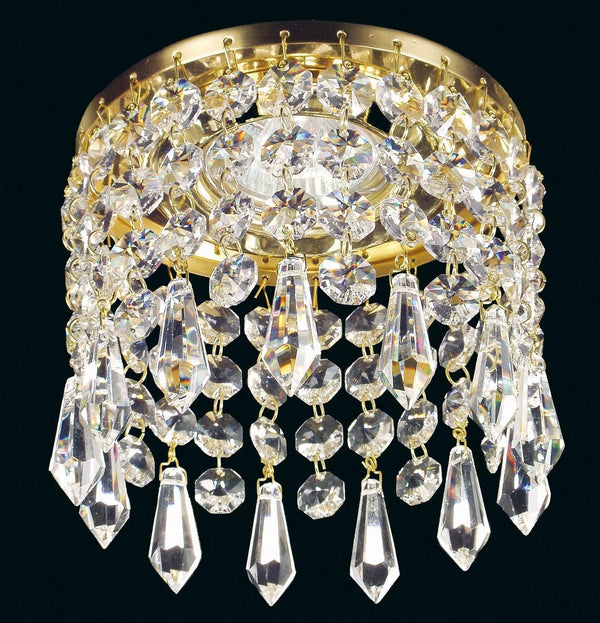
| Medium cascade surface-mounted | G9 | Ø 12 cm, height 13 to 26 cm | No cut-out indicated | Not applicable | Zenvesilo, Quintilla, Saillina, Mirra, Bravesso |
| Long drop surface-mounted | G9 | Ø 12 cm, height 46 cm | No cut-out indicated | Not applicable | Hellen |
| Compact format | G9 | Ø 11 cm, height 11 cm | No cut-out indicated | Not applicable | Guttella |
Cascade, round shape or dome: which silhouette to choose?
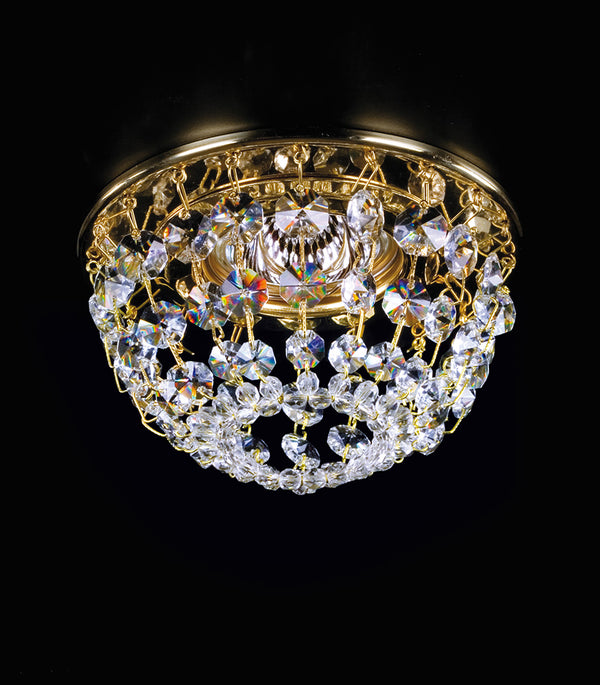
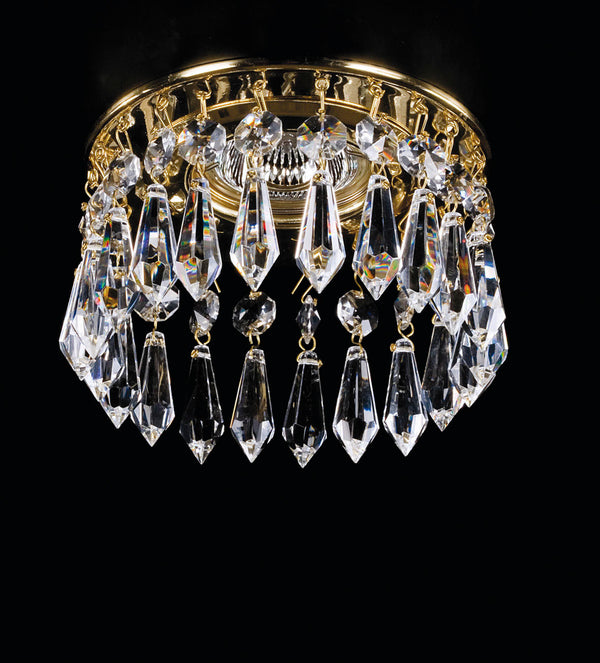
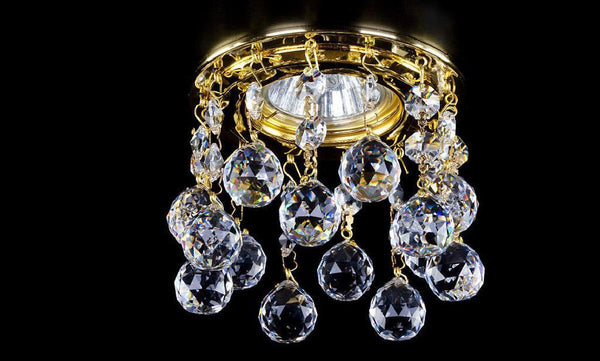
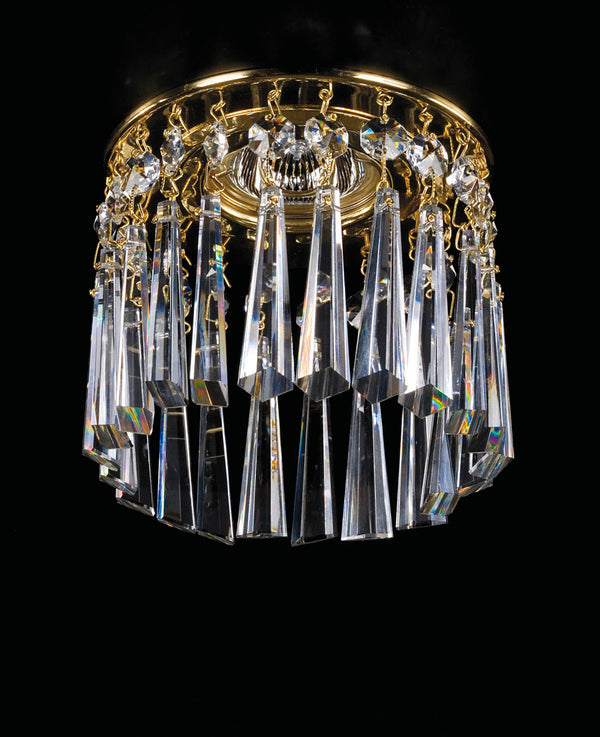
The cascade is the most common shape in the collection, the round shape accounts for about one model in five and the dome remains marginal. The cascade gives a vertical reading of the light: it stretches the room downwards and suits high ceilings where you want to mark an axis. The round shape gathers light around the luminous point and blends into the ceiling, practical under a low ceiling. The dome rounds off the volume and remains the most understated of the three.
| Shape | Presence in the selection | What it gives | Available finishes |
|---|---|---|---|
| Cascade | Most common shape | Vertical drop of drops, beads or pendants, vertical reading of the light | Gold or silver |
| Round | About one model in five | Compact silhouette around the luminous point | Gold or silver |
| Dome | Marginal shape | Rounded volume, more understated look | Gold or silver |
Gold or silver: how to match your crystal spotlights?
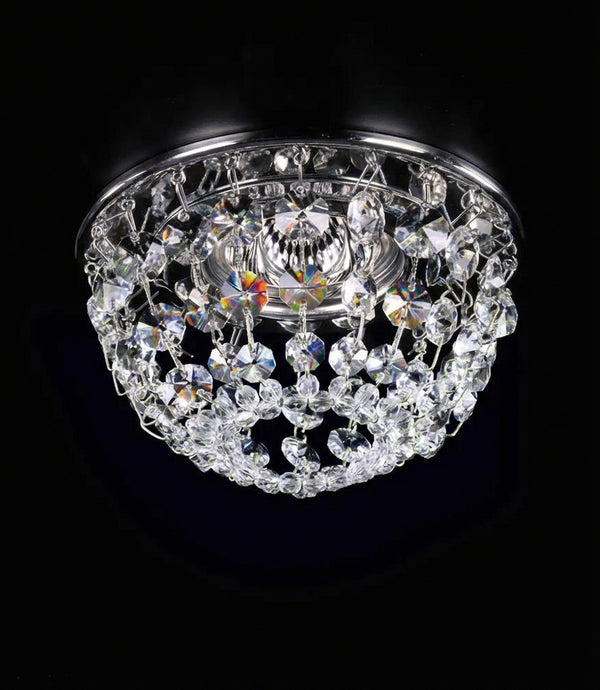
Both finishes cover the whole selection, and the metal already present in the room decides. Brass, copper or warm wood call for gold; stainless steel, aluminium and cool greys call for silver. Mixing the two in the same room works if one remains dominant and the other occasional.
Crystal itself is neutral: it takes on the tint of the bulb and the ambient light. A gold model above a light oak work surface stays in the bohemian tone, while a silver version on a grey splashback is more discreet. To decide on a completely different register, compare with the more contemporary spotlights or the metal spotlights.
How to arrange spotlights on the ceiling?
To arrange spotlights on the ceiling, first draw the plan of the furniture and the areas to be lit, then transfer the points keeping identical gaps and symmetry relative to the room's axis. Fewer well-aligned points are better than scattered ones.
Align the spotlights with useful areas
A crystal spotlight lights below it and a little around. So place the points above what needs to be seen: the end of a workbench, the corner of a work surface, in front of a bookcase. Mark them on the floor, barefoot under the future light, then transfer to the ceiling with a plumb line. It is the same logic as for adjustable spotlights, except that here the beam is set by the position of the point, not by orientation.
Avoid the constellation effect
Multiplying closely spaced points creates a busy ceiling and shadow areas between each source. Two or three evenly spaced spotlights light better than a tight row. Also keep a margin from the walls so that the crystal's sparkle does not hit the wall directly below the light.
How many spotlights in a kitchen?
The number depends on the surface area, the shape of the room and the areas to be lit, not on a single rule. General lighting and work surface lighting are counted separately. In this selection, GU10 models take up 65 mm, with a cut-out of 80 to 120 mm to plan for.
Count by zones rather than by surface area
A general zone for moving around, a zone over the work surface, one for the dining corner if the room has one. Short recessed or surface-mounted models suit the work surface, provided they stay above the useful area and do not dazzle the person working. Cascades, being longer, are reserved for above the table. The kitchen lighting solutions give other layout examples, as do the modern kitchen spotlights.
What to check before ordering
Three points: the required cut-out (80 to 120 mm for recessed models), the support thickness (5 to 20 mm) and the bulb socket. A surface-mounted model avoids the cut-out and the thickness question, at the cost of a visible light. The Cristallor spotlight with drops comes in both recessed and surface-mounted versions: this type of model lets you choose according to the ceiling constraint rather than the other way round.
How to wire spotlights in series or in parallel?
In series, the spotlights share the same circuit and all go out if one fails; in parallel, each keeps the same voltage and remains independent. For home lighting, parallel wiring is the standard solution, to be carried out by an electrician.
Series or parallel: what it changes
Parallel wiring lets you switch on or replace one point without touching the others, and that is what you expect from a living room ceiling. Series wiring is only of interest in very specific cases and makes any fault visible across the whole circuit. If you want to adjust the intensity, the control is prepared on the circuit side: dimmable spotlights require a dimmer compatible with the chosen bulbs.
Wiring, on the electrician's side
Cut the power at the consumer unit before any work and entrust the wiring to a professional. Tell them the number of points, the bulb sockets and any switch or dimmer control. This information appears in the product sheets for our black spotlights as well as in the rest of the complete lighting range.
How to care for a crystal spotlight?
Regular dusting is enough to keep the sparkle: a soft, lint-free cloth, without aggressive products or alcohol, on the drops and the frame. When changing the bulb, handle the crystal with care, cut the power and check that the chains and fastenings are tight. The whole selection is guaranteed for two years by the manufacturer.
Secure payment, tracked delivery and returns available, with Designix customer service for any question about a specific model.
Frequently asked questions about crystal spotlights
How many spotlights in a kitchen?
No single rule: it all depends on the surface area, the shape of the room and the areas to be lit. General lighting and work surface lighting are counted separately, then you check the 80 to 120 mm cut-out and the support thickness before ordering recessed spotlights.
How to wire spotlights in series or in parallel?
In series, the spotlights share the same circuit and all go out if one fails; in parallel, each keeps the same voltage and works independently. Parallel wiring is the standard solution for home lighting and is entrusted to an electrician.
How to arrange spotlights on the ceiling?
Start from the furniture plan, place the points above the areas to be lit, then transfer them to the ceiling with identical gaps and symmetry relative to the room's axis. Even spacing matters more than a large number of points.
What is the difference between a GU10 and a G9 socket?
GU10 is found on recessed models and short 65 mm surface-mounted models, with a cut-out of 80 to 120 mm to plan for in the support. G9 is used on longer cascade surface-mounted models, which require no cut-out.
Can crystal spotlights be installed in a bathroom?
The whole selection is IP20, a rating that protects only against solid objects and suits dry rooms. In a bathroom, you must stay outside areas exposed to water splashes and choose a light with a higher protection rating.
What height should be planned for a surface-mounted spotlight with crystal chains?
It depends on the model: in this selection, surface-mounted models with a G9 socket measure 11 to 46 cm in height, compared with 65 mm for short GU10 models. So you need to check the clearance available under the light.
Take your ceiling and clearance measurements before choosing, then browse the black recessed spotlights and the black LED spotlights if you are looking for a dark finish to match the crystal.