
Concrete table lamps
This selection is also available in our French store: Lampes à poser en béton


- Tracked delivery to your country Tracked delivery
- Secure payment at checkout Multiple payment methods
- 14 days to change your mind 14-day returns
- Secure payment Secure payment
Not sure of your style? Find it in 30 seconds
A few questions, and we will show you the pieces made for you.
Frequently asked questions
What table size for how many people?
Which tabletop material should I choose?
Extendable or fixed?
How do I care for the tabletop?
The right furniture, in the right place
Check the dimensions with our fit checker and receive pieces made to last. Unsure? Our team will answer your questions.
- Tracked delivery
- Pay in instalments, where available
- 14 days to change your mind
- Advice & showroom in Lyon, France
Concrete is opaque: light does not pass through the wall, it comes out through the top and bottom of the cube or tube. With a freely chosen E27 bulb, the effect ranges from a soft halo to a sharp beam, always contrasted by the mineral grey of the lamp.
What kind of light does a grey concrete concrete table lamp give?
Expect a low, contained point of light: the block is only 10 cm high, it lights the hand, the book or the plate, not the whole room. The grey of the concrete frames this light without reflecting it, and the E27 socket leaves the choice of bulb to you.
Concrete table lamp: a sharp point of light, never diffuse
The wall is solid: nothing filters through the sides. Everything passes through the top opening and the bottom opening, which gives two cones of light and a dark silhouette in the middle. It is this contrast that makes the lamp readable on a light-coloured piece of furniture. The 15 W LED stated on the spec sheet corresponds to the power intended for the fixture; it is up to you to choose the bulb temperature: around 2700 K for a warm white in the evening, towards 4000 K for a more neutral white when working. To compare with other LED effects, see the designer LED table lamps.
Concrete-effect table lamp: do not confuse imitation with real concrete
Here the material is concrete, not a coating that imitates it: the grey shade comes from the mass and stays the same on the edges. A concrete-effect coating marks more quickly and its grey sometimes leans towards beige. If you are looking for a mineral effect but lighter, the ceramic lamps play the same card with a glaze.
Where to place a concrete table lamp in the home?
On a desk, a bedside table, a side table or a kitchen worktop: both the cube and the tube stand without fixing and move from one room to another. The IP20 rating makes them suitable for indoor use, away from the outdoors and damp areas.
A point of light for the living room or dining room
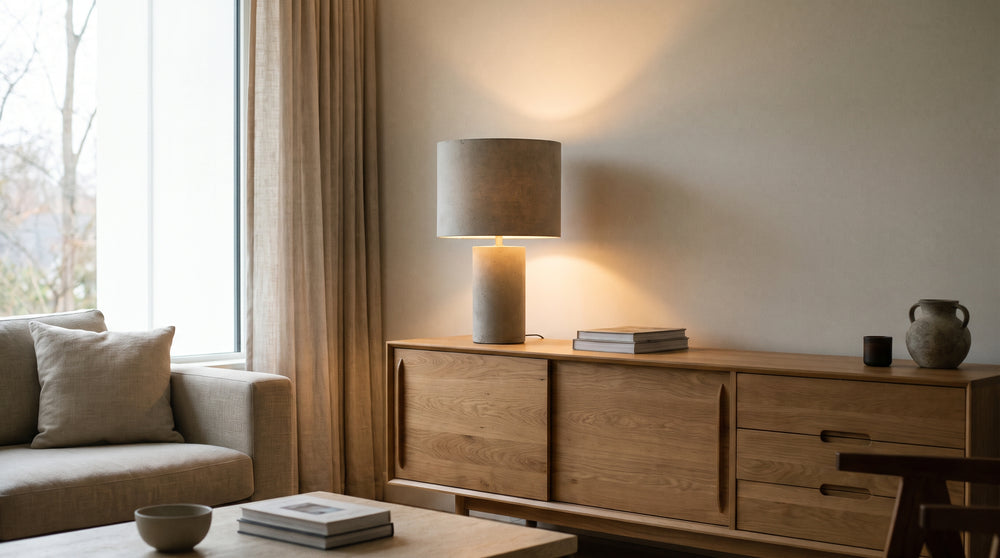
At the end of a sofa, the block adds accent lighting without competing with the pendant. In the dining room, placed on the sideboard, it lights the dishes and leaves the table in a softer light. It is the proportions that make it right here, not the spectacular: a 10 cm footprint, a single shade, a simple shape. For more living room ideas, look at the designer table lamps for the living room.
A desk, kitchen or bedside lamp
On a worktop, the cube stays at the end of the surface and leaves the prep area free. On a bedside table, it fits next to the book without overhanging the furniture. For a more fully equipped workstation, the designer desk lamps complete the choice, and the bedside models for the bedroom cover the rest of the room.
| Room or use | What is expected of the lamp | Format to favour | Why |
|---|---|---|---|
| Desk, worktop | A stable light close to the hands | Cube or tube at the end of the surface | 10 cm footprint, the writing area stays free |
| Bedside table | A low, contained light | Cube 10 x 10 x 10 cm | Compact shape that does not overhang the furniture |
| Living room, side table | A point of accent light | Tube Ø 10 cm | Vertical silhouette that makes its mark without cluttering |
| Kitchen, dining room | Light an area without dazzling | Cube or tube at the end of the surface | Opaque wall: light comes out through the top and bottom |
| Several lamps in a row | A consistent shade | Repeat the same model | Same grey, same height, same effect from one point to the next |
How to choose between the concrete cube and the tube?
The cube measures 10 cm by 10 cm by 10 cm, the tube 10 cm in diameter for 10 cm in height: same floor footprint, different silhouette. The cube suits low surfaces and right angles, the tube suits narrow spaces and vertical lines.
Concrete-base table lamp: a solid block, no added base
No stem, no arm: the shape stands on its own and puts all its weight on the furniture. That is what makes it stable near a keyboard or a cup, and easy to move with one hand. The Novlineta grey concrete bedside cube illustrates this firm stance well.
Cube or tube: which to choose in a small space?
On a narrow shelf or between two books, the tube takes up less width and rises straight. The cube, on the other hand, aligns with the angles of a piece of furniture and blends with objects laid flat. Both share the same E27 socket, the same IP20 and the same 15 W power, so the choice comes down purely to the line.
| Model | Shape | Dimensions | Colour | Socket | Protection rating | Power | Styles | Rooms |
|---|---|---|---|---|---|---|---|---|
| Novlineta | Cube | W 10 x D 10 x H 10 cm | Grey | E27 | IP20 | 15 W | Modern, industrial, minimalist | Desk, kitchen, dining room, living room, bedroom |
| Haelia | Tube | Ø 10 cm x H 10 cm | Grey | E27 | IP20 | 15 W | Modern, industrial, minimalist | Desk, kitchen, dining room, living room, bedroom |
How to match a grey concrete lamp with your decor?
Mineral grey works as a neutral: it accepts light wood, black metal, raw linen or ceramic without fighting them. What you place around the lamp matters more than the lamp itself.
A modern, industrial or minimalist interior
In a modern style, the lamp stands alone on a lacquered piece of furniture and becomes the mineral object of the room. In an industrial setting, it sits alongside a metal frame and a raw wall. In a minimalist setting, one lamp per surface is enough. To take the comparison further, the modern table lamps for the living room and the Nordic table lamps show other balances.
Which colours around a mineral grey
Grey accepts blonde wood, matte black, off-white or deep green without ever clashing. Just avoid multiplying different greys on the same piece of furniture: a single concrete block per surface is enough to set the tone. For a stronger contrast, the black version for the living room and the wooden table lamps give two opposite directions.
How to connect several lamps to a single electrical supply?
Several lamps can share the same supply if they are wired in parallel, on the same circuit breaker, within the power intended for that circuit. Switch off the power, identify live and neutral, then connect each lamp in parallel rather than in series.
Wiring several lamps in parallel: the diagram to remember
Each lamp receives live and neutral from the same starting point, then the conductors continue to the next one. Connections are made in terminals or boxes, never bare behind a piece of furniture. The power is switched off at the breaker before any work, and the absence of voltage is checked before touching a wire. The Designix lighting range distinguishes lamps with a cord, ready to plug in, from models to be wired to the mains.
Wiring 3 lamps to 1 switch: what changes
The three lamps come on together: the switched live is common, each keeps its own supply. If one is removed, the others still light. The point to watch remains the sum of the powers drawn compared with what the circuit can handle, to be checked on the consumer unit. For a workstation, the LED desk lamps and the adjustable lamps are often simpler to connect.
How to care for a concrete lamp and change its bulb?
A soft, slightly damp cloth is enough on concrete, then leave it to dry in the air. The E27 bulb is changed with the power off and the fixture cold, and the lamp is covered by a 5-year warranty.
Cleaning raw concrete without marking it
No abrasive product, no scraper, no water left standing in the hollow of the opening: concrete absorbs whatever you leave on it. A wrung-out microfibre cloth, natural drying, and the grey shade stays even. To vary the materials on the same piece of furniture, the metal desk lamps also clean with a quick wipe.
Which E27 bulb for a concrete lamp?
The E27 socket accepts a filament bulb for a warm white, or an LED for a more neutral light and lower consumption. The intended power is 15 W: stay within this range so as not to heat the block unnecessarily. The Haelia raw concrete tube follows exactly the same logic.
Secure payment, tracked delivery, returns and Designix customer service: the four points that frame the order, from choosing the format to receiving it.
Choose the format that suits your furniture: the cube for a low surface, the tube for a narrow area. Find everything in the full lighting catalogue, and compare with the LED models for the bedroom or the LED desk lamps if the use is more functional. Those who prefer a light that can be directed will find what they need in the adjustable lamps.
Frequently asked questions about concrete table lamps
What is the difference between a table lamp and a floor lamp?
A floor lamp stands on the ground thanks to a stem and lights higher up, near an armchair or a sofa. A table lamp rests on a piece of furniture: here the cube and the tube are only 10 cm high and move from one table to another.
What is meant by a designer ball table lamp?
The ball lamp refers to a luminous sphere, often placed on the floor or on a piece of furniture. These concrete models instead play with the cube and the tube, two shapes with right angles, with the same 10 cm footprint and an E27 socket.
What are the trend lighting fixtures in 2026?
Demand is turning towards compact volumes, mineral materials such as concrete or ceramic, and simple geometric shapes. The standard E27 socket remains sought after because it lets you choose the bulb: the cube and the tube in 15 W LED are part of this movement.
Is a concrete table lamp suitable for a bedroom?
Yes: at 10 cm high and with an E27 socket, it sits on a bedside table and gives off a low halo, without taking up the walkway. Grey concrete stays discreet on a light-coloured piece of furniture. The IP20 rating, however, requires keeping it indoors, away from damp.
Can several lamps be connected in parallel?
Yes, that is the usual setup: in parallel, each lamp receives the same voltage and lights normally, even if one is removed. In series, they would share the voltage and light poorly. The point to watch remains the total power allowed by the circuit.




