
Concrete ceiling lights










- Tracked delivery to your country Tracked delivery
- Secure payment at checkout Multiple payment methods
- 14 days to change your mind 14-day returns
- Secure payment Secure payment
Not sure of your style? Find it in 30 seconds
A few questions, and we will show you the pieces made for you.
Frequently asked questions
How do I choose the right product?
What are the delivery times?
Can I return an item?
Can I pay in instalments?

An interior that reflects who you are
Carefully selected pieces, shipped from our warehouses. Our team advises you before you buy, so you choose with confidence.
- Tracked delivery
- Pay in instalments, where available
- 14 days to change your mind
- Advice & showroom in Lyon, France
Start by measuring the room to be lit and the space available on the ceiling, then choose the socket: a compact square for a hallway, a rectangular model above a table. These concrete ceiling lights are mounted on indoor ceilings, run on LED, have an IP20 rating and come with a 5-year warranty.
How to choose a concrete ceiling light
Concrete ceiling light: the criteria to check first
Three questions are enough to narrow it down: which room, how much ceiling space, what light you want. Format comes first, because a 10 cm square and a 55 cm rectangle do not play the same role. The socket then decides the effect, GU10 for directed spots, E27 for a visible bulb. Style makes the final call: the whole selection is in concrete, with a predominantly industrial and minimalist look that pairs easily with existing furniture. The 5-year warranty covers every model.
Concrete light fixture: what light effect
Concrete is a matte material: it absorbs light instead of bouncing it back, which avoids reflections on the ceiling and gives a settled light. On spot models, the light goes to a precise point; on bulb models, it spreads more widely around the fixture. Some models add a glass diffuser or a metal reflector that concentrates light downwards. To see the full range, browse all our light fixtures, and for a sober contemporary look, see the modern-style LED ceiling lights.
Where to install a concrete ceiling light at home
A concrete light fixture for the living room or dining room
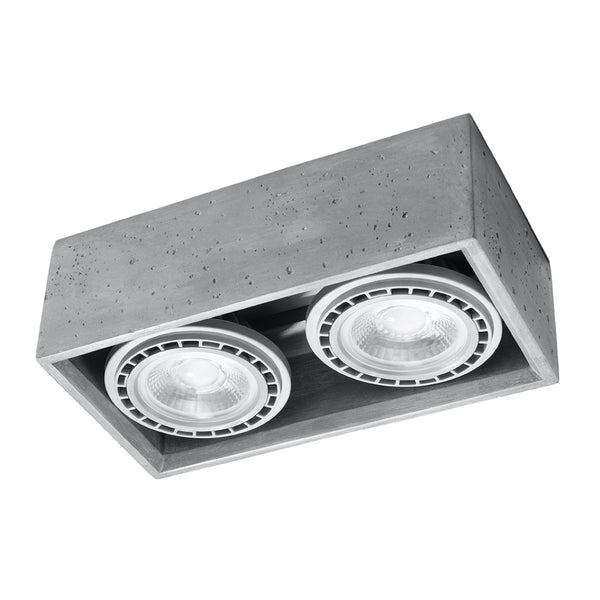
In a living space, you want a generous format that holds the surface. Above a table, a rectangular model with several lamps lights the whole length without multiplying ceiling points. In a living room, a square or cube placed in the centre is enough to set the mood. Uses recorded on the collection put the living room first, followed by the dining room: these are the two rooms where the ceiling light carries the most. To go further, see how to light a living room according to its size.
Which concrete ceiling light for a hallway or entrance
In a passage, light must go straight down and stay discreet. Compact squares and spot cylinders work well: they take up little ceiling space and can be repeated along the hallway. In an entrance, a round or cubic model with a reflector creates a clear point of light. These rooms also feature, along with the bedroom, among the frequent uses of the collection. A hallway light is chosen on the same logic, and for the bedroom, bedroom ceiling lights favour small formats. All models are IP20: they stay in dry rooms. For a wet room, solutions for damp rooms are better. In the kitchen, kitchen lighting requires the same attention to the worktop.
| Shape | Recorded dimensions | Recommended rooms | Socket |
|---|---|---|---|
| Compact square | 10 x 10 x 10 cm | Living room, bedroom, dining room | E27 |
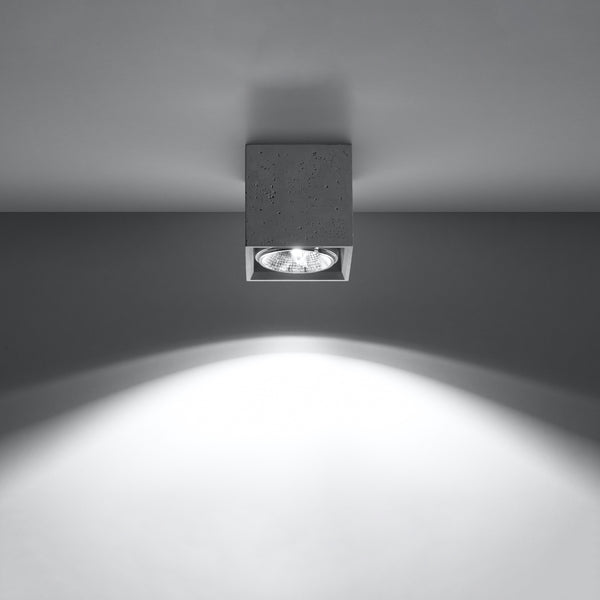
| Square with spots | 14 x 14 x 9 cm | Hallway, entrance, living room | GU10 |
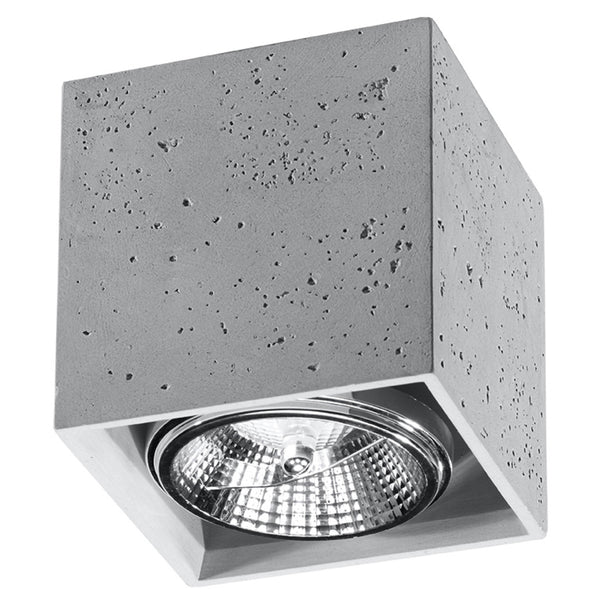
| Cubic with circular reflector | 14 x 14 x 14 cm | Living room, bedroom, entrance | GU10 |
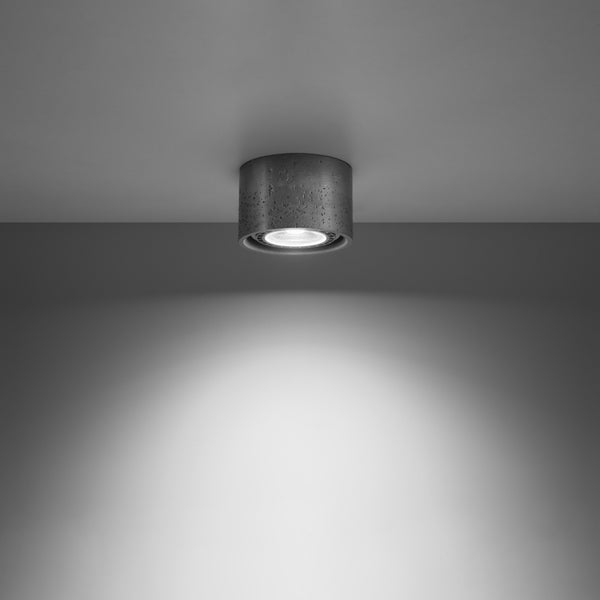
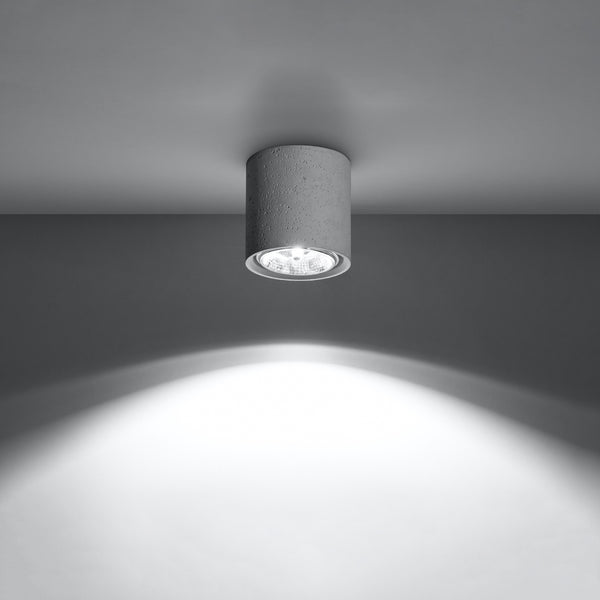
| Cylindrical with module | Ø 14 x 9 cm | Hallway, entrance, bedroom | GU10 |
| Tube with downward beam | Ø 10 x 10 cm | Living room, bedroom, hallway | GU10 |
| Rectangular three lamps | 13.5 x 55 x 10 cm | Living room, dining room | E27 |
What light does a concrete LED ceiling light give
GU10, E27 or integrated LED: which setup
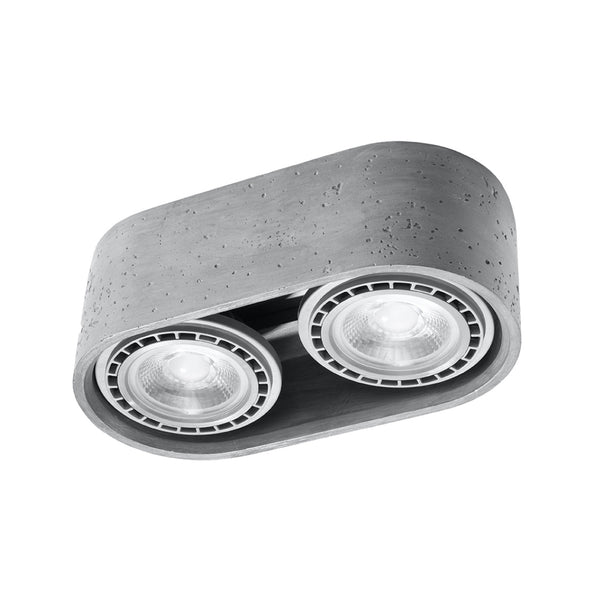
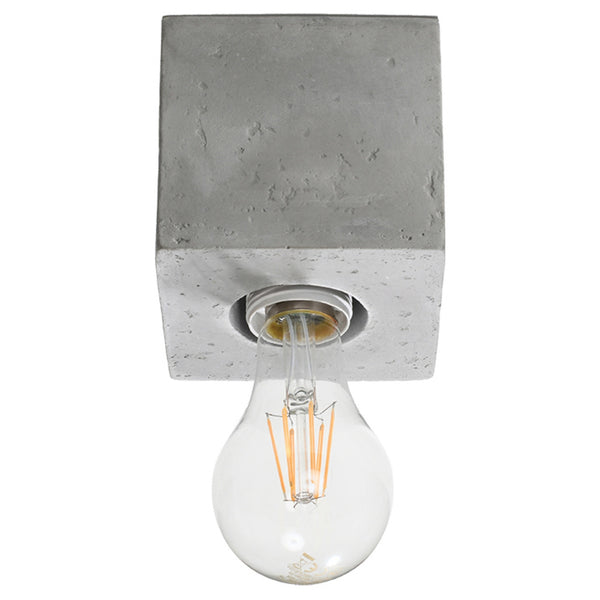
The GU10 socket takes a pin bulb, adjustable on most spot models: the light goes to a precise point, a wall, a worktop or the end of a hallway. The E27 socket takes a screw bulb, visible under the structure: diffusion is wider and softer. The integrated LED module, behind a white diffuser, gives an even light with no bulb to change. All three setups coexist in the collection, with a majority of GU10 models. If you prefer the visible bulb, the E27 socket models gather these shapes, including the concrete cube with bulb.
10, 15 or 18 W: which power for which room
Power follows the surface and the number of light points. GU10 spot models are rated at 10 W, a level suited to a hallway, an entrance or a small living room where light is directed. E27 bulb versions go up to 15 W, for a living space or a bedroom. The square with white diffuser is rated at 18 W with a warm white light (2700 to 3500 K) spread widely: this is the format to favour above a table or in an open kitchen. The whole selection runs on LED.
| Socket | Recorded power | Type of diffusion | Models concerned |
|---|---|---|---|
| GU10 | 10 W | Directed spots, recessed or beam | Laredo, Falerna, Albano, Brenno, Corenza, Quadia, Orbio, Halara |
| E27 | 15 W | Visible bulb under the structure | Brut, Nyxon, Wyntra |
| Integrated LED | 18 W | White diffuser, even light | Lorvale |
A dimmer remains useful in a bedroom or living room where you lower the light in the evening: dimmable ceiling lights meet this need.
Square, tube or round: which shape of concrete ceiling light to choose
Square, tube, round: which shape for which ceiling
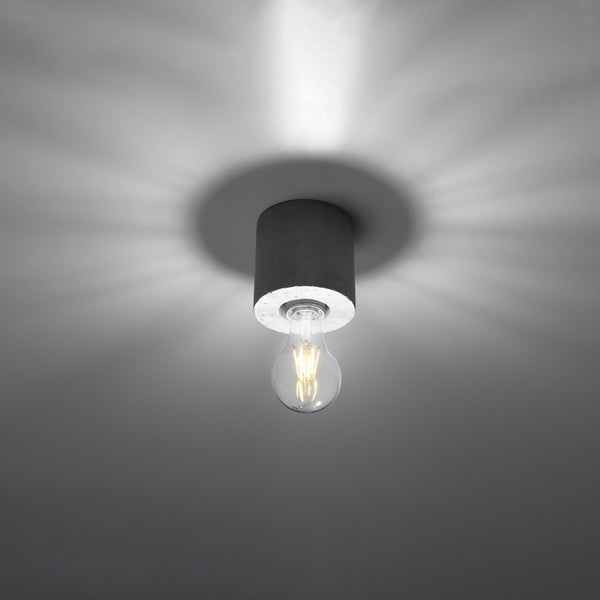
Shape is chosen on two criteria: the geometry of the room and the available height. A 10 or 14 cm square suits rectangular rooms and low ceilings, because it stays flush. A cylinder of Ø 14 x 9 cm marks a passage without weighing it down. A tube of Ø 10 cm hangs low but projects light downwards: it highlights a wall or a worktop. A rectangle of 13.5 x 55 cm follows the length of a table. Squares make up half of the shapes in the collection, tubes a quarter. For a more singular design, see the pieces with a crafted design.
Industrial or minimalist style: how to match it
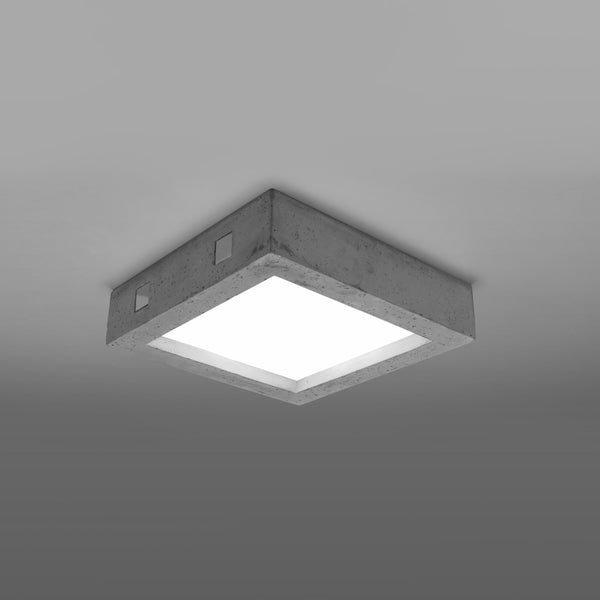
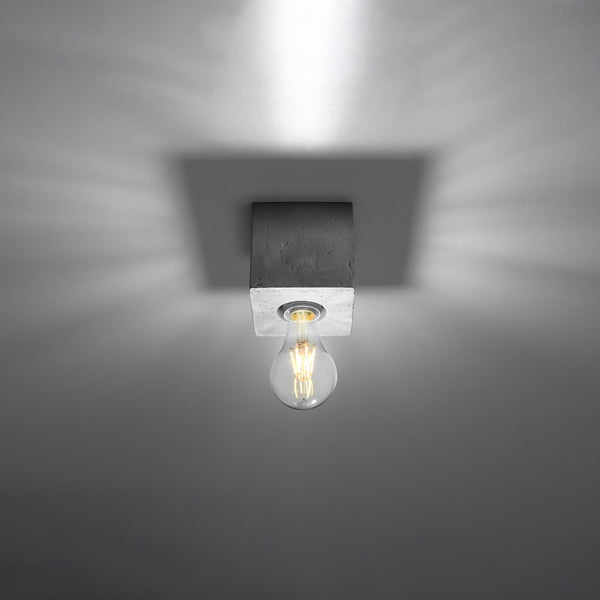
Grey concrete is neutral: it accepts light wood, black metal and white without conflict. On an oak table, a square with spots keeps the whole sober; on black furniture, a model with a metal reflector brings contrast. Two shapes also exist in green and beige, for those who want to move away from grey without changing material. The model with a luminous halo illustrates this sobriety well: concrete, square format, framed light.
How to position a concrete ceiling light
Centre of the room or table axis: where to fix the ceiling light
Two simple markers. At the centre of the room when the fixture lights the whole space: living room, bedroom, entrance. In the axis of the table when it lights the table: a rectangle with three lamps is placed parallel to the long side, centred on the tabletop. In a hallway, align the models along the length of the passage, evenly spaced. A model with a downward beam is placed facing what it should highlight. The tube with directed beam matches this last use.
Sloped ceiling: which concrete ceiling light to favour
Under a sloped ceiling, a compact format that does not hang low is better: a square or a cylinder with GU10 spots, adjustable towards the area to be lit. Fixing must be checked according to the support, especially on panelling or plasterboard. The IP20 rating remains valid for indoor use in a dry room. If you are looking for a model suited to passages, the modern hallway ceiling lights show the most discreet formats.
Concrete ceiling light: maintenance, IP20 and warranty
How to clean a concrete ceiling light
A soft dry cloth is enough to dust the concrete. No abrasive product, no damp sponge on the material. Cut the power before any work, then clean the spots with a soft brush or a dry cloth, without dismantling the module. GU10 and E27 bulbs can be replaced without any special tool once the fixture is switched off.
Why the IP20 rating matters when choosing the room
IP20 protects against solid objects, not against water. The whole selection is IP20: it is therefore intended for dry rooms, without splashes or condensation. A bathroom or a very damp room requires another rating. The 5-year warranty covers all models, a point of reassurance at the time of purchase. To compare more broadly, the complete lighting range gathers the other families.
Concrete, black metal or wood ceiling light: which material to choose
Concrete, black metal, wood: what effect in a modern living room
Concrete gives a mineral material, matte and grey, which calms a very colourful room. Black metal is more graphic and reflects light, which gives a sharper but sometimes colder effect. Wood warms and suits Nordic interiors. There is no best material: the choice follows the atmosphere already in place. The black metal versions and the wooden ceiling lights show the other two options.
Grey, green or beige concrete: how to match it to the room colours
Grey dominates the collection by far, with a few green and beige variations on two shapes. Grey pairs with white, black and wood; green matches light walls and plants; beige goes with warm tones and rattan. In all cases, the material stays matte and does not compete with the wall colours. The choice is made on the desired atmosphere, not on a passing trend.
Which concrete ceiling light models for which use
Compact formats for hallway and entrance
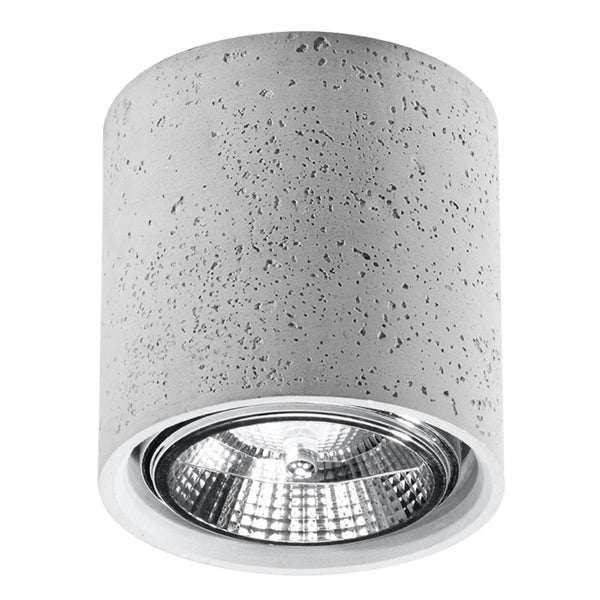
For a passage, small squares and cylinders with 10 W GU10 spots stay discreet and direct the light: the model with a luminous halo at 10 x 10 x 10 cm, the cylinder with module at Ø 14 x 9 cm, or the cube with circular reflector at 14 x 14 x 14 cm for an entrance. These formats can be repeated along a hallway without overloading the ceiling. For a workspace, also look at office ceiling lights.
Large formats for table and living space
Above a table, the rectangular ceiling light with three lamps in E27 covers 55 cm in length and lights the whole table. For a dining room or an open kitchen, the square with white diffuser at 33 x 33 x 8 cm spreads an even light. A cube with a 15 W bulb suits a smaller living room or a bedroom.
See the rectangular ceiling light with three lamps or the square with white diffuser for a dining room depending on the room to equip.
Secure payment, tracked delivery, possible returns and Designix customer service: you order with peace of mind, and the 5-year warranty covers your concrete ceiling light.
Frequently asked questions about concrete ceiling lights
How to choose a ceiling light
Start from the room and the surface to be lit, then the format available on the ceiling: a compact square for a hallway, a large model for a table. Then choose the socket, GU10 for directed light or E27 for wider diffusion, then the style. Power follows use, from the small spot format to the diffuser model.
How to position a ceiling light
At the centre of the room or in the axis of the area to be lit: above the table for a rectangular model, along the hallway for a spot format, facing a wall or a worktop for a model with a downward beam. In a passage, align several models along the length.
What is a fixture fixed to the ceiling called
A fixture fixed directly to the ceiling is called a ceiling light. It differs from the pendant, which hangs by a cable, and from the chandelier, often suspended and with several light points. The collection brings together concrete ceiling lights to be mounted on indoor ceilings.
Which ceiling light for a sloped ceiling
A compact format is better, square or cylindrical, with GU10 spots adjustable towards the area to be lit. These models are fixed to indoor ceilings and are IP20; the fixing must be suited to the support, especially on plasterboard or panelling.
Is a concrete ceiling light suitable for a bathroom
The models in this collection are IP20, a rating intended for dry rooms, with no protection against water splashes. For a bathroom, turn to a fixture whose protection rating is suited to humidity.
What is the difference between a GU10 socket and an E27 socket
The GU10 socket takes a pin bulb, used on spot models that direct light to a precise point. The E27 socket takes a screw bulb, visible under the structure, for wider lighting of the room. Both setups exist in the collection.




