220V spotlights
- Tracked delivery to your country Tracked delivery
- Secure payment at checkout Multiple payment methods
- 14 days to change your mind 14-day returns
- Secure payment Secure payment


Not sure of your style? Find it in 30 seconds
A few questions, and we will show you the pieces made for you.








Frequently asked questions
How do I choose the right light output?
At what height should the light be installed?
What type of bulb?
Compatible with LEDs and dimmers?
Light changes everything
From statement chandeliers to discreet wall lights, we help you choose the right brightness, height and style for every room.
- Tracked delivery
- Pay in instalments, where available
- 14 days to change your mind
- Advice & showroom in Lyon, France
Allow one 220V spot every 80 cm to 1 m in a hallway, then distribute them according to what you want to light: a worktop, a wall, a table. These models connect directly to the mains, without a transformer, with a GU10 or E27 base. The entire selection is LED and IP20, so intended for dry rooms.
How should ceiling spots be arranged?
Ceiling spots are arranged according to what you want to light: aligned along the axis of a hallway or entrance to guide your steps, in a line above a worktop, or in a ring around a living area. An adjustable spot can be aimed toward the wall or the object to be highlighted.
220V spot in a hallway: align or cross?
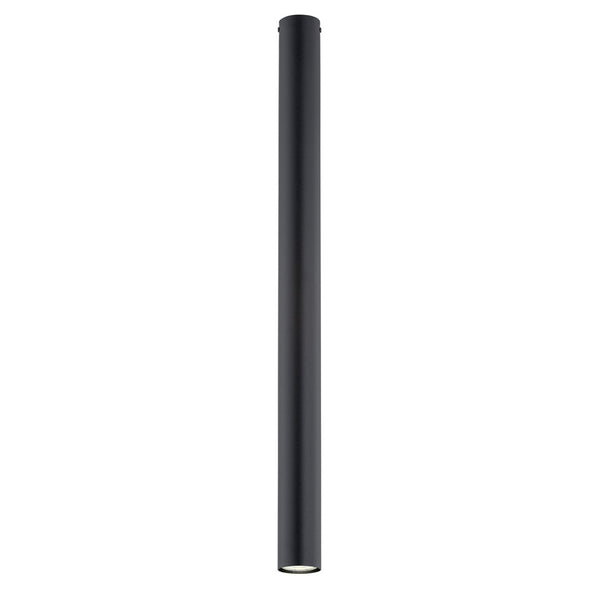
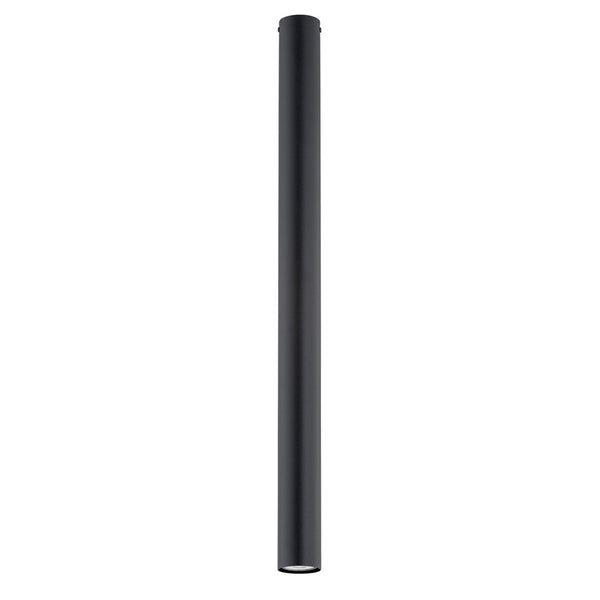
In a hallway, alignment along the axis creates a line that follows your walk, with regular spacing of about 80 cm to 1 m. Crossing two rows is only justified beyond 1.50 m in width. The Novlinilo tube spot, cylindrical, in metal and steel, 8 W with a GU10 base, holds that line without interruption. For circulation areas, also browse our hallway lighting.
Extra-flat 220V spot: when should you plan for one?
A slim, discreet model is chosen when ceiling height is limited or when you do not want the fixture visible from the room. The Myrrha spot mounts to the ceiling as a short cylinder and keeps the passage clear. Find the other references in all black LED spots.
What is the difference between a 220V spot and a 12V spot?
A 220V spot connects directly to the household network, without a transformer. A 12V spot operates at very low voltage and needs a transformer to be powered. All models in this collection are 220V: the connection is therefore made without a conversion box.
220V spot without transformer: what it changes at connection
No box to fit behind the plate and no intermediate part to replace: you change the GU10 or E27 bulb, not the power supply. The volume to allow above the fixture remains small, which matters when space is tight. This is the case for the black recessed spots installed in a drywall ceiling.
220V or 12V spot: which to choose for renovation?
When the existing supply is already 230 V and the cable reaches the installation point, 220V avoids adding a transformer in an often crowded false ceiling. 12V keeps its value where the transformer already in place works. If you do not want to open the ceiling, a surface mount is done with metal spots, screwed onto a plate or base.
How to connect a 220V LED spot without a transformer?
The 220V spot connects directly to the room's power supply, without a box between the cable and the fixture. Switch off the circuit at the breaker, identify phase, neutral and earth according to the model, then secure the spot. The IP20 models in the collection remain reserved for dry rooms.
What precautions before connecting a 220V spot?
Switch off at the breaker and check that there is no voltage before touching the conductors. Identify the phase, neutral and earth, then follow the fixture's terminal block. If in doubt about the condition of the circuit, call an electrician. A model with black adjustable spotlights connects exactly like a fixed model: only the head moves after installation.
Connecting a 220V spot to an existing switch
The spot is controlled from the wall switch already in place, without an additional module. Several points in the same room connect in parallel on the same line: control remains single and lighting is simultaneous. For a living room, modern-style spots fit into this circuit without modification.
Recessed 220V spot: how to choose it and where to install it?
A recessed installation requires a cutout in the ceiling and a model designed for it; a plate or base is mounted on the surface, without cutting, when the ceiling is solid, low, or the cable passage is already in place. In all cases, these spots are IP20, so for dry rooms.
| Room | Base | Power rating | Color | Models in the collection |
|---|---|---|---|---|
| Hallway | GU10 | 8 to 10 W | Black | Novlinilo, Myrrha |
| Entrance | GU10 | 8 W | Black | Novlinilo, Myrrha |
| Bedroom | GU10 or E27 | 10 to 15 W | Black | Spotia, Rotella |
| Living room | GU10 or E27 | 8 to 15 W | Black | Rotella, Novlinilo, Otéa |
| Kitchen | GU10 | 8 W | Black | Novlinilo, Callinissa |
| Office | E27 | 15 W | Black | Rotella, Lorlinano |
Recessed 220V spot: what a ceiling cutout requires
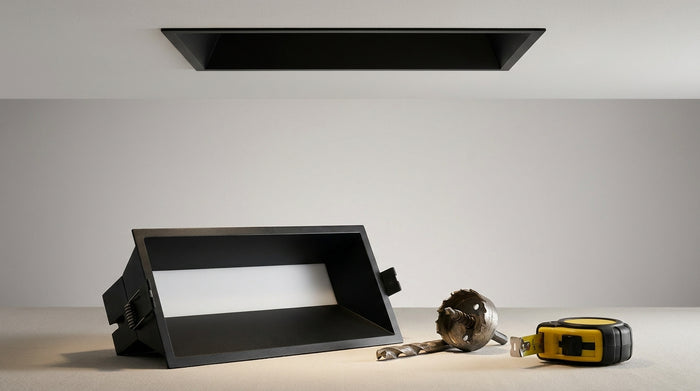
You need to check the space available above the plate and then drill to the diameter indicated on the model's datasheet. A drywall ceiling opens easily, a solid slab much less so. In a living room, recessed spots for living rooms are distributed in a ring around the living area rather than in a line in the center.
220V spot on a plate or base: when recessing is not possible
On a low ceiling, a solid slab or a cable already surface-mounted, the plate is screwed on the surface and the fixture remains visible: nothing is broken. The Lorlinano spot with light wood plate, with an E27 base, 15 W and three adjustable spotlights, illustrates this setup for a bedroom or office.
Dimmable 220V spot: how do you know if the model accepts a dimmer?
A spot is dimmable only if the manufacturer states it: this depends on the fixture's electronics and not on the base. In this collection, a minority of models accept a dimmer, such as the Otéa spot with several adjustable heads, whose light intensity can be adjusted after installation.
Identifying a dimmer-compatible spot on its product page
The mention appears in the fixture's specifications, not in those of the bulb alone. If the page does not mention dimming, consider that the model cannot be adjusted. Dimmer-compatible spots are grouped in a dedicated selection.
LED spot with dimmer: where is the adjustment made?
Adjustment is made at the wall, on the compatible control, never on the fixture itself. That is the benefit of the Otéa spot and its adjustable heads: mounted on a rail with several heads, it modulates intensity according to the moment, low in the evening, full for reading or working.
Adjustable or fixed 220V spot: which to choose depending on the room?
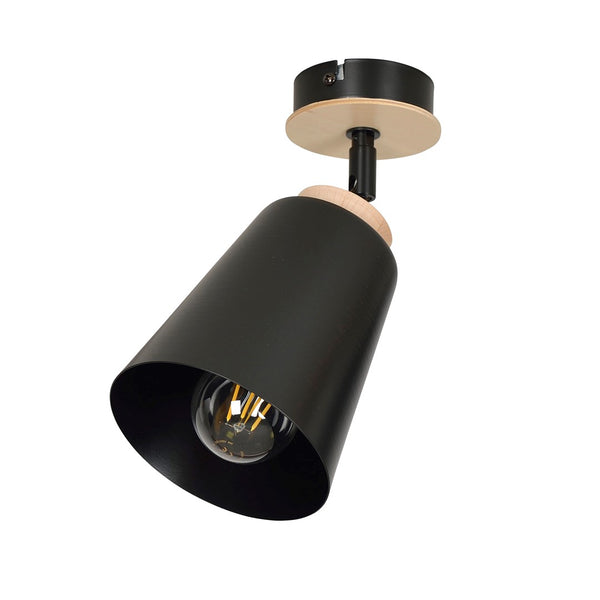
An adjustable spot is set after installation and directs light toward a wall, a worktop or an object to be highlighted. A fixed spot lights straight down: it suits circulation areas and rooms where you want even light rather than a precise point.
| Criterion | GU10 base | E27 base |
|---|---|---|
| Models in the collection | Spotia, Sillinilo, Novlinilo, Myrrha, Callinissa, Sillinella | Rotella, Lorlinano, Vallinilo |
| Power rating | 8 W and 10 W | 15 W |
| Associated materials | Metal and steel | Wood, metal and steel |
| Styles noted | Modern, minimalist, zen, contemporary | Nordic |
| Rooms noted | Hallway, kitchen, living room, entrance, dressing room, bedroom | Bedroom, office, living room |
Adjustable spot above a kitchen worktop
Above the worktop, the head is aimed toward the preparation area and leaves the rest of the room in soft light. A narrow beam avoids lighting the wall instead of the worktop. Kitchen spots with a GU10 base, at 8 W, are placed in a line above the worktop.
Adjustable spot in a bedroom: direct without glare
In a bedroom, the head is turned toward the wall or a picture, never toward the bed: light bounces off the surface and illuminates without glare. The Rotella spot, with an E27 base on a wood base, replaces several light points on its own. Compare bedroom spots to adjust the number of heads.
For a living room, start from LED spots for living rooms rather than an isolated model: distribution matters more than power.
Do LED spots heat up?
An LED heats up significantly less than a halogen bulb for the same use: the heat produced remains contained and dissipates through the fixture. You simply need to leave a little air around the spot and avoid enclosing the model under insulation.
Behind glass wool or under an insulated slab, heat no longer escapes and the electronics age faster. Leave free space around the fixture body. Black recessed LED spots are installed in a dry, ventilated ceiling.
A spot used in the evening, at low intensity, heats less than a model left on continuously: this is often the case for LED spots for bedrooms.
Black or white 220V spot: which color and which protection rating?
Black remains the dominant color in the collection, with a few white and gray models. The choice mainly comes down to matching the ceiling: a black spot blends into a dark ceiling or emphasizes a graphic line, a white spot makes the fixture disappear into a light ceiling.
220V spot in a bathroom: what does IP20 allow?
IP20 protects against solid objects and contact, not against water: these spots are suitable for dry rooms, not the wet zones of a bathroom. For a wet room, a higher protection rating is required. Find dark shades in the black models.
Outdoor 220V spot: what to check
Outdoors, the protection rating must withstand rain and humidity, which IP20 does not provide. These models are reserved for dry indoor rooms. For outdoor use, look for a higher rating, around IP44 depending on exposure, in a selection designed for outdoors.
Secure payment, tracked delivery, returns and Designix customer service accompany every order, and the fixtures in this selection are guaranteed for two years.
To place this family within our full range, browse our lighting catalog. White is covered separately in the light-colored selections. And if you are still unsure about installation, return to the models with adjustable direction before confirming your cart in the Designix lighting universe.
Frequently asked questions about 220V spots
Does an LED spot require a transformer?
No, not a 220V spot: it connects directly to the home's network. It is the 12V spot, at very low voltage, that needs a transformer to operate. All models in this collection are 220V and therefore connect without a transformer.
How do you know if a spot needs a transformer?
Look at the voltage indicated on the fixture's datasheet: a 220V spot connects to the mains, a 12V spot requires a transformer. If the datasheet only mentions the network voltage with a GU10 or E27 base, the spot works without a transformer.
What are the disadvantages of LED lamps?
LEDs consume little, but their light is more directional and color rendering varies from one model to another. On a spot with integrated LED, the source cannot be replaced: the fixture must be changed at the end of its life. The purchase price remains higher than a conventional bulb.
Is it possible to replace a conventional bulb with an LED bulb?
On a spot with a GU10 or E27 base, the source can be replaced: you can therefore switch from a conventional bulb to an LED bulb with the same base. Check the power and desired light temperature on the product page before changing.
Why are LED bulbs rated F?
The energy class shown depends on the ratio between the light produced and the electricity consumed, calculated according to current regulations. An LED can therefore be rated F while consuming little: the letter does not summarize the model's actual consumption.