Lampshade for a round lamp base: getting the proportions right
This article is also available in French: Quel abat jour pour pied de lampe rond
.
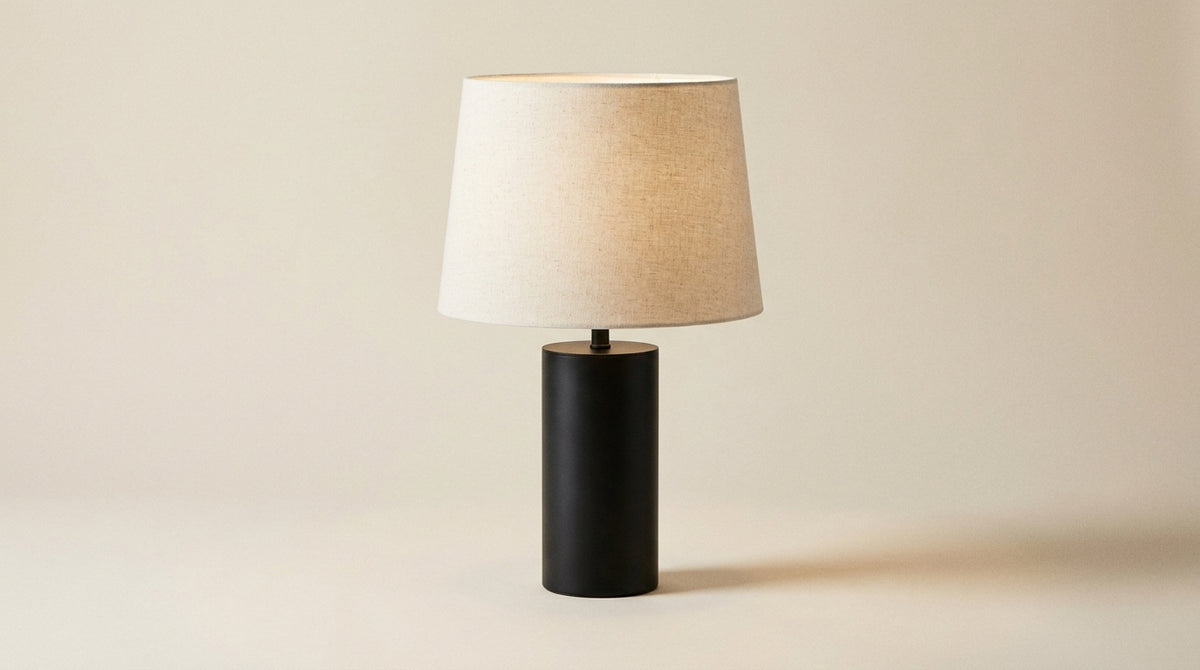
Measure three things on the base: the diameter of its widest part, its height up to the socket, and the diameter of its neck. On a round base, the lampshade should be at least as wide as the base and cover the socket. That is what avoids the mushroom effect, that squat lamp you end up never looking at again.
Which lampshade for a round lamp base?
The lampshade should be at least the diameter of the base, peak at two thirds of the height measured up to the socket, and fit a neck of the same diameter. A round model remains the safest choice: it follows the curve of the base and spreads the light evenly.
The usual rule of proportion
The height of the lampshade is roughly two thirds of the height of the base, measured from the bottom up to the socket. This is a trade rule, tried and tested on classic bases. A 40 cm base therefore calls for a lampshade of around 26 cm.
Too low, the fabric squashes the lamp. Too high, the socket stays visible and becomes a dark spot in your field of vision. The neck is measured to the millimetre: a 4 cm ring will not screw onto a 6 cm neck.
- Bottom diameter: at least equal to that of the base, never less.
- Height: two thirds of the height up to the socket.
- Neck: same diameter as the socket, ring supplied or threaded socket.
- Material: linen or cotton for soft light, glass or metal for a sharper beam.
This method also works for a floor lamp: only the scale changes. If you are hesitating between two sizes, our lighting advice covers old, mismatched or very slender bases.
Why round wins on a round base
Out of a survey of 31 lampshades in our catalogue as of 30 September 2026, 58% have a round shape. The round silhouette answers the curve of the base, and the eye accepts the whole immediately. It also spreads light evenly, with no shadow above the table.
An oval works, provided the difference in diameter stays subtle. A triangle or hexagon is noticed before the light it produces.
Your base is measured but you are still hesitating between two diameters? Send us its dimensions and we will compare them with the product sheets: simply have your choice approved before ordering.
Which lampshade for a ball lamp base?
On a ball base, wide and low, the lampshade should be wider than it is tall. A flared drum caps the sphere without hiding it. A narrow model leaves the socket bare and breaks the roundness that makes the base worth having.
A wide, low ball base
The two-thirds rule no longer applies here, as the sphere is often wider than it is tall. Aim for a lampshade diameter that exceeds that of the ball, and a moderate height that does not turn the lamp into a column.
| Base type | Recommended lampshade | Why |
|---|---|---|
| Straight, cylindrical base | Round or drum | Extends the vertical line without cutting it |
| Ball base, wide and low | Flared drum, wider than tall | Caps the sphere without hiding it |
| Tapered, spindle base | Tapered | Follows the taper of the stem |
| Glass or ceramic base | Round, plain material | Lets the base material speak |
Ball base in glass or ceramic
Both materials catch the light and reflect it. The lampshade should then stay discreet, otherwise the lamp becomes a double decorative object.
- Natural linen: matte texture that calms a glossy glass.
- Brushed fabric: solid opacity, light directed downwards.
- Smoked glass: tinted transparency, the bulb stays visible.
- Matte black metal: sharp contrast on a pale ball.
On a bedside table, these volumes matter as much as the light itself: we covered this point in our article on bedside lamps that change a bedroom. Short, wide models stand out quickly in a selection of designer bedside lamps.
How do you calculate the size of a lampshade for a lamp?
Take the height of the base up to the socket, divide by three, multiply by two: that gives you the lampshade height. For the diameter, start from the widest point of the base and never go below it. Two reference points are enough in most cases.
How do you calculate the template of a lampshade?
The template is the pattern of the fabric stretched between the two circles. The top and bottom diameters set the angle, and therefore how much light is projected onto the sides. This calculation is mainly useful for replacing a damaged cover or making one yourself. The lampshade size in relation to the base can then be read at a glance, without testing in store.
The bottom diameter, the one that does everything
It is what decides the overall look. A wide bottom lights the room around the lamp, a narrow bottom concentrates light on a work surface. The material matters just as much: in the same survey of 31 references as of 30 September 2026, 52% declare a linen material, a texture that softens the beam. For large volumes and high ceilings, a large lampshade restores the balance.
- Wide bottom: ambient light, room lit around the lamp.
- Narrow bottom: concentrated beam, reading and desk.
- Intermediate bottom: compromise for a living room or hallway.
Once you have the dimensions, the rest is simple: the lampshade collection for table lamps brings together 789 references as of 30 September 2026, from linen drum to smoked glass.
Lampshades for a round base
 pleated white fabric pendant, oval shade Ø 60 cm | Velina
 K1068RS grey linen lampshade
 Black arc wall reading light, fabric shade Ø60 | Noctis
 Black Scandinavian floor lamp, cork shade, living room reading light | Stang
 Designer light rattan chandelier | Calya
 Black Zig-Zag 4253ZW floor lamp with white linen shade – a unique design and functional use
See the whole selection: Lampshades: Pendant, Table Lamp and Floor Lamp
Which lampshade shape for a round base: round, tapered or square?
Round or tapered, never square. Tapered goes with a spindle base, round with a straight base, and square reintroduces angles that the curve of the base rejects. On a cylindrical stem, the round lampshade remains the safe bet.
Tapered on a spindle base
Tapered picks up the taper of the stem: wide at the bottom, narrower at the top. The eye travels down the base without interruption. It is the shape that forgives tall, slender bases the most, and the one that sends light up towards a wall best.
Why square breaks a round base
Two geometries contradict each other in the same silhouette. Square works on a base with right angles, a square stem or a metal base. Elsewhere, it draws the eye to the joint instead of the light. The lampshade collection lets you compare the three families side by side before deciding.
- Round: safe bet on a straight or ball base.
- Tapered: designed for a spindle or tall base.
- Oval: acceptable if the difference in diameter stays slight.
- Square: reserved for stems and bases with right angles.
What is your lamp base, and what light are you looking for?
How do you choose the colour of a lampshade?
Start from the colour of the base and the wall, not the sofa. In a survey of 31 lampshades in our catalogue as of 30 September 2026, black comes first (52%), ahead of white (32%) and gold (23%). These figures describe our selection, they do not dictate yours.
What is the trendiest lampshade colour?
Black dominates for a practical reason: it frames the light downwards and structures a space without weighing it down. White and natural keep their place as safe bets in bedrooms, where soft light is what you want. Smoked glass brings depth to an already colourful room, without adding a tint.
The light produced matters as much as the tint. A 2700 K bulb warms a natural linen, a 4000 K cools a smoked glass and brings out its grey reflections.
Natural linen, black, smoked glass
- Natural linen: diffuse, warm light, ideal in a bedroom.
- Matte black: beam directed downwards, suited to desks.
- Smoked glass: tinted transparency, the bulb remains a motif.
- Gold or brass: reflects an amber light late in the evening.
To extend the effect of smoked glass around the room, a glass light repeats the same tint on the ceiling. In a bedroom, a bedroom light matching the base discreetly unifies the whole.
How do you care for a lampshade, and get it approved before ordering?
A fabric lampshade is dusted dry, with a soft brush or a lint roller, never with water. Wet cleaning stains, loosens the tension of the fabric and yellows linen. Two minutes a month are enough to keep the original tint.
How do you clean a fabric lampshade without dulling it?
Brush from top to bottom, without pressing, with the lampshade removed if possible. For ingrained dust, a barely damp microfibre cloth, without household products. Our guide to cleaning a fabric lampshade covers greasy stains and delicate fibres.
- Soft brush: weekly dusting, a quick job.
- Lint roller: hairs and fine dust on linen.
- Damp microfibre: light stains, without product.
- Water and detergent: avoid, the fabric loses its shape.
If a ring or a neck is missing to remount the lamp, the Designix help and after-sales page points you to the right part.
Who can confirm compatibility before purchase?
A retailer or an installer spots in a minute what a drawing does not show: the play of the neck, the thickness of the fabric under the socket, the heat given off by the bulb. We support these professionals as a partner to interior decoration professionals, with references and dimensions to back it up.
For a verifiable opinion, the Designix Google listing shows its up-to-date rating: Designix Google listing.
On the same subject
In stock · shipping costs shown at checkout · up to 30% off in your cart


Ready to turn inspiration into reality?
Tell us about your room, your style and your budget, and we will show you the pieces that truly suit your project.
Get guidance in 30 seconds →