Trendy living room pendant lights 2026: which light should you choose?
This article is also available in French: Suspension salon tendance
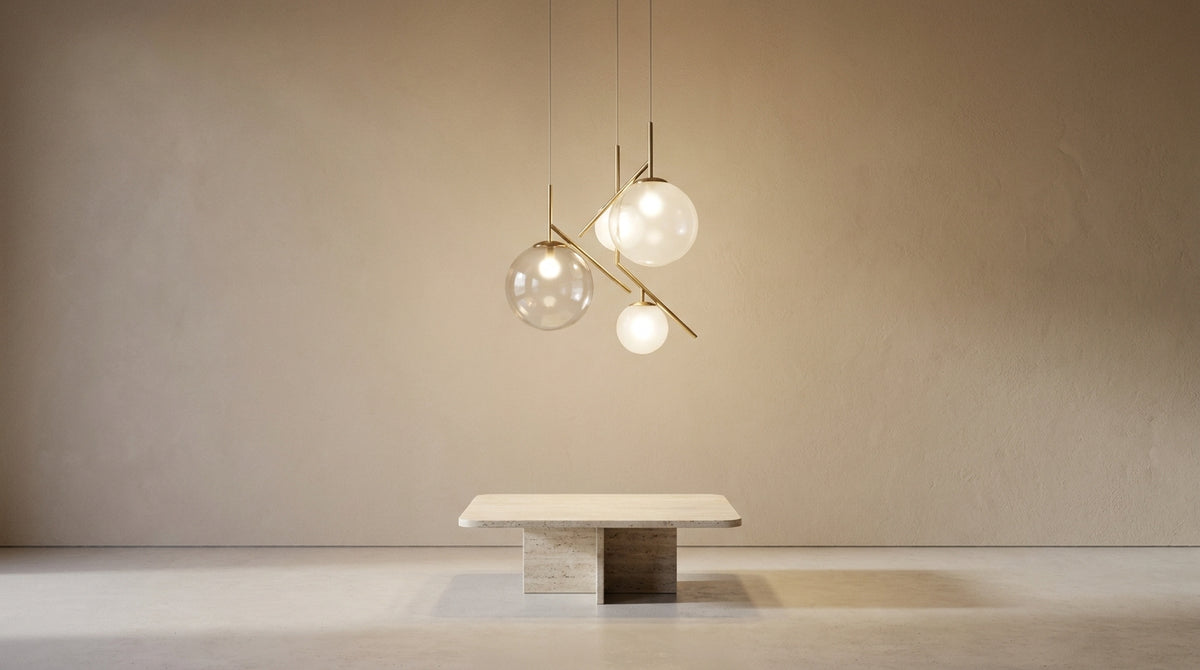
Allow for a diameter close to one third of the width of the furniture to be lit, a cord set between 70 and 80 cm above the surface, and a warm light around 2700 K. These guidelines frame most living rooms before style even comes into question. Measure, set the height, then choose the shape and the material.
Which pendant light should you put in a living room in 2026?
It all depends on the area to be lit. A dining table calls for a single piece 40 to 60 cm in diameter, an island three small aligned modules, a reading corner without a table a raised pendant light. An open-plan living room is handled in two stages: a high point in the centre, low sources at the ends.
A pendant light is therefore chosen first of all on its diameter, its cable length and its number of points. The colour of the metal comes last, once the format has been validated.
| Living room area | Recommended format | Bottom of the light |
|---|---|---|
| Dining table | 1 piece 40 to 60 cm | 70 to 80 cm above the surface |
| Island or counter | 3 modules 20 to 25 cm | 75 to 85 cm above the surface |
| Living area without a table | 1 piece 50 to 70 cm | 190 to 210 cm from the floor |
| Open-plan living room | 2 points 30 to 40 cm | clear passage below 210 cm |
- The diameter above all: it determines the area actually lit
- The number of points: one for a table, two or three for a long living room
- The adjustable cable: useful as soon as the furniture may change position
In a living room of 20 to 30 m², a single well-sized piece is often enough. The living room pendant collection brings together the intermediate diameters, the ones that light without overpowering the furniture.
What height and what diameter for a pendant light?
Set the bottom of the light between 70 and 80 cm above a dining table, between 75 and 85 cm above a counter, and leave 210 cm of clearance from the floor in passageways. The diameter follows the width of the furniture: one third of it for a round piece, half of it spread over two or three modules.
How do you adjust a height-adjustable pendant light?
An adjustable cable leaves room for manoeuvre: you install, you step back to the living room entrance, you adjust. Keep 30 to 50 cm of slack below the ceiling so you can lower the piece again if the furniture moves.
The details of the adjustments are in our article on the height-adjustable pendant light, to read before drilling into a concrete ceiling.
What diameter should you choose for a large pendant light in an open living room?
Beyond 60 cm, a single piece becomes the focal point of the room. Under a low ceiling, two smaller models are better: the visual volume remains comparable, and the light comes down less.
- 70 cm above a surface: any lower and the bulb enters the diners' field of vision
- One third of the width of the furniture: the rule that avoids a light that is too small, the most common mistake
- 210 cm of clear passage: the constraint to check before buying for an open-plan living room
- Two points rather than one large one: simpler to balance in a long room
Do you install this type of light in series for your clients? The Designix professional space, in Vaulx-en-Velin, lets you validate the model, check the fixings and prepare the installation with a direct contact.
If you are still hesitating between two diameters, or if your current dimmer is a concern, the Designix team will decide with you before the order.
What light colour for a living room?
Aim for 2700 K, the warm light that brings out woods and textiles without yellowing them. Up to 3000 K, the living room stays restful; beyond that, the lighting takes on an office feel. Keep a single temperature for the whole room, otherwise the areas clash with each other.
What are the lighting trends for 2026?
Warm sources and large opal diffusers are replacing visible bulbs. The trendy pendant light of 2026 is recognisable by its veiled light more than by its design. Here is what is really changing in 2026, between organic shapes and raw materials.
Why plan for a dimmer in the evening?
A living room lit at full power all evening is tiring. A dimmer lowers the intensity without touching the colour, and that is often when the room becomes liveable. To light a living room effectively, the main source should never remain the only one.
- 2700 K kept at all intensity levels
- Dimmable bulb essential, otherwise the dimmer buzzes
- A low point as a complement, to avoid harsh contrast with the ceiling
Add a second low layer: a floor lamp near the sofa, a reading light, a wall light. All the work on ambient lighting happens through these secondary sources.
Once the temperature is chosen, the rest depends on the light itself: a wide diffuser rather than a bare bulb, a shade that cuts the glare.
Which shapes and which materials should you choose?
Look for the material that diffuses, not the one that shines. Opal glass, woven rattan, textile shades: these are what give that enveloping light associated with a cosy living room pendant light. Curves go with almost everything, while strong geometric shapes require an interior that is already designed.
Why do natural materials and curves dominate?
Rattan, bamboo and cane filter the light and project a pattern onto the walls. That is what a trendy living room light is looking for: a light that has a texture. Our article on the trendy living room light shows these materials in situation.
- Opal glass: even light, easy to clean
- Rattan and bamboo: filtered light, shadows cast on the walls
- Textile: soft result, choose light colours so as not to darken the room
Glass and brass: the duo that stands the test of time?
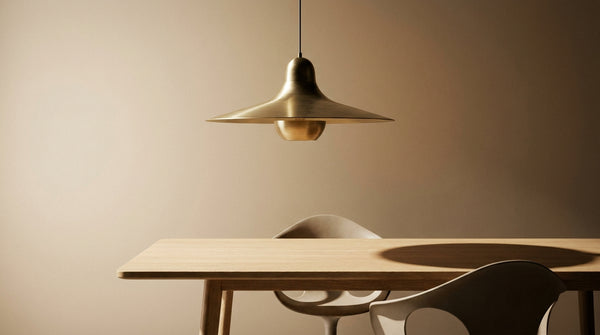
Glass diffuses, brass structures. A fine brass frame with an opal globe stands the years better than a very colourful piece, and it accepts a visible filament bulb when the piece suits it. The glass light comes as a ball, a cylinder or a bell.
If you mix several sources, it is better to combine light styles by material rather than by colour: one shared metal is enough to hold the whole together.
In which living room will your pendant light live?
Pendant, chandelier or ceiling light: which should you choose?
The pendant light comes down and lights a specific area. The chandelier decorates as much as it lights, for a living room with a high ceiling. The ceiling light remains the solution for low rooms and passageways, when there is not enough clear height below the light.
| Type | When to choose it | Bottom of the light |
|---|---|---|
| Pendant | Identified area to be lit | 70 to 80 cm above the surface |
| Chandelier | High ceiling, decorative effect sought | 75 to 90 cm above the furniture |
| Ceiling light | Low ceiling, passageway | flush against the ceiling |
In a characterful living room, a chandelier replaces the central pendant light and gives the room a point of view.
When height is lacking, an LED ceiling light covers the area without coming down into the field of vision.
On the same subject
In stock · shipping costs shown at checkout · up to 30% off in your cart


Ready to turn inspiration into reality?
Tell us about your room, your style and your budget, and we will show you the pieces that truly suit your project.
Get guidance in 30 seconds →