Narrow hallway lighting: the light that widens
This article is also available in French: Luminaire couloir étroit
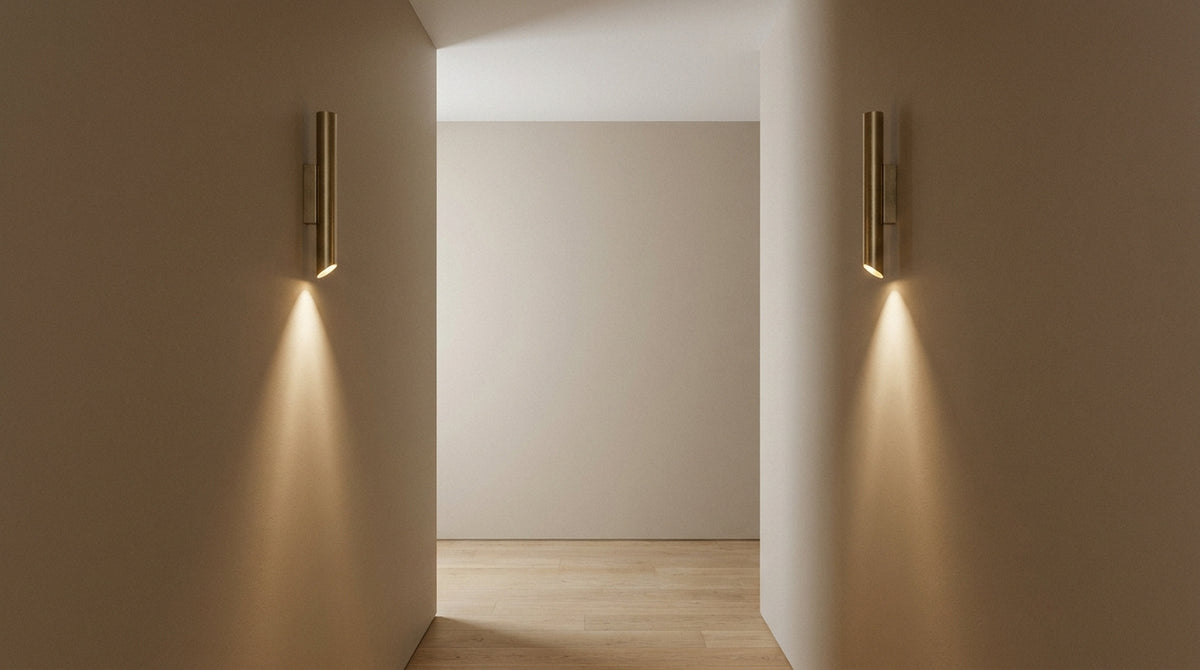
Under 1.20 m wide, use wall lights rather than a central ceiling fixture: light should hit the walls, not the floor. Plan for two dual-emission wall lights, at 1.70 m from the floor, spaced 2 m apart. Above 1.20 m, a flat ceiling light no more than 8 cm thick becomes possible again.
Which light for a narrow hallway?
Measure the width before choosing: under 1.20 m, only a wall light stays out of the walkway. Between 1.20 and 1.50 m, a flat ceiling light works. Beyond that, a short pendant becomes possible again. Wall projection must never exceed 12 cm.
In a 90 cm hallway, a light that projects 15 cm leaves only 75 cm to walk through. That measurement, not wattage, decides comfort. A hallway and entrance lighting plan therefore starts from two figures: floor width and ceiling height.
Light fixture: a short definition, and the criterion that matters in a hallway
A light fixture is the complete unit that holds the bulb and diffuses its light: wall light, ceiling light, pendant, spotlight. In a hallway, the decisive criterion is projection, meaning how far it sticks out from the wall. The catalogue lists 37,868 references as of 29 October 2026; in a sample of 250 listings, 57% state Hallway and 56% Entrance.
- Projection: 12 cm maximum on a walkway wall
- Dual emission: lights upwards and downwards, widening the hallway
- IP20: sufficient in a dry hallway, and 94% of the 250-listing sample is IP20
- Socket: E27 for a standard bulb, GU10 for an adjustable spotlight
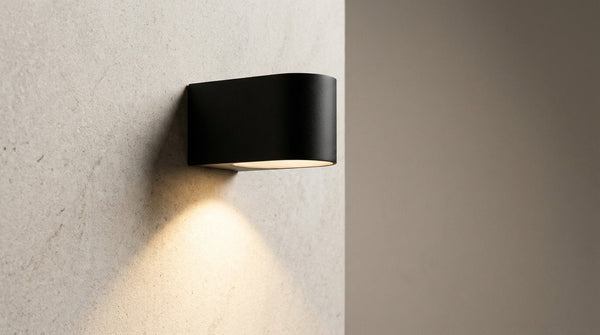
A dual-emission wall light casts two cones, one upwards and one downwards: the walls are lit over their full height and the walkway looks wider. The hallway wall lights gather the models whose projection stays under that 12 cm.
Pendant for a narrow hallway: how low?
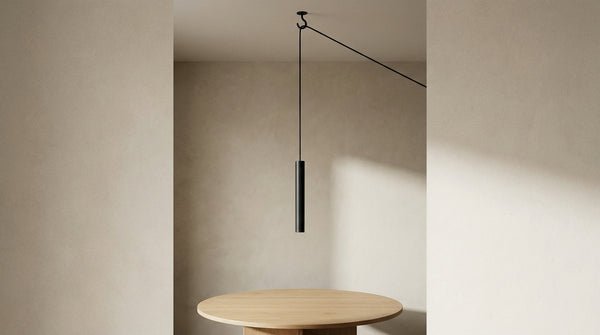
Allow 2.10 m clear below the shade, never less than 2 m. In a hallway 1.40 m wide, a pendant 30 cm in diameter remains acceptable; under 1.20 m, it grazes your shoulders. A wall light or a flat ceiling light is better there.
The hallway pendant is reserved for tall volumes and wide hallways, where it brings a verticality nothing else provides.
Ceiling light for a narrow hallway: the flat rule
Aim for 6 to 8 cm total thickness, fixing included. A flat ceiling light illuminates widely without casting shadows on the walls, provided it has a white diffuser and 3000 K light. Above 10 cm, it eats into the perspective.
A hallway ceiling light is not just a fallback: placed on the centre line, it fixes the dark zones two wall lights leave between them.
A slim LED ceiling light covers a 5 m hallway without multiplying light points or drill holes.
Lights designed for a narrow hallway
 Pendant light | Interlacia
 Pendant light | Nivara
 Pendant light | Ysandre
 Ceiling light | Bruna
 Living room floor lamp | Hyra
 Wall light | Sveva
See the full selection: Alternative to Luminaire.fr: designer lighting shop | Designix
Which colour makes a hallway look bigger?
Light matte walls, white ceiling, grazing light on the surfaces: this combination pushes the walls back the most. An off-white or a very light beige in a matte finish absorbs reflections and doubles the perceived width. A dark shade, on the other hand, shrinks a hallway under 1.20 m.
Colour is not everything: the way light hits it decides the rest. Lighting the walls rather than the floor is often enough to widen the visual space with light, without repainting.
Which colour for a windowless hallway?
A matte off-white on all four walls and the ceiling. Without a window, light comes only from the fixtures: a satin finish bounces a grey veil onto the ends of the hallway, a matte finish does not. Avoid pure white, which turns blue under a 4000 K bulb.
Which colour for a dark hallway?
Keep the walls light and raise the temperature to 3000 K: the hallway stays crisp without turning yellow. Two wall lights are enough for 3 m. A deeper accent wall at the end of the hallway, lit with grazing light, adds depth without darkening the walkway.
3000K bulbs hold that useful middle ground between warm white and neutral white, where an overly marked 2700 K yellows a beige wall.
| Finish | Effect in a narrow hallway |
|---|---|
| Matte off-white | Pushes the walls back, does not show shadows from the wall lights |
| Light matte beige | Warms a windowless hallway, very forgiving at 2700 K |
| Very light matte grey | Adds depth, requires regular wall lighting |
- Matte everywhere: no stray reflections on the side walls
- White ceiling: bounces light downwards without patches
- A single accent wall: at the end of the hallway, never on the sides
How do you light a long, narrow hallway?
Break it up: three sources are better than one big one. Alternate a wall light every 2 to 2.5 m with a flat ceiling light in the centre. A 6 m hallway needs at least three light points, otherwise both ends stay in shadow.
How do you place spotlights in a hallway?
Align them on the centre line, spaced 1.20 to 1.50 m apart, with the first spotlight 60 cm from the end wall. Keep them 40 to 50 cm from the side walls: too close, they draw zigzag patches on the paint.
An L-shaped hallway or a door mid-run breaks that alignment. Hallway spotlight lighting then shifts by half a spacing to avoid the door frame shadow.
The distance between spotlight and wall remains the reference to adjust on site, before drilling.
A spotlight bar settles the question in one go: the modules arrive already spaced and aligned.
Entrance hallway lighting: continuity
Stick to the same family as in the hallway: same finish, same temperature, same mounting height. An entrance hallway is treated as the first room of the home, not as a utility area.
The entrance light must also withstand use: repeated switching, bags set against the wall, coats brushing the shade.
Wall lights with a motion sensor save you hunting for the switch in the dark with your hands full.
Would you rather have the layout checked before drilling? Send the hallway width and ceiling height via the contact page, and we will reply with a mounting plan.
What kind of hallway do you have?
How do you install a light in a hallway?
Switch off the power, locate the conduits, then fix into the masonry rather than plasterboard alone. A 1.5 kg wall light holds on two plugs suited to the substrate; beyond that, plan a reinforcement plate screwed into the load-bearing wall.
At what height should a wall light be mounted?
At 1.70 m from the floor as a median value, or 1.90 m in a hallway where people walk with their arms full. The practical rule: the source above eye level, never in the line of sight. Two wall lights go at exactly the same height to the millimetre, otherwise the difference is immediately visible.
The height of a wall light also depends on the moulding: allow 10 cm below the upper moulding so it is not lit from behind.
How do you install a hanging light?
A hook fixed into the concrete block, never into plasterboard, and a cable clamp to adjust the drop. The light stays on the hallway centre line, equidistant from both walls. Test the height before locking the cable.
An adjustable LED wall light solves L-shaped hallway cases: tilt the head towards the walkway rather than the end wall.
- Support: masonry or resin anchor, never plasterboard alone
- Height: 1.70 m for a wall light, 2.10 m below a pendant
- Alignment: centred between the two walls, checked with a tape measure
- Warranty: 2 years on 85% of the 250-listing sample as of 29 October 2026, worth keeping in mind
In stock · shipping costs shown at checkout · up to 30% off in your cart


Ready to turn inspiration into reality?
Tell us about your room, your style and your budget, and we will show you the pieces that truly suit your project.
Get guidance in 30 seconds →