55 mm recessed spotlight: how to choose it and install it correctly
This article is also available in French: Spot encastrable diametre 55mm
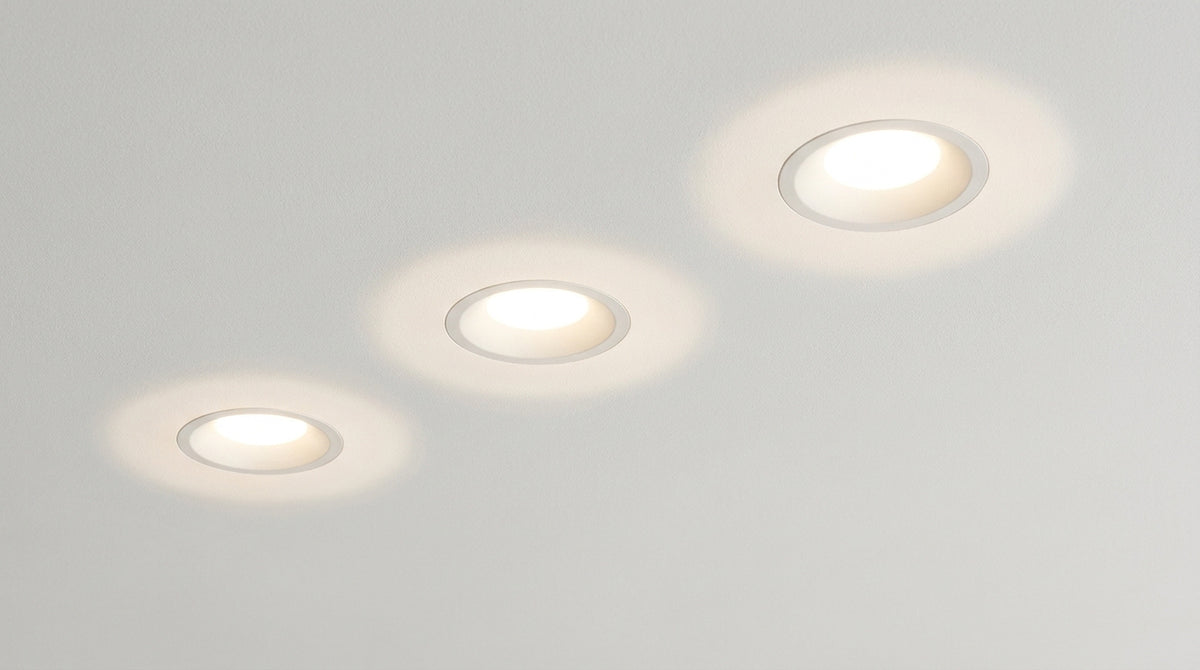
Measure two dimensions before anything else: the cut-out diameter and the bezel diameter. A spotlight sold as 55 mm is cut with a 55 mm hole, while its visible ring is wider. Then check the available depth behind the panel before reaching for the hole saw.
What is the standard hole diameter for a recessed spotlight?
There is no single dimension: it depends on the model. For small recessed fittings, 55 mm is a common cut-out, but other spotlights require a wider opening. The reliable figure is the one printed on the product sheet or on the box, never the one of the spotlight you are replacing.
What are the dimensions of a recessed spotlight, bezel included?
What you see on the ceiling is the bezel: it is always wider than the hole, otherwise the spotlight would fall through. When renovating a living room, these dimensions are recorded before choosing the model: they determine the layout as much as the style.
- Cut-out diameter: the hole cut in the panel, the dimension used to buy the hole saw.
- Bezel diameter: the visible ring, wider than the hole, which covers the opening.
- Recess depth: the space needed behind the panel, between the module and the insulation.
- Tilt range: the travel of an adjustable spotlight, to be checked when the bezel swivels.
Why does the space behind the ceiling matter as much as the diameter?
A good diameter is not enough if the module does not fit. A plasterboard panel leaves little void, a technical suspended ceiling leaves more. Measure the available height between the ceiling surface and the obstacle above: duct, joist or insulation. In small spaces, a mini spotlight often solves the problem.
Why does a 55 mm cut-out not mean a 55 mm bezel?
Because these two dimensions do not measure the same thing. The cut-out is the hole in the panel; the bezel is the visible ring of the spotlight, always wider. A model with a 55 mm cut-out therefore has a larger bezel, and it is the bezel that covers the ceiling around the opening.
What is the diameter of a hole saw for a recessed spotlight?
The one of the stated cut-out, no more and no less. For a spotlight with a 55 mm opening, you use a 55 mm hole saw. A hole saw that is too large leaves a visible gap; one that is too tight grips and the fixing springs hold poorly.
- Hole saw at the right diameter: 55 mm for a 55 mm cut-out, with no approximation.
- Central pilot hole: it guides the hole saw and prevents drift at the start of the cut.
- Moderate speed: plasterboard chips at too high a speed.
- Dimension marked in pencil: the spotlight's product sheet gives the measurement, copy it before drilling.
Does a recessed spotlight need a protective cover?
Not all spotlights have one. An IP20 indoor model often comes bare, with the LED exposed. As soon as the room is damp or dusty, a glass cover closes the module, protects it and can be wiped clean with a cloth.
Before ordering, note the cut-out diameter and the available depth: two minutes of measuring avoid a failed cut. If you would rather confirm your layout with someone, our team replies directly via the contact page.
The installation itself is detailed step by step: mounting a spotlight in the ceiling always starts with the same dimension check.
220 V LED recessed spotlight with a 55 mm cut-out: what to check before buying?
Three points: the voltage, the base and the available space. At 220 V, the spotlight connects directly to the mains, with no transformer to hide behind the panel. A 55 mm hole leaves little volume, which almost always points to an integrated LED module rather than a socket.
In a survey of 247 references from our Spot LED collection declaring a base, as of 29 September 2026, 96% state an integrated LED and 3% a GU10. In the same survey, 96% of the product sheets show a 5-year warranty.
- 220 V: direct connection to the mains, nothing to house behind the panel.
- Integrated LED: the standard for small cut-outs, the module cannot be replaced.
- GU10: interchangeable lamp, but it requires a more generous opening.
- G4: low-voltage capsule, reserved for niches and small spaces.
What is the diameter of a GU10 spotlight?
Wider than a 55 mm cut-out accepts. The socket and its lamp take up a volume that requires a larger opening, often on adjustable models. Replacement is then done lamp by lamp, with a GU10 LED bulb at the right angle.
To find your way between formats, the bulb base size is read on the box, never by eye.
55 mm recessed spotlight with a G4 base: when does it work?
The G4 is a tiny low-voltage capsule that fits into small spaces: niche, display case, furniture, stair step. It runs at 12 V, so with a transformer. With a 55 mm cut-out, it is precision lighting, not a general light source. Our selection of G4 and G9 bases covers this type of replacement.
55 mm diameter spotlight in the bathroom: which IP rating?
Aim for IP44 as soon as the spotlight is near the shower or bath, and IP65 if splashes can reach it directly. Away from water points, IP20 is enough. The higher the number, the better the module resists moisture.
Where will your 55 mm spotlights go?
IP20, IP44 or IP65: how to read these two digits?
The first digit concerns solids, the second water. An IP20 protects against a finger and ordinary dust, nothing more. An IP44 resists splashes, an IP65 jets. Our survey of 249 references from the Spot LED collection, as of 29 September 2026, shows that the current range stays dry: 96% declare IP20, 2% IP44 and 2% IP65.
- IP20: dry rooms, hallway, entrance, living room, bedroom.
- IP44: bathroom, around the shower, kitchen exposed to steam.
- IP65: direct splashes, sheltered outdoor areas, very damp rooms.
In other words, a bathroom spotlight has to be looked for specifically. In a bathroom light fitting, the IP rating appears on the product sheet: that is what decides, not the look of the bezel.
Does a recessed spotlight cope with the steam of a walk-in shower?
As long as water does not reach it, an IP44 fitted slightly back copes without difficulty. Steam alone does not require IP65. Above or against the jet, choose a sealed model and avoid pointing it at the shower head.
Which 55 mm spotlight for which room?
A 55 mm fits anywhere ceiling space is limited: hallway, entrance, kitchen, bathroom. In a living room, it is used in a regular grid rather than as a single point, with two or three adjustable modules near the walls to light a picture or a piece of furniture.
55 mm recessed spotlights selected room by room


How many 55 mm spotlights on a living room ceiling?
The number is calculated from the surface area and the use, not from the spacing of the joists. A living room often needs only a regular grid completed by a few adjustable points. Calculating the number of spotlights per m² gives the basis.
The distance between spotlights in the ceiling then sets the alignment, and the result changes completely depending on whether they follow the wall or the table.
Where to place spotlights in the living room and kitchen?
In the same survey of 249 references as of 29 September 2026, 100% of the product sheets link the spotlight to the living room and 84% to the kitchen. In a kitchen, the points are closer together above the worktop; in a living room, they are spaced out for ambient light. A well-positioned kitchen light fitting completes the grid without overpowering it.
When an installer fits out an entire home, the order goes through in series: opening a professional account lets you group references and quantities. A few field markers also help with the choice: the tips for installing recessed spotlights in your living room cover the most common cases. For a wall to highlight, a directional spotlight does the job without multiplying the points.
Which colour temperature to choose?
Around 3000 K, the light stays warm and suits living rooms. A cooler white wakes up a kitchen or a worktop. Between two references, it is often the only criterion that really changes the mood.
In stock · shipping costs shown at checkout · up to 30% off in your cart


Ready to turn inspiration into reality?
Tell us about your room, your style and your budget, and we will show you the pieces that truly suit your project.
Get guidance in 30 seconds →