Spider chandelier: the right room, the right height
This article is also available in French: Lustre araignée
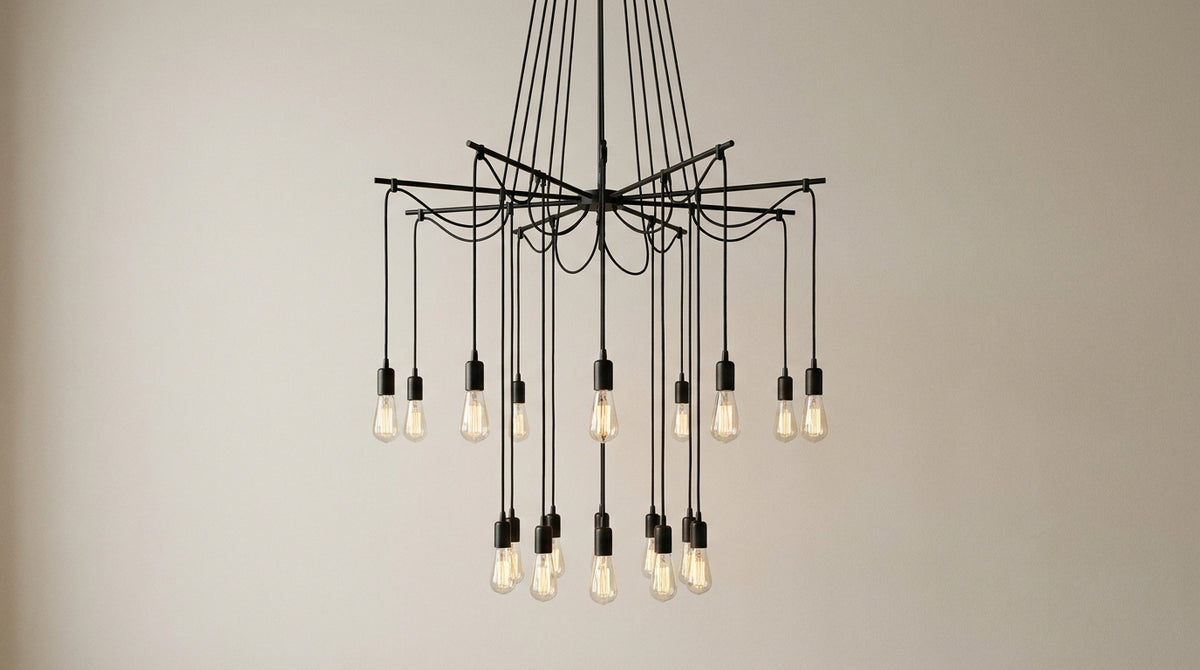
Measure the ceiling height, then the distance between the ceiling and the tabletop. A spider chandelier is chosen after that: a multi-drop structure, cables radiating from a central point, one bulb per drop. Allow one E27 socket per branch and a single ceiling fixing point.
What is a spider chandelier?
It is a pendant whose cables fall in free drops from a central point, each drop carrying a bulb. The structure stays visible, with no shade or closed body. This open silhouette gives it its name and plenty of presence in the volume.
In a living room being fully redone, this statement piece is planned together with the rest: a living room and family room lighting project is designed in one go, from the central point to the wall lights and table lamps. In a room that is already furnished, the spider chandelier stands on its own, provided you measure before choosing.
A multi-drop structure, without a shade
The drops spread out from the central cable through a cross piece or an openwork canopy. Each drop is a textile cord or a metal sleeve, ending in a bare socket. The material changes the mood a great deal.
- Cord: braided thread, immediate visual warmth, very right on a white wall or stone.
- Black metal or brass: clean lines, graphic reading, easy care.
- Glass: cabochon or diffuser, discreet sparkle and softer light.
- Rattan or bamboo: rounded volume, warm mood, rooms with light walls.
On a survey of 72 references from our Grand Lustre collection as of 5 October 2026, metal is declared on 61% of the survey and glass on 29%. Two families that cover most projects.
Chandelier or pendant light: the difference that matters
A pendant lights a zone, a chandelier lights a room. A pendant goes above a worktop or a table, a chandelier sits at the centre of the volume and takes on several bulbs. To see clearly, chandelier or pendant light is also distinguished by the number of light points: eight drops behave like a chandelier, three drops like a wide pendant.
Which spider chandelier for which room?
Living room and dining room come first. On 72 references surveyed in our Grand Lustre collection as of 5 October 2026, 90% of the survey mentions the living room, 88% the dining room, 67% the bedroom and 44% the kitchen. The same structure therefore changes role depending on the room and the installation height.
Three criteria are enough to decide before looking at the models.
- The tabletop decides the diameter: the structure stays narrower than the table.
- The ceiling height decides the available drop length.
- The use decides the number of bulbs: dinner, reading, evening ambience.
The choice then narrows very quickly. Above a table, you want a chandelier that lights the tabletop without dazzling the guests; in a bedroom, a more compact model with adjustable intensity.
Which spider for your ceiling?
In a bedroom, it is better to keep to a small diameter and a light you dim in the evening: a bedroom chandelier selection is read first by the width of the drops. In an open kitchen, floor clearance is what matters, before style.
At what height should you hang a spider chandelier?
Everything starts from floor clearance: aim for 2.10 m below the structure to move around without hitting it. Above a table, the measurement is taken from the tabletop, with 70 to 80 cm between the tabletop and the bottom of the bulbs. A high ceiling is not compensated for by lengthening the cables.
Above a table
The reference measurement is the gap between the tabletop and the bottom of the structure. Too high, the light scatters; too low, it dazzles the people seated.
| Location | Height to aim for | Starting point |
|---|---|---|
| Dining room | 70 to 80 cm above the tabletop | The tabletop |
| Living room, family room | 2.10 m floor clearance | The finished floor |
| Hallway, corridor | 2.10 m minimum | The finished floor |
Two other references matter: the structure stays narrower than the tabletop, with 20 to 30 cm of setback on each side, and the canopy goes at the centre of the table, not at the geometric centre of the room. To cross room size with fixture format, this guide on choosing a chandelier by its dimensions complements the tape-measure check.
A large living room is treated differently from a dining room: a dining room fixture is set to the tabletop, while a living volume accepts a wider and higher structure.
High ceiling: lower the structure, do not stretch it
Beyond 3 m of ceiling height, the structure is lowered with a rigid rod or a chain, rather than stretching flexible cables. The result is more stable, the light stays close to faces, and the silhouette keeps its proportions. Everything to do with high-ceiling chandeliers comes down to this drop, not to the size of the structure.
That is also where a large chandelier makes full sense: a more generous structure fills the void instead of suffering it.
How many bulbs, and which socket?
The number of drops follows the surface to be lit: four for a table of six, six to eight for a large living room. On the socket side, our survey puts E27 first, declared on 46% of the 72 references in the Grand Lustre collection surveyed on 5 October 2026.
Six-bulb spider chandelier: what it involves
Six drops means six bulbs to buy and six sockets on the same circuit. That changes three things.
- Cumulative power: six 6 W LEDs are more than enough in a living room, at 2700 K for warm light.
- The dimmer: beyond four bulbs, it becomes the real everyday comfort in the evening.
- Uniformity: buy the bulbs in a batch, same colour temperature, same shape.
- Spacing: the drops must cover the tabletop, not just the centre.
E27, integrated LED, GU10: what our survey says
The E27 socket is declared on 46% of the survey, the LED mention on 19%, GU10 on 8%. The IP20 rating is declared on 100% of the survey: these structures are designed for dry rooms, not for a damp bathroom. The details of bulb types help you decide between visible filament and diffuse light.
- E27: standard socket, you choose the bulb and can replace it.
- Integrated LED: even output, cannot be replaced, long life.
- GU10: more directed beam, useful to highlight a wall or a surface.
On that basis, a selection of E27 filament bulbs set to 2700 K gives warm light and a visible filament. On the same survey, the warranty is declared as 2 years on 63% of the survey and 5 years on 38%.
With or without a shade: what it changes
A spider chandelier is recognised by its exposed bulbs: without a shade, the bulb becomes a decorative element and is chosen in filament or slightly tinted. Adding shades to each drop softens the light but weighs down the silhouette, and loses the graphic effect. If you go for that option, better to choose understated models, like these cord shades, which extend the material of the cables.
Spider chandeliers: the multi-drop models


Once the room and height are settled, only the structure remains: browse the chandelier collection and compare the drops side by side.
Wiring a spider chandelier: 2 wires, 3 wires?
The connection does not depend on the number of drops. Two wires are enough for a simple supply, three when a protective conductor is added. All sockets are connected to the same circuit, whatever the number of bulbs.
3-wire spider pendant
Three conductors means a live, a neutral and an earth. The green and yellow wire connects to the corresponding terminal on the canopy and is kept: it protects a metal structure. On the survey of 72 references of 5 October 2026, suspended mounting is declared on 93% of the survey, which remains the most common case. For the step by step, this guide on wiring a 3-wire chandelier details the order of operations.
2-wire spider pendant
Two wires means a live and a neutral, with no protective conductor. This case is found on older installations, where the light point never had an earth. Before installing a metal structure in this configuration, technical advice avoids makeshift work: simply contact us with two photos, the ceiling and the existing connection. Three preparations cannot be skipped.
- Switch off the power at the breaker and check there is no voltage before touching the wires.
- Identify the conductors: blue for neutral, green and yellow for earth.
- Prepare the fixing: anchor suited to the support, the canopy takes the full weight.
If you prefer to entrust the installation, the team works from Vaulx-en-Velin and the Designix Google listing lets you check the company's reliability in one click, with no rating copied here.
In stock · shipping costs shown at checkout · up to 30% off in your cart


Ready to turn inspiration into reality?
Tell us about your room, your style and your budget, and we will show you the pieces that truly suit your project.
Get guidance in 30 seconds →